FKI Presents Four Global Economic Keywords for 2023: D.O.W.N.
[Asia Economy Reporter Han Yeju] Amid expectations of an economic recession due to global economic uncertainties this year, there are claims that attention should be paid to nationalist policies and discriminatory regulations.
The Federation of Korean Industries (hereinafter FKI) interpreted this year's global policy directions, including the above, into four keywords: 'D.O.W.N (D: Discriminatory Measures, O: Opportunity Capture, W: Prolonged War, N: Alliance Cohesion)' on the 16th.
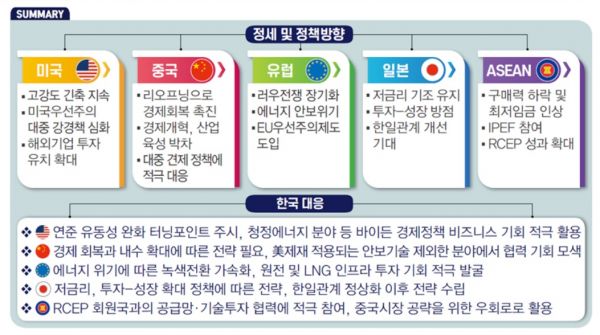
Although the world economy has emerged from the shock of the pandemic, the IMF forecasts the global economic growth rate at 2.9% this year, indicating that the global economy is entering a recession phase. The expected growth rates for the US, EU, and Japan are 1.4%, 0.7%, and 1.8%, respectively, making economic slowdown in major advanced countries inevitable. The ASEAN region is predicted to grow by 4.3%, and China is expected to be the only country growing over 5% due to reopening, but the prolonged Russia-Ukraine war, supply chain instability, and persistent inflation keep the global economy in uncertainty.
Meanwhile, the US and EU are expected to expand nationalist policies and discriminatory regulations. Although the US Congress achieved bipartisan balance in the November midterm elections last year, the America First policy remains bipartisan, and accordingly, a tougher stance toward China is expected to intensify. In the EU, following the pilot implementation of the Carbon Border Adjustment Mechanism (CBAM) in October this year, a series of nationalist policies such as the EU Critical Raw Materials Act (CRMA) and the EU Foreign Subsidies Regulation are anticipated to be introduced.
Accordingly, South Korea is expected to diversify cooperation areas with value-sharing countries such as Europe, Canada, Australia, and Japan, and prepare joint response strategies to new US-origin regulations. Vulnerable industries heavily affected by the carbon border adjustment system, such as steel and cement, need to proactively prepare countermeasures, and monitoring including impact analysis of newly introduced systems is essential.
Additionally, it is a timely moment for marketing the US Infrastructure Investment and Jobs Act, CHIPS Act, and Inflation Reduction Act (IRA), which came into effect last year. Various US government policies to attract foreign investment are expected. The FKI noted that although the IRA contains discriminatory provisions, it also offers benefits such as clean energy and advanced manufacturing tax credits, which South Korea's clean energy and battery industries should utilize.
China is expected to have higher growth potential than last year due to reopening, tax cuts, real estate stimulus, and increased liquidity support strengthening private sector support. It is advised to seek opportunities in the Chinese domestic market boosted by stimulus measures and especially to establish diversification strategies such as entering the service industry. Furthermore, in response to Western restrictions like the import ban on Chinese semiconductor equipment, the Chinese government is expected to counteract by expanding foreign investment attraction and opening government procurement markets. It was emphasized that while utilizing China's market opening opportunities such as government procurement, careful judgment is necessary to exclude sectors directly related to security when exploring possible cooperation areas.
Regarding the EU, security and energy concerns are expected to intensify due to the prolonged Russia-Ukraine war. Although the EU has reduced coal dependence and increased natural gas reliance, supply still falls short of demand, keeping natural gas prices and electricity rates on the rise. The FKI pointed out that Korean companies should expand cooperation in defense and energy industries in Eastern Europe and actively participate in Western European value-sharing alliance cooperation demands such as Ukraine reconstruction projects.
Especially, the ongoing energy and raw material crises due to the war have increased calls for accelerating the green transition. The EU plans to increase investment across the entire eco-friendly industry supply chain and expand eco-friendly industrial production facilities within the European Union. For South Korea, it is necessary to seek cooperation opportunities in nuclear power and LNG infrastructure investments in Europe and climate change response technology development.
Alongside this, the FKI also noted the trend of global economic restructuring of supply chains through friend-shoring and bloc formation. The Indo-Pacific Economic Framework (IPEF), centered on the US, is expected to gain momentum as seven ASEAN countries agreed to participate last year. These ASEAN countries are expected to use the IPEF as leverage for their national interests amid US-China conflicts rather than siding with one party. In this process, South Korea appears to have room for cooperation with these countries. The Regional Comprehensive Economic Partnership (RCEP), which marked its first anniversary, has expanded overall ASEAN trade volume and led to increased distribution of goods, capital, and services, and is expected to contribute to enhanced cooperation with China in the future. Japan is expected to announce its 'Free and Open Indo-Pacific Strategy,' emphasizing the importance of strengthening trilateral cooperation among South Korea, the US, and Japan. Moreover, given the Kishida administration's strong willingness to improve Korea-Japan relations, it is necessary to prepare strategies for reorganizing cooperative projects and expanding cooperation upon easing export regulations in anticipation of normalization of Korea-Japan relations.
Kim Bongman, head of the FKI International Headquarters, stated, "With continued trade deficits due to export declines, the prevalence of nationalist policies and expansion of various trade regulations make the global economic environment challenging." He added, "Nevertheless, it is necessary to quickly establish strategies according to market conditions by discovering opportunities even amid crises." He emphasized, "We hope the government supports companies to secure competitiveness on the global stage even during the recession phase."
© The Asia Business Daily(www.asiae.co.kr). All rights reserved.

















