KIST Research Team
Domestic researchers have developed a soft robot that can enter the human body, move freely like an octopus, and change colors like a butterfly. This is evaluated as a foundational technology for soft robots performing difficult tasks such as surgery.

The Korea Institute of Science and Technology (KIST) announced on the 15th that a research team led by Dr. Kim Daeyoon of the Functional Composite Materials Research Center succeeded in manufacturing a soft robot with a Janus structure and developing it into a smart sensor for methanol detection.
Today, robots are used in various fields beyond industrial sites, including disaster response, healthcare, security, and defense. Traditional metal-based robots exert strong force because they connect rigid bodies at joints to actuators such as motors, but they have difficulty performing flexible movements and can pose risks to humans in case of malfunction. Recently, ‘soft robots’ made of soft and flexible materials have emerged, but they face challenges in control complexity compared to metal-based robots.
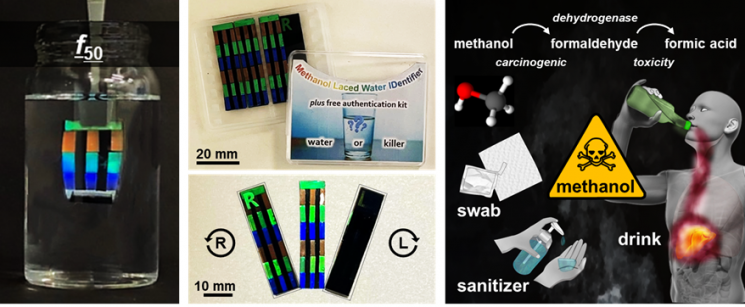 The KIST research team developed a kit that can detect methanol contamination in water using a Janus-type soft robot capable of freely changing various movements and altering light reflection according to motion. Image courtesy of KIST
Inspired by the free movement of soft-bodied animals like octopuses, the research team adopted a method that allows the soft robot to automatically respond to the surrounding environment rather than controlling its movements through precise computing. By patterning two types of polymer films with different flexibility and expansion capabilities, the soft robot naturally exhibits movements such as bending, folding, and twisting in desired directions according to the environment. Additionally, by introducing spiral nanostructures found in insects like butterflies, the soft robot exhibits photonic crystal properties that selectively reflect various colors of light. This enables users to easily recognize changes in the soft robot’s movement through color changes as the surrounding environment varies.
In particular, the research team applied the soft photonic crystal robot to develop a sensor that can quickly and easily detect whether water is contaminated with methanol. Methanol can cause fatal effects such as headaches, vomiting, dizziness, and vision impairment when ingested excessively, but it is more than 70% cheaper than ethanol, leading to increased misuse cases after COVID-19. The methanol detection sensor using the soft photonic crystal robot is economical as it can be reused dozens of times. It requires no energy such as electricity, allowing easy detection of methanol-contaminated water anytime and anywhere. Moreover, the circular polarization characteristics from the spiral nanostructure of the soft robot make counterfeiting difficult, effectively ensuring product reliability.
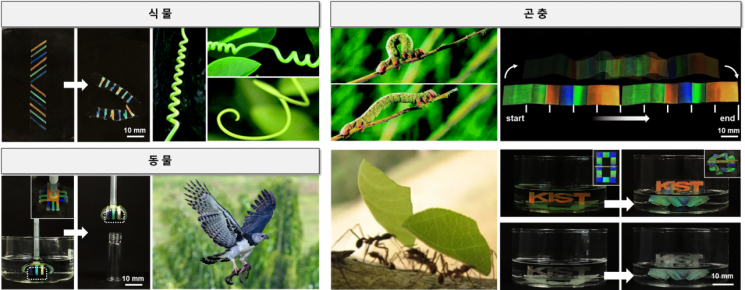 The soft robot developed by the KIST research team demonstrated various movements exhibited by water, insects, and animals. Image courtesy of KIST
Furthermore, the soft robot developed by the research team successfully demonstrated various movements such as an eagle snatching prey, a caterpillar crawling, a plant climbing a support, and an ant lifting and carrying objects. When comprehensively applied, this means that flexible and smart next-generation surgical robot materials can be developed that enter the human body without damaging soft organs and can treat wounds.
Dr. Kim Daeyoon said, “This research is significant in implementing soft robots, which are technically at an early stage, to be helpful in daily life,” and added, “If multi-stimuli responsive materials that can simultaneously and instantly respond to various external stimuli are developed in the future, soft robots could be widely commercialized.”
This research result was published in ‘Advanced Functional Materials’ (IF: 19.924, JCR 4.658%) and was selected as a Hot Topic in the field of robotics while also featuring as a cover paper.
© The Asia Business Daily(www.asiae.co.kr). All rights reserved.



















