KIST Research Team
Domestic researchers have developed a technology that can instantly detect the presence of microplastics in water using light. The time, which previously took a day, has been shortened to a few seconds, drawing attention to the potential impact on related technologies and industry activation.
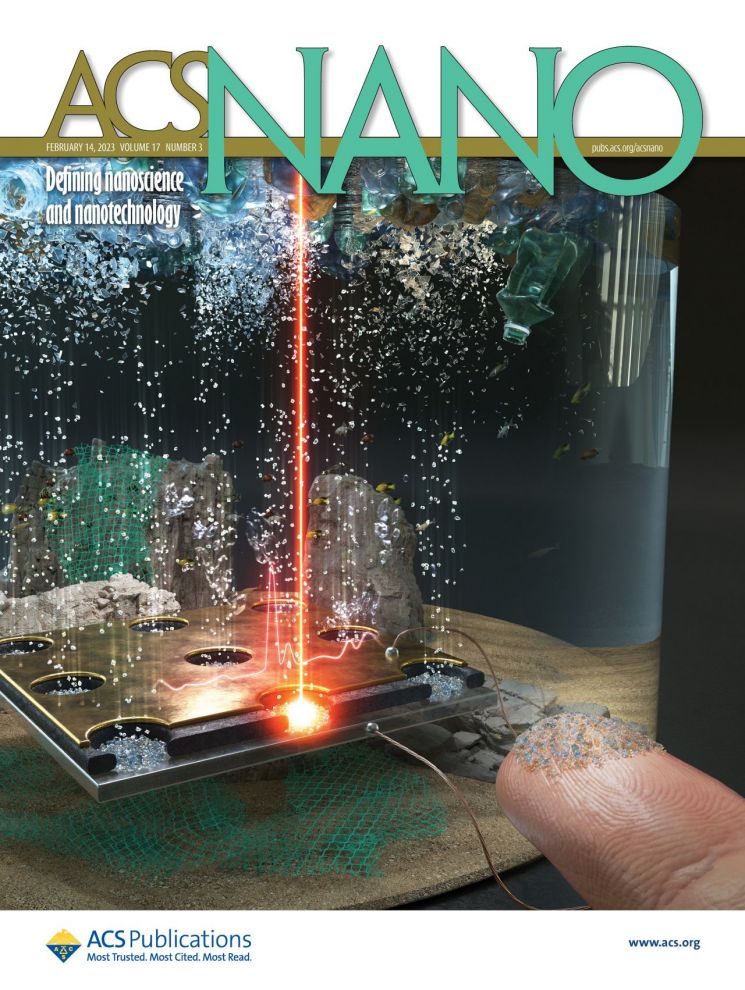 Cover of the latest issue of the international academic journal 'ACS Nano (IF: 18.027)'. Photo by KIST
The Korea Institute of Science and Technology (KIST) announced on the 16th that Dr. Yuyong Sang’s research team at the Brain Convergence Technology Research Division developed a system that can concentrate samples in a short time using an electro-optical trap with nanosized gold and silver particles along with ultrafine nanoplastics, and detect them in real time using light.
The research team supplied electricity to a large-area three-layer vertical electrode with metal on both sides separated by an insulating film, and simultaneously adopted a Raman optical detection method that analyzes the energy difference between incident light and scattered light according to the vibration frequency of molecules. In this process, plasmonic nanoparticles of nanosized gold and silver particles were used to concentrate the samples. As a result, the concentration and detection time required for microplastic detection was reduced to a few seconds. In actual experiments, they succeeded in detecting 30-nanometer (nm) polystyrene particles at a concentration of 10 micrograms (μg)/ℓ, confirming the optical detection performance of ultra-low concentration real-time nanoplastics.
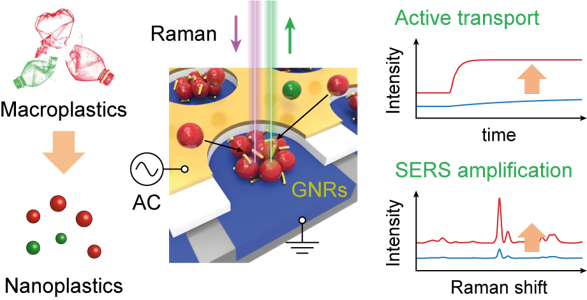 Schematic diagram of a system that detects microplastics in real time using light. Image courtesy of KIST
The research also utilized the dielectrophoresis phenomenon to easily separate particles from the sample. Through this, they secured a core technology that enables real-time separation and detection in one platform at one-second intervals for the entire process of collection, separation, and analysis, which previously took more than a day for nanoplastic analysis.
The research team said, “The significance of this research achievement lies in enabling ultra-high sensitivity real-time detection of microplastics,” adding, “We expect to expand the research results to measure microplastic concentrations in various water resources and utilize it as a technology to secure safe water resources.”
The research results were published as a cover paper in the latest issue of the international journal 'ACS Nano (IF: 18.027)'.
© The Asia Business Daily(www.asiae.co.kr). All rights reserved.


















