KCCI Survey of 202 Domestic Manufacturers
[Asia Economy Reporter Choi Seoyun] As the opposition party has announced plans to forcibly pass the so-called Yellow Envelope Act, officially the 'Amendment to Articles 2 and 3 of the Labor Union Act,' during this month's extraordinary session of the National Assembly, the Korea Chamber of Commerce and Industry (KCCI) has conducted a survey on awareness of the Yellow Envelope Act among domestic manufacturers. The survey results showed that 9 out of 10 manufacturers responded negatively.
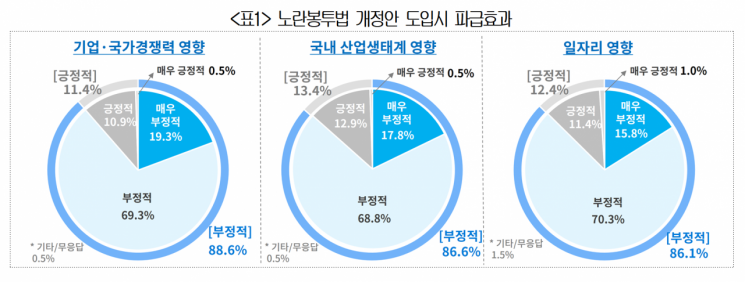
According to the KCCI's survey conducted over two days starting from the 9th, targeting 202 manufacturing companies, 88.6% of the companies answered that the Yellow Envelope Act would have a negative impact on corporate and national competitiveness.
The Yellow Envelope Act limits companies' claims for damages against illegal strikes by labor unions and guarantees that subcontractor unions can negotiate and engage in industrial actions against the primary contractors. It defines the primary contractor as the employer of the subcontractor union.
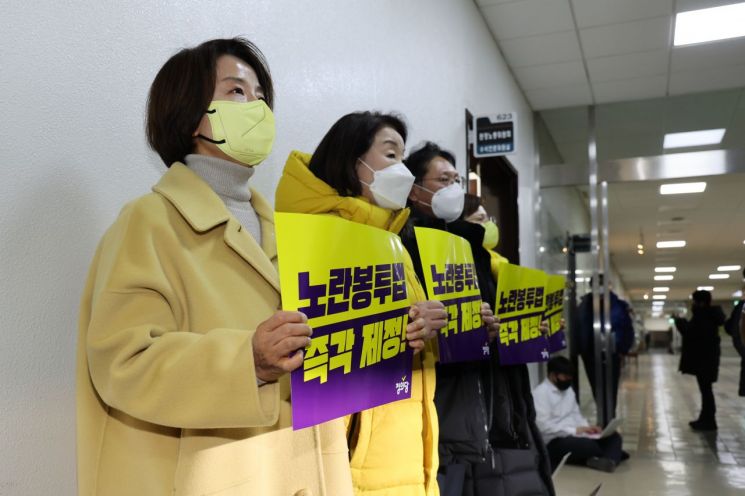 Jeongui Party Floor Leader Lee Eun-ju (from left), Assemblywoman Shim Sang-jung, and other members are picketing to urge the enactment of the Yellow Envelope Act in front of the Employment and Labor Law Review Subcommittee meeting room of the Environment and Labor Committee held at the National Assembly on the afternoon of December 26 last year.
 [Image source=Yonhap News]
86.6% of companies believed that the Act would also negatively affect the domestic industrial ecosystem, which is composed of close cooperative relationships among large, medium, and small enterprises. Regarding the impact on jobs, 86.1% of companies viewed it negatively.
Recently, the opposition party reignited the issue by stating their intention to pass the Yellow Envelope Act during the February extraordinary session of the National Assembly, following controversies at the end of last year. Accordingly, the National Assembly's Environment and Labor Committee plans to hold the Employment and Labor Bill Review Subcommittee on the 15th and a plenary session on the 21st to attempt to pass the amendment.
A KCCI official stated, "The Yellow Envelope Act conflicts with the current labor-management legal system and practices, which are based on direct employment relationships," adding, "It is legislation that turns illegal acts into legal acts."
He continued, "If the legislation is passed, the industrial field will be embroiled in legal disputes over who to negotiate with, what to negotiate about, and how, leading to a significant increase in illegal strikes, unforeseen side effects, and social confusion."
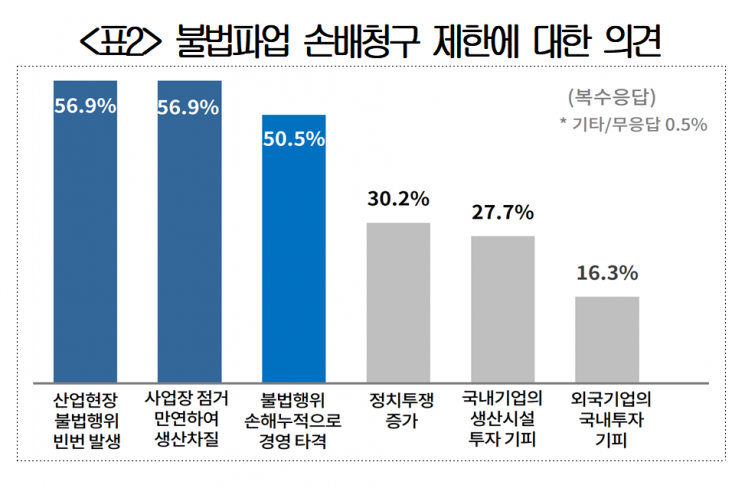
Regarding the expected impacts of limiting companies' claims for damages, companies were most concerned about 'frequent illegal acts at industrial sites' (56.9%, multiple responses allowed) and 'production disruptions due to widespread workplace occupations' (56.9%). This was followed by 'management damage due to accumulated losses' (50.5%), 'increase in political struggles' (30.2%), 'domestic companies avoiding production investment' (27.7%), and 'foreign companies avoiding domestic investment' (16.3%).
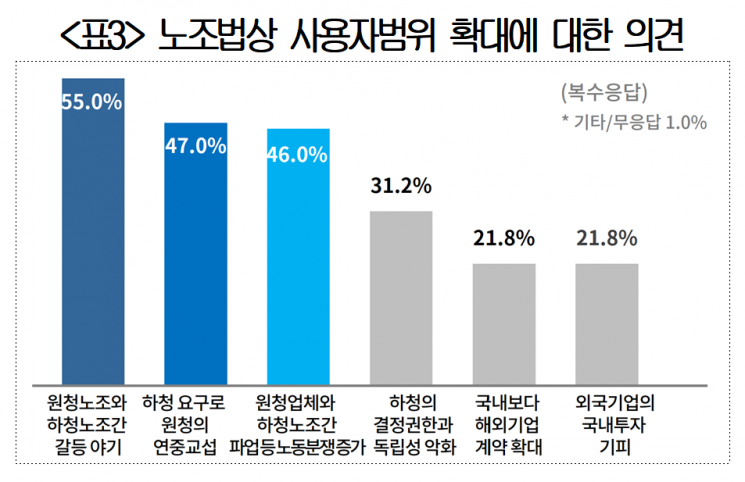
Regarding the recognition of primary contractor employer status, which allows subcontractor unions to request negotiations and strike against primary contractors, companies were most concerned about 'conflicts between primary contractor unions and subcontractor unions' (55.0%). This was followed by 'year-round negotiations by primary contractors' (47.0%) and 'increase in labor disputes such as strikes between primary contractors and subcontractor unions at industrial sites' (46.0%).
Kang Seok-gu, Head of the KCCI Research Division, said, "In the current situation where the manufacturing sector, which drives our economic growth, is facing increasing difficulties due to the recent global economic downturn and supply chain restructuring, if the Yellow Envelope Act allows partner companies and subcontractor unions to negotiate directly with large corporations, the independence and competitiveness of numerous small and medium-sized enterprises could be significantly diminished."
© The Asia Business Daily(www.asiae.co.kr). All rights reserved.
![Clutching a Stolen Dior Bag, Saying "I Hate Being Poor but Real"... The Grotesque Con of a "Human Knockoff" [Slate]](https://cwcontent.asiae.co.kr/asiaresize/183/2026021902243444107_1771435474.jpg)


















