Stone Pagoda from the Unified Silla Period, Confirmed Construction Date
[Asia Economy Yeongnam Reporting Headquarters Reporter Dongguk Lee] Pohang City announced on the 13th that the ‘Pohang Beopgwangsa Site Three-story Stone Pagoda’ has been designated and officially announced as a Gyeongsangbuk-do Designated Cultural Property.
The ‘Pohang Beopgwangsa Site Three-story Stone Pagoda’ is located in Sang-eup-ri, Singwang-myeon, Buk-gu, and is a typical late Unified Silla stone pagoda consisting of a pedestal, body, and upper finial.
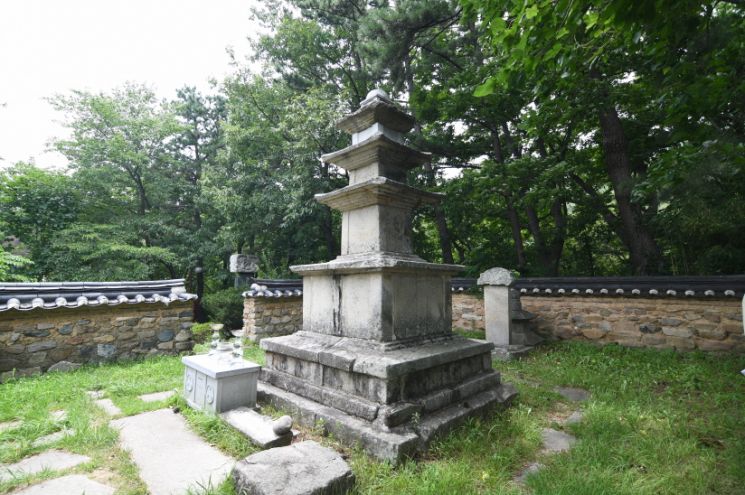 The 'Pohang Beopgwangsa Temple Three-Story Stone Pagoda,' recognized for its value as a cultural asset designated by Gyeongbuk Province.
It is built in a style with a three-story body on a double pedestal, and the base of the lowest story of the body has changed to a bent bracket form, showing the developmental trend of Unified Silla stone pagoda styles.
Additionally, it is the only stone pagoda confirmed to have a pagoda inscription that uses the Buljeong Jonsung Dharani Sutra (佛頂尊勝陀羅尼經) as the inscription text. The clearly recorded construction year (828, 3rd year of King Heungdeok) and renovation year (846, 8th year of King Munseong) on the pagoda inscription serve as a chronological standard for 9th-century stone pagodas. Due to these cultural values, it was designated as a provincial cultural property (tangible cultural property) after review by the Gyeongsangbuk-do Cultural Heritage Committee.
The ‘Beopgwangsa Site,’ where the newly designated cultural property is located, is known as a royal temple established during the Unified Silla period, and excavation surveys have been conducted since 2010 to confirm the scale and architectural style of the temple site.
So far, the excavation results have attracted attention by confirming a large stone Buddha statue about 4 meters in size, the floor of the main hall site paved with green-glazed tiles, and the corridor area surrounding the main hall site.
Mayor Kangdeok Lee stated, “We plan to hold a comprehensive academic conference in the second half of this year to summarize the investigation results of Beopgwangsa Site and gather opinions from renowned domestic and international cultural heritage experts to explore directions necessary for future cultural heritage maintenance.”
He added, “Considering the pagoda inscription that clearly confirms the construction and renovation years of the Beopgwangsa Site Three-story Stone Pagoda and the well-preserved relics excavated inside, such as the sarira reliquary, it has sufficient value as a national designated cultural property (treasure). Therefore, we plan to promote its elevation to a national designated cultural property (treasure) through collecting diverse expert opinions and conducting additional investigations.”
© The Asia Business Daily(www.asiae.co.kr). All rights reserved.

















