Unlike Dogfighting and Cockfighting, Bullfighting Is Exempt from Punishment
Debates on 'Bullfighting Animal Abuse' Also Arise Overseas
[Asia Economy Reporter Hyunju Park] Is bullfighting a traditional culture that should be preserved, or is it abuse that harms innocent animals?
Recently, controversy over animal abuse has arisen surrounding bullfighting festivals. This is as regions such as Cheongdo-gun in Gyeongbuk and Uiryeong-gun in Gyeongnam have resumed bullfighting festivals that were suspended for a while due to COVID-19.
The exact origin of bullfighting, a part of our folk culture, is not preserved. However, it is known to have started as a game enjoyed by herdsmen after the establishment of agrarian culture, gradually expanding in scale to village or clan units, eventually taking the form of the game as it is today. Since 1971, it has developed into a nationwide competition.
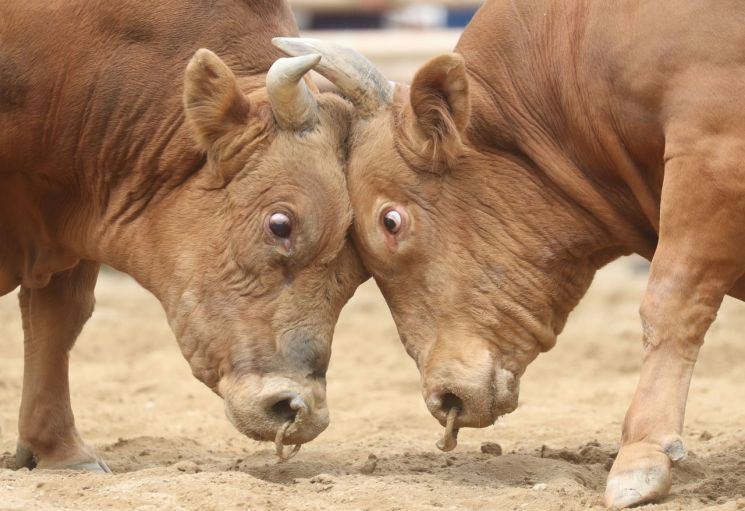 On the afternoon of June 10 last year, two bulls participated in a strength contest at the '33rd Uiryeong National Traditional Bull Fighting Competition' held at the Uiryeong Folk Bull Fighting Stadium in Uiryeong-eup, Uiryeong-gun, Gyeongnam. [Image source=Yonhap News]
Regions famous for bullfighting festivals argue that they should enact 'Bullfighting Support Ordinances' to preserve traditional culture. In fact, Cheongdo-gun, famous for bullfighting, passed the Bullfighting Promotion and Support Ordinance in the provincial council in 2016, providing various support for breeding fighting bulls and bullfighting events. These regions expect bullfighting matches to attract tourists and help revitalize the local economy.
However, animal protection organizations claim that bullfighting is nothing more than animal abuse disguised as traditional culture. They view forcing gentle cattle, which do not fight other individuals in nature, to fight for human amusement as abuse itself. Feeding animal-based tonic foods or training bulls to raise them as fighting bulls for competitions is also considered abuse.
On the 13th, Animal Freedom Coalition and the Green Party held a press conference stating, "Folk bullfighting was a village festival when cattle plowed rice paddies and fields, where strong bulls from each village competed in strength to foster harmony after the farming season," and criticized, "Raising fighting bulls through abusive training or feeding them animal-based tonic foods to win prize money in bullfighting is not preserving traditional culture."
In particular, these organizations argue that the exemption clause in the Animal Protection Act, which does not consider bullfighting as animal abuse, should be deleted. According to Article 8 of the Animal Protection Act, acts that cause injury to animals for gambling, entertainment, or amusement purposes are considered animal abuse. However, cases such as folk games prescribed by the Ministry of Agriculture, Food and Rural Affairs ordinances are excluded from punishment. Unlike dogfighting or cockfighting, bullfighting is classified as a folk game and is not subject to punishment.
This debate is not limited to Korea. In bullfighting's country of origin, Spain, and other Latin American regions, arguments over whether 'bullfighting' is animal abuse or a cultural heritage and tourist attraction are sharply divided.
As awareness of animal rights spreads and criticism arises that bullfighting is a cruel blood sport, some countries such as Chile and Argentina have banned bullfighting. However, in countries including Spain, the country of origin, as well as France and Colombia, bullfighting events continue to be held except in some regions.
© The Asia Business Daily(www.asiae.co.kr). All rights reserved.

















