[Asia Economy Sejong=Reporter Dongwoo Lee] The trade deficit has approached $5 billion from the beginning of this month to the 10th, increasing the likelihood of a deficit for 12 consecutive months. Although total export value increased, the main item, semiconductors, decreased by more than 40% compared to the same period last year. The increase in imports of the three major energy sources?crude oil, gas, and coal?also negatively impacted the trade balance deficit.
According to the Korea Customs Service on the 13th, the export value from February 1 to 10 (provisional customs clearance basis) was $17.617 billion, up 11.9% from the same period last year, and imports were $22.588 billion, up 16.9%. Both exports and imports increased, but the increase in imports was larger than that of exports, resulting in a trade deficit of $4.97 billion. The trade deficit size until the 10th of this month was larger than the same period last year (-$3.563 billion).
The number of working days during this period was 8.5 days, two days more than the same period last year (6.5 days). Considering the number of working days, the average daily export value decreased by 14.5%.
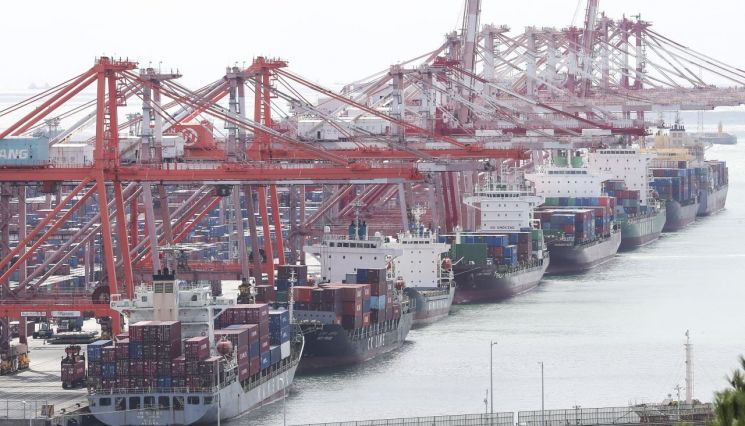
Trade Deficit Swamp for 12 Consecutive Months
Thus, the possibility of a trade deficit continuing for 12 consecutive months from March last year to the 10th of this month has increased. Maintaining a trade deficit for a full year is the first time in 25 years since January 1995 to May 1997. From the beginning of this month to the 10th, energy imports of crude oil, gas, and coal amounted to $6.636 billion, accounting for 29.3% of total imports ($22.588 billion). During this period, gas imports ($2.313 billion) increased by 86.6%, crude oil ($3.451 billion) by 44.9%, and coal ($872 million) by 60.3% compared to the same period last year. Energy import values have recently exceeded $15 billion monthly due to supply chain instability caused by the Russia-Ukraine war.
To make matters worse, the decline in trade volume due to the global economic recession has also increased the decrease in exports of key items. During this period, semiconductor exports amounted to $1.958 billion, down 40.7% compared to the same period last year. Semiconductor exports have shrunk for seven consecutive months from August last year (-7.8%) to the 10th of this month. In particular, semiconductor exports last month fell by a staggering 44.5%, marking the largest decline in the past year.
In fact, the decline in semiconductor prices has translated into business performance for the domestic semiconductor industry. In the fourth quarter of last year, Samsung Electronics’ semiconductor division recorded sales of 20.07 trillion won and operating profit of 270 billion won due to a sharp drop in global market demand. This represents a 22.83% decrease in sales and a 96.95% decrease in operating profit compared to the same period last year. SK Hynix also recorded sales of 7.6986 trillion won and an operating loss of 1.7012 trillion won during the same period, marking its first quarterly loss in 10 years since the third quarter of 2012.
Trade with China Declines for 9 Consecutive Months... Reopening as a Variable
Exports to China, the largest trading partner, have also declined for nine consecutive months since June last year. This is due to economic activity contraction caused by a surge in COVID-19 infections in China during the first quarter of this year. Exports to China until the 10th of this month were $3.525 billion, down 13.4% compared to the same period last year. Exports of major items with high export shares to China, such as semiconductors (-40.7%), home appliances (-32.9%), and computer peripherals (-45.6%), decreased.
However, the speed of China’s reopening (resumption of economic activities) is a key variable. If China’s economic reopening accelerates, it is expected to provide relief for Korean exports. The Korea International Trade Association forecasted that China’s reopening would increase Korea’s real gross domestic product (GDP) by 0.16 percentage points and exports by 0.55 percentage points.
Meanwhile, until the 10th of this month, export items such as petroleum products (28.8%), passenger cars (166.8%), ships (3.9%), and automobile parts (41.7%) increased, although semiconductors decreased. By region, exports increased to the United States (48.0%), the European Union (53.3%), and Vietnam (2.3%), while exports to China (-13.4%) and Taiwan (-22.8%) decreased. Imports increased compared to the same period last year for crude oil (44.9%), gas (86.6%), and semiconductors (3.4%), but decreased for semiconductor manufacturing equipment (-19.1%) and precision instruments (-8.7%). Imports from the United States (31.9%), the European Union (14.1%), and Saudi Arabia (30.3%) increased, while imports from China (-10.3%) and Japan (-3.9%) decreased.
© The Asia Business Daily(www.asiae.co.kr). All rights reserved.
![User Who Sold Erroneously Deposited Bitcoins to Repay Debt and Fund Entertainment... What Did the Supreme Court Decide in 2021? [Legal Issue Check]](https://cwcontent.asiae.co.kr/asiaresize/183/2026020910431234020_1770601391.png)
















