Trade Deficit and Consumption Slowdown
Growth Rate Downgrade Expected
"Additional Rate Hikes Unlikely"
Concerns Over Gap with Market Interest Rates
[Asia Economy Reporter Seo So-jeong] Recently, as the government has shown a perspective that emphasizes the economy over inflation, attention is focused on whether the Bank of Korea (BOK) will respond with a 'hold' on the base interest rate decision scheduled for the 23rd. On that day, the BOK is likely to revise downward this year's growth forecast from the 1.7% projected in November, and with growing concerns about the economy, there is a growing expectation that the rate will be held steady. However, due to the impact of public utility fee hikes, consumer price inflation remains high at over 5% this month, and with the interest rate gap between Korea and the U.S. widening to 1.25 percentage points, concerns about capital outflow are increasing, deepening the BOK's dilemma over the base rate decision.
According to the BOK on the 13th, recent government remarks emphasizing the economy have become a major factor in monetary policy. Deputy Prime Minister and Minister of Economy and Finance Choo Kyung-ho said at the monthly forum of the Editors' Association on the 10th, "While firmly maintaining the stance of price stability, we are gradually moving toward a situation where we need to pay attention to the economy as well," adding, "If the price stability stance is firmly established, all policy stances should turn toward the economy."
Although Deputy Prime Minister Choo's remarks include the caveat "if the price stability stance is firmly established," making them somewhat theoretical, they are interpreted as reflecting the intention to shift the focus from inflation to the economy. Until the end of last year, Choo emphasized price stability, saying, "For the time being, we will focus on price stability while comprehensively considering macroeconomic conditions such as financial, corporate, real estate risks, and the economy."
However, with the new year, concerns about an economic recession have emerged, and growth forecasts are expected to be revised downward, signaling a change in atmosphere that the time to prioritize the economy is approaching. The Korea Development Institute (KDI) recently lowered its economic growth forecast for the first half of this year from 1.4% to 1.1%, a 0.3 percentage point drop. Following a record trade deficit of about $12.7 billion in January and a nearly $5 billion trade deficit from February 1 to 10, export alarms are ringing. Combined with high inflation and high interest rates causing a slowdown in consumption, a downward revision is inevitable. Additionally, with a clear decline in real estate prices and increasing interest burdens on 'Yeongkkeuljok' (those who borrow to the maximum), the possibility of real economic instability spilling over into financial markets cannot be ruled out.
A changed atmosphere is also sensed among many Monetary Policy Board members. On the 7th, BOK Monetary Policy Board member Seo Young-kyung said at a special meeting hosted by the American Chamber of Commerce in Korea, "Korea's monetary policy is already tight, and this situation will continue for a considerable period," effectively supporting a hold. While maintaining the current stance for the time being, she implied concerns that additional rate hikes would be difficult as the current rate of 3.5% exceeds the neutral rate range, and Korea's economy this year is expected to see a sharp decline in exports and a weakening consumption recovery trend.
According to the minutes of the 1st Monetary Policy Committee meeting of 2023 (held on January 13), released by the BOK on the 31st of last month, many board members expressed caution about further rate hikes. One member stated, "The effects of the tight monetary policy over the past year and a half are becoming evident, and asset markets, led by the housing market, continue to show sluggish trends with transactions sharply contracting," adding, "Recently, the growth rate of the total money supply (M2) has sharply slowed, and if this trend continues, a decrease in real money supply adjusted for inflation cannot be ruled out, which means the stage to worry about demand-side inflationary pressures has already passed."
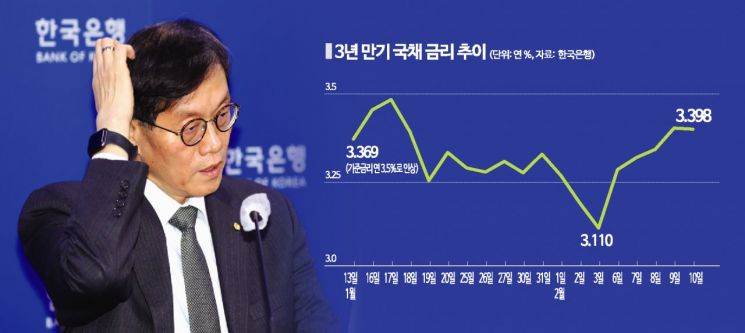
However, the ongoing inversion of interest rates, where major market rates fall below the base rate this year, is reducing the effectiveness of monetary policy and adding to the burden of policy decisions. According to the Korea Financial Investment Association, the benchmark 3-year government bond yield closed at 3.398% on the 10th. Since the BOK raised the base rate to 3.5% on January 13, the 3-year government bond yield has remained below the base rate for a month. Some speculate that if the gap between the base rate and market rates becomes excessively large, further tightening cannot be ruled out, deepening the BOK's dilemma over monetary policy.
Oh Chang-seop, a researcher at Hyundai Motor Securities, said, "With the inversion of long- and short-term interest rates in major countries like the U.S., and the perception that domestic rates have already peaked, the inversion between the base rate and market rates continues," adding, "The market is rather pressuring the BOK to cut rates." If the inversion where market rates fall below the base rate persists for a long time, there is a view that the BOK might follow market sentiment and lower the base rate.
© The Asia Business Daily(www.asiae.co.kr). All rights reserved.


















