Significant Decentralization of Central Government Authority to Local Governments
Bottom-Up Approach to Local Extinction Measures
Local Governments Lead, Central Government Provides Support
[Asia Economy Reporter Koo Chae-eun] The “Plan for Decentralization of Central Authority” announced by the Office for Government Policy Coordination on the 10th centers on shifting the local extinction countermeasures from a ‘top-down’ approach to a ‘bottom-up’ approach. This is based on the judgment that viewing local governments as passive executors of policies handed down by the central government cannot produce effective measures against local extinction. This perspective is rooted in the view that during the Moon Jae-in administration, the selection of innovation cities and the relocation of public institutions were top-down processes, which failed to generate synergy with local areas and thus ended in failure.
The Office for Government Policy Coordination organized 57 items of authority transfer across six sectors through more than 30 rounds of coordination and consultation with central ministries. These are key tasks proposed by local governments themselves, suggesting that “if authority is transferred first, they can perform well.”
A senior official from the Office for Government Policy Coordination said, “Central ministry-led regional development plans were uniform and did not reflect the uniqueness of regions or the demands on the ground. By giving opportunities to local governments through this plan, creative and autonomous ‘local decentralization’ will be realized, which will also help revitalize local economies.”
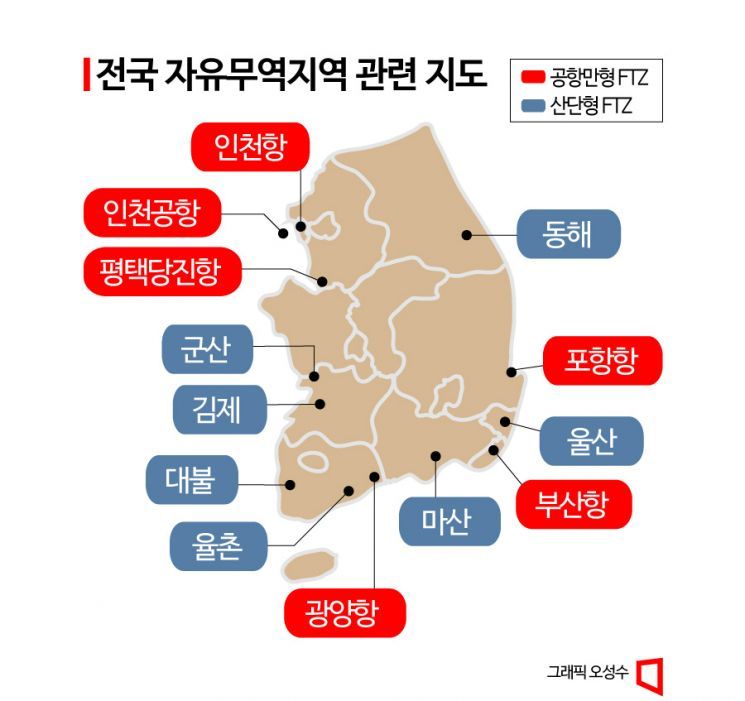 The government has decided to transfer the authority for planning and operating projects in 13 nationwide Free Trade Zones (FTZs) to the governors of cities and provinces. When local governments establish business plans to enhance the competitiveness of small and medium-sized enterprises, the Ministry of Industry, a central government agency, will coordinate policies through an "Operation Council" in which it participates. This changes the system so that policies are proactively formulated at the local level, while the central government provides support from the background.
Among the materials of the “Plan for Decentralization of Central Authority” released by the Office for Government Policy Coordination on this day, excluding those already announced through the New Year’s work report (such as the expanded authority to lift Greenbelt restrictions
The government decided to transfer the authority for planning and operating Free Trade Zone (FTZ) projects to the mayors and governors of cities and provinces. Previously, the Ministry of Trade, Industry and Energy, a central ministry, could design ‘competitiveness enhancement projects’ in 13 Free Trade Zones such as Masan and Gunsan. However, there were criticisms that the central government did not fully understand local conditions and circumstances, resulting in ineffective implementation. Going forward, if local governments establish plans to strengthen the competitiveness of small and medium-sized enterprises, the Ministry of Trade, Industry and Energy, as a central ministry, will coordinate policies through an ‘operation council’ in which it participates. When local governments take the lead in policy formulation, the central government will support from the rear.
The authority for unmanned island development project planning, previously held by the Ministry of Oceans and Fisheries, was also transferred to the mayors and governors of cities and provinces. Unmanned islands are naturally formed lands surrounded by the sea and exposed above sea level at high tide. In South Korea, unmanned islands account for 86.3% of all islands, totaling 2,918. Until now, even to build an observatory on an unmanned island, approval from the Minister of Oceans and Fisheries was required. The government has transferred this authority to the mayors and governors.
Additionally, the government decided to transfer the authority for developing hinterland complexes of local-managed ports and designating management agencies from the Ministry of Oceans and Fisheries to the mayors and governors. Since port hinterland complexes are directly related to the local economy and residents’ lives, it was judged more efficient for local governments, which are closely connected to the area, to take the lead in development and management.
Furthermore, the government plans to expand and strengthen local government participation in determining and allocating the scale of foreign workforce introduction. Environmental impact assessments based on local government ordinances will also be given priority over central government ordinances. Along with this, the areas and districts where local government heads are delegated the authority to approve farmland conversion will be expanded.
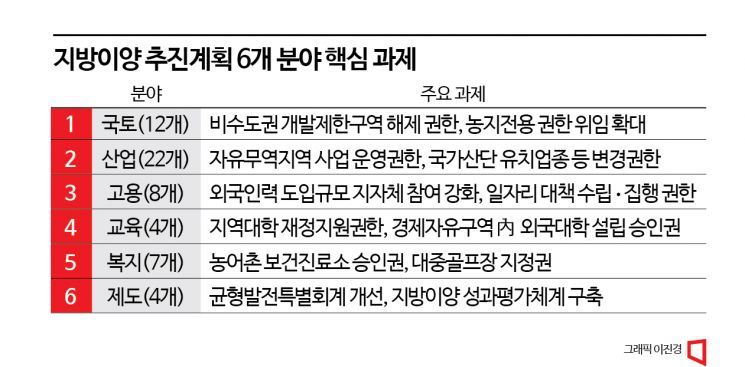
In addition, the government selected a total of 57 tasks across six sectors including land, industry, employment, education, welfare, and systems.
The most notable among those announced in the New Year’s work report is the expansion of local government authority over the development restriction zones (Greenbelt) in the metropolitan area (and other regions). The Yoon Seok-yeol administration has significantly expanded the area within which mayors and governors have authority to lift Greenbelt restrictions by more than three times. Previously, the authority to lift Greenbelt restrictions was delegated to mayors and governors for areas under 300,000 square meters, but going forward, the delegation range will increase to ‘within 1 million square meters.’ This expands the area from the size of the National Assembly building to one-third the size of Yeouido. This measure allows mayors and governors to take direct initiative and respond flexibly to local development demands. It is interpreted as correcting the central government’s excessive regulation of Greenbelt lifting in non-metropolitan areas on grounds of fairness and environmental conservation.
Financial support authority for local universities, which have been embroiled in debates over their survival, will also be delegated to local governments. This empowers local governments to take the lead in nurturing local talent and building a development ecosystem, moving away from the previous method where the Ministry of Education, a central ministry, directly selected and supported local universities.
Prime Minister Han Duck-soo said, “We will trust the potential of local areas and boldly promote authority transfer,” adding, “We are accustomed to a centralized administrative culture that views local governments as executing agencies and objects of supervision, but maintaining the status quo is not the way to overcome the crisis.”
© The Asia Business Daily(www.asiae.co.kr). All rights reserved.
!["The Woman Who Threw Herself into the Water Clutching a Stolen Dior Bag"...A Grotesque Success Story That Shakes the Korean Psyche [Slate]](https://cwcontent.asiae.co.kr/asiaresize/183/2026021902243444107_1771435474.jpg)

















