Korea Consumer Agency Survey Results
No Price Changes Despite Inflation
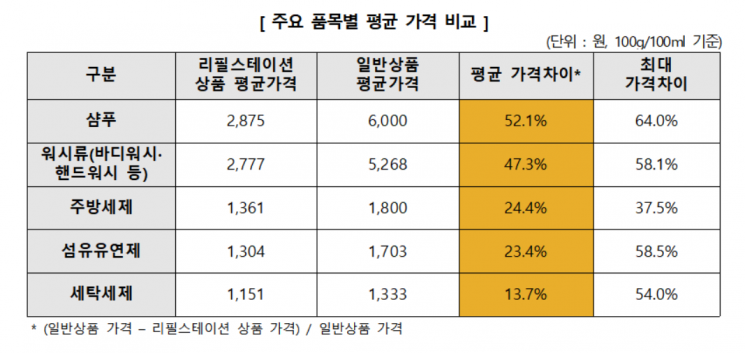
As consumer interest in eco-friendliness has been increasing recently, it was found that refill station products, which sell only the contents without packaging containers, are up to 64% cheaper than regular products of the same type.
On the 10th, the Korea Consumer Agency surveyed the prices of 62 refill products sold by five companies participating in the Carbon Neutral Practice Point System (Sugarbubble, Aromatica, Amorepacific, Almang Store, Waffle Soft) and found that they were on average 41.8% cheaper than the regular products' list prices. In particular, while the prices of regular products rose by an average of 16.1% from 2021 to 2022, the prices of refill station products showed little change.
The product category with the largest price difference was shampoo. The average price of shampoo at refill stations was 2,875 KRW per 100g, which was on average 52.1% cheaper than the list price of the same regular products, with some prices up to 64% lower. On average, body wash and hand wash were 47.3% cheaper, dish detergent 24.4%, fabric softener 23.4%, and laundry detergent 13.7% cheaper at refill stations.
Refill station products showed almost no price fluctuation despite the inflation situation. The average price of refill station products was 3,123 KRW per 100g in 2021 and 3,128 KRW last year. In contrast, the average price of regular products rose by 16.1%. For example, Aromatica Rosemary Scalp Scaling Shampoo’s regular product price jumped 66.7% from 2021 to 2022, but its refill station price remained unchanged.
In an online survey of 600 consumers who knew about or had used refill stations, 74% responded that standard containers were necessary. Among the five companies, two required the exclusive use of their own containers, which were priced between 500 and 1,000 KRW.
Among 152 consumers who experienced dissatisfaction, the most common complaint (24.3%) was the inability to check product information such as expiration dates. This was followed by complaints about the mandatory purchase of exclusive containers (21.1%) and the inability to purchase due to out-of-stock or unavailable products (16.4%).
81.3% said they intend to continue using refill stations in the future, citing reasons such as reducing waste like plastic (57%), lower prices (17.8%), and the ability to purchase only the desired quantity (17.2%).
Regarding user satisfaction, there were criticisms about the lack of product variety and poor store accessibility. Since November last year, the Korea Consumer Agency has been providing refill station location information on navigation apps in collaboration with T Map to enhance consumer convenience.
The Korea Consumer Agency stated, “We will recommend businesses improve the provision of information such as expiration dates for refill products and strengthen accessibility to refill stores, and propose to related organizations to expand participation of refill station companies to activate the Carbon Neutral Practice Point System.”
© The Asia Business Daily(www.asiae.co.kr). All rights reserved.
!["The Woman Who Threw Herself into the Water Clutching a Stolen Dior Bag"...A Grotesque Success Story That Shakes the Korean Psyche [Slate]](https://cwcontent.asiae.co.kr/asiaresize/183/2026021902243444107_1771435474.jpg)
















