Capital Region 37% vs Yeongnam Region 39.97
Age 20-40 32% vs Age 60+ 42%
"Will Only Know on the Day of the Party Congress"
[Asia Economy Reporters Kum Boryeong and Kim Youngwon] The list of delegates for the People Power Party's March 8 party convention has been finalized. This convention delegate list, which reflects 100% of the party member votes, consists of approximately 840,000 members. With a significant increase in the proportion of members from the metropolitan area and the 20-40 young and middle-aged demographic, the election landscape has become uncertain.
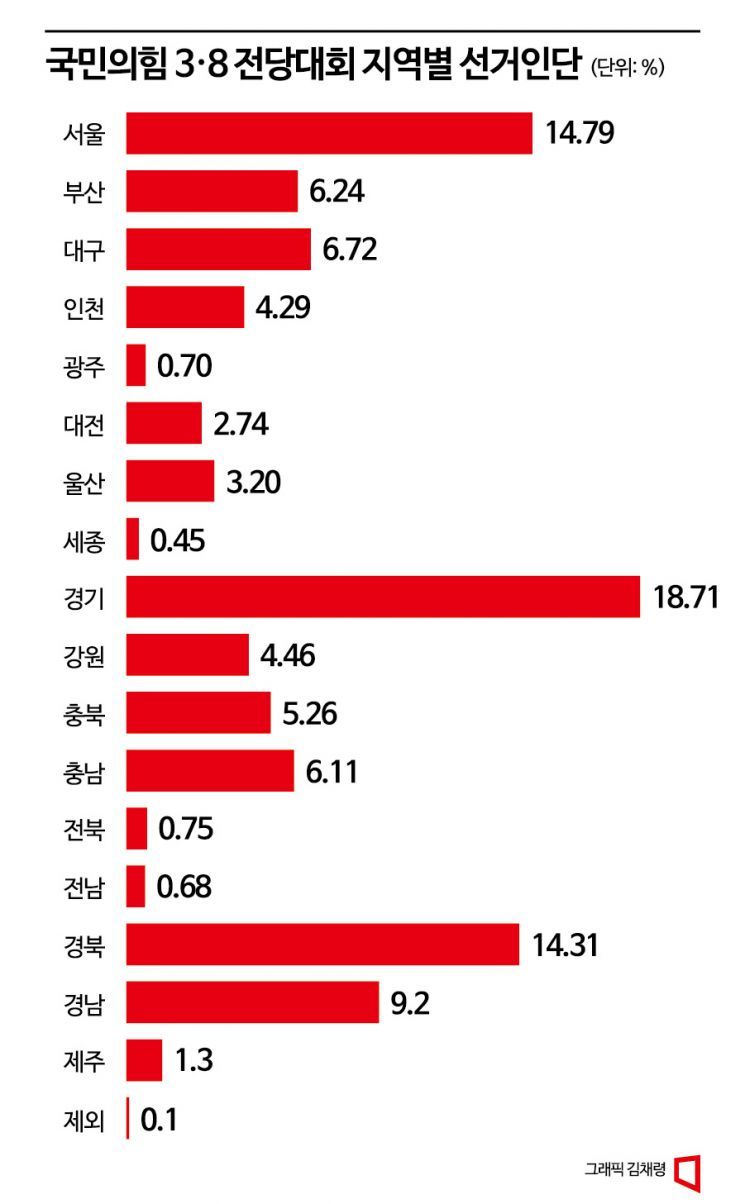
According to the People Power Party on the 10th, this convention delegate list has increased by 510,000 compared to the first convention in 2021 when former leader Lee Jun-seok was elected. By region, the metropolitan area (Seoul, Incheon, Gyeonggi) accounts for 37.79% of the total delegates, while Daegu and Gyeongbuk delegates make up 21.03%. Traditionally, the Daegu and Gyeongbuk region had the highest proportion of party members, but the metropolitan area's share has significantly increased. Additionally, the Busan, Ulsan, and Gyeongnam delegates account for 18.64%, making the total Yeongnam delegates (39.67%) similar in number to the metropolitan delegates.
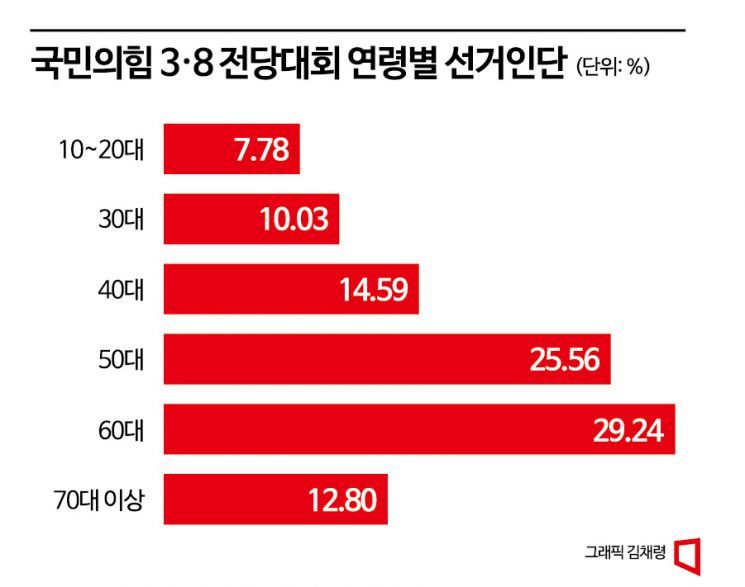
The number of young party members has also noticeably increased. The 20s and 30s age group accounts for 18.08%, and the young and middle-aged group including those in their 40s reaches 32.4%. Members in their 50s make up 25.56%, and those aged 60 and above comprise 42.04%. Given that the Lee Jun-seok leadership period saw a surge in metropolitan and young members, there is an interpretation that these groups may not be favorable to the party mainstream, the pro-Yoon (pro-Yoon Seok-yeol) faction.
However, since party members chose President Yoon Seok-yeol in last year's presidential primary, it is also possible that some metropolitan and young members may not choose the 'anti-Yoon (anti-Yoon Seok-yeol) candidates.' Furthermore, with an increase in members in their 50s and 60s and above, predicting the election outcome remains difficult. Jang Sung-chul, director of the Public Opinion Center, said, "Although the youth population increased significantly during Lee Jun-seok's leadership, pro-Yoon faction members also increased. It is difficult to predict election results based on region or age."
Professor Shin Yul of Myongji University's Department of Political Science said, "Traditional conservative members of the People Power Party have voted strategically. Winning the general election is necessary for regime continuation, and if the president's approval rating falls below the current level, next year's general election could become a referendum on the regime, so strategic choices will be made." Contrary to expectations that anti-Yoon faction members would unite due to the 'Yoon Core Group (Yoon Seok-yeol's key associates)' controversy, party members who experienced a drop in President Yoon's approval rating due to the 'Lee Jun-seok incident' may vote strategically.
Leading party leadership candidates Kim Ki-hyun and Ahn Cheol-soo are in a close race for first place in opinion polls. The results of polls released on the same day also differ significantly, making it difficult to read the election landscape. Additionally, there are limitations to opinion polls.
Fluctuating Support Rates Across Poll Results
In a survey conducted by Realmeter commissioned by Media Tribune on February 6-7 (402 People Power Party supporters nationwide aged 18 and over, with a margin of error of ±4.9 percentage points at a 95% confidence level), candidate Kim received 45.3%, Ahn 30.4%, Chun Ha-ram 9.4%, and Hwang Kyo-ahn 7.0%. Compared to the previous survey (January 31 - February 1), Kim's support rose by 9.3 percentage points, while Ahn's dropped by 12.9 points, showing significant volatility.
However, another poll released on the same day showed Ahn leading. In a party leader suitability survey conducted by Hangil Research commissioned by Cookie News from February 4-6 (527 People Power Party supporters nationwide aged 18 and over, with a margin of error of ±2.8 percentage points at a 95% confidence level), Ahn received 35.5%, Kim 31.2%, indicating a close race within the margin of error.
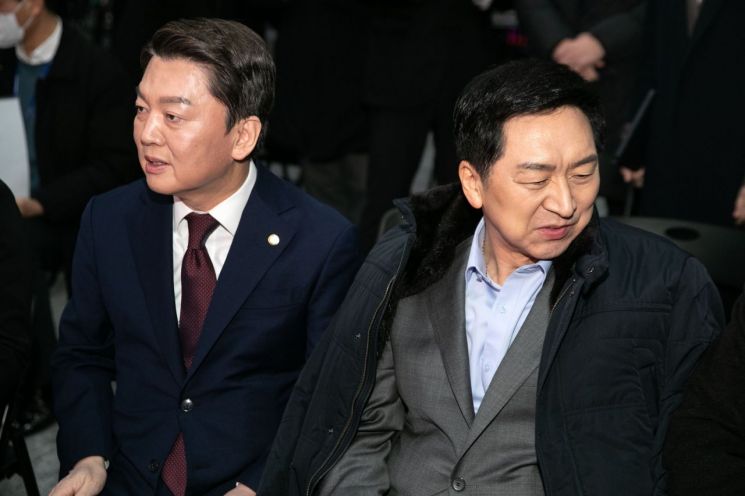 On the morning of the 7th, candidates Kim Ki-hyun and Ahn Cheol-soo are seated at the People Power Party's 3rd party convention candidate vision presentation held at a broadcasting studio in Gangseo-gu, Seoul. (Photo by Yonhap News)
There was analysis that former lawmaker Na Kyung-won’s de facto endorsement of Kim on the afternoon of the 7th influenced the Realmeter poll, but subsequent polls contradicted this. In a party leader suitability survey conducted by SBS commissioned to Next Research on February 6-7 (309 People Power Party supporters nationwide aged 18 and over, with a margin of error of ±5.6 percentage points at a 95% confidence level), Ahn received 32.9%, Kim 25.6%, Hwang 8.4%, and Yoon Sang-hyun 3.5%. For detailed information on each poll, refer to the Central Election Poll Deliberation Commission website.
Experts Point Out Limitations Such as Small Samples and Low Response Rates
Public trust in frequently changing opinion polls is declining. Experts point out the small sample size as a primary issue.
Lee Kang-yoon, director of the Korea Social Opinion Institute (KSOI), said, "Generally, opinion polls are conducted with 1,000 samples, but among them, only 400-500 respondents identified as People Power Party supporters were asked whom they support. That is a somewhat small sample size. If 1,000 People Power Party supporters were sampled and surveyed according to gender, age, and regional party member distribution, a more accurate picture could be approached. It’s not that the polls are wrong, but this should be kept in mind."
The low response rate is also cited as another factor. Um Kyung-young, director of the Era Spirit Research Institute, explained, "If the response rate is too low, statistics can be erratic or results can fluctuate. There is a high possibility of under- or over-representation, causing excessive skewing to one side." The overall response rates for each poll were 2.9% for Realmeter, 3.5% for Hangil Research, and 15.3% for Next Research.
Differences in survey methods also affect poll results. Realmeter applied a wireless 90% and landline 10% automated response system (ARS) random digit dialing (RDD) method. Hangil Research combined wireless ARS surveys (90%) and landline interviewer surveys (10%). Next Research used wireless (88%) and landline (12%) telephone interviewer surveys. Generally, telephone interviews are considered more accurate than ARS, but experts say "this is not necessarily the case." Professor Shin Yul of Myongji University’s Department of Political Science and Diplomacy said, "It is wrong to say ARS polls cannot be trusted; in elections, ARS can be more accurate. Those who respond to ARS polls until the end are politically highly engaged voters who will go to the polls regardless of rain, snow, or typhoons."
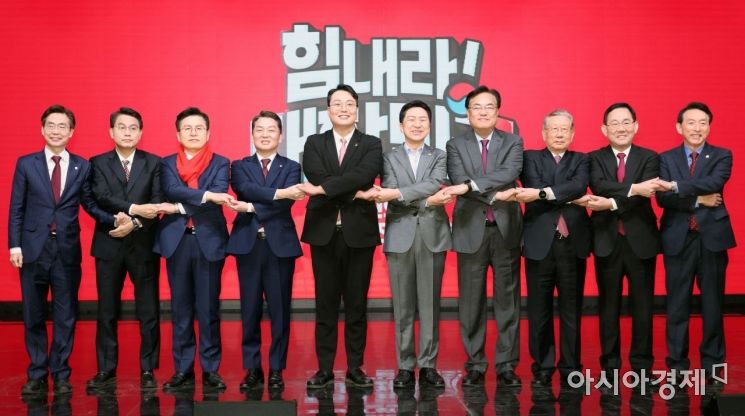 On the 7th, at a broadcasting studio in Gangseo-gu, Seoul, the leadership of the People Power Party and the party representative candidates, including Emergency Committee Chairman Jeong Jin-seok and Floor Leader Joo Ho-young, are taking a commemorative photo at the 3rd party convention candidate vision presentation. From the left: Cho Kyung-tae, Yoon Sang-hyun, Hwang Kyo-ahn, Ahn Cheol-soo, Cheon Ha-ram, Kim Ki-hyun, party representative candidates; Jeong Jin-seok, Emergency Committee Chairman; Yoo Heung-soo, election management committee chairman of the party convention; Joo Ho-young, Floor Leader; Kim Seok-ki, Secretary General. Photo by National Assembly Press Photographers Group
'100% Party Member Vote' Still Uncertain
Politicians are raising questions about the conflicting poll results. Candidate Yoon Sang-hyun said at a press meeting after the party convention vision presentation on the 7th, "Honestly, I don’t trust opinion polls. They survey 300-400 people using ARS, which is not an opinion poll but a deception. Such polls have no real meaning."
Since this party convention is conducted through 100% responsible party member voting, trust in various opinion polls is somewhat low. A People Power Party official said, "There have been continuous talks about reverse voting, but when receiving poll calls, even those who are not People Power Party supporters might say they are. The polls should only be seen as a trend, and the actual support rates will only be known on the day of the convention."
© The Asia Business Daily(www.asiae.co.kr). All rights reserved.

![Clutching a Stolen Dior Bag, Saying "I Hate Being Poor but Real"... The Grotesque Con of a "Human Knockoff" [Slate]](https://cwcontent.asiae.co.kr/asiaresize/183/2026021902243444107_1771435474.jpg)

















