[Asia Economy Reporter Choi Seok-jin, Legal Affairs Specialist] The Supreme Court has ruled that even if a company with issues in capital payment and construction business registration concealed these facts and received subcontracting to carry out construction, it cannot be punished for fraud if there were no defects in the construction and no financial loss occurred.
This means that, apart from being punished or sanctioned under relevant laws for each violation, it is difficult to consider that there was a deceptive act necessary for establishing fraud.
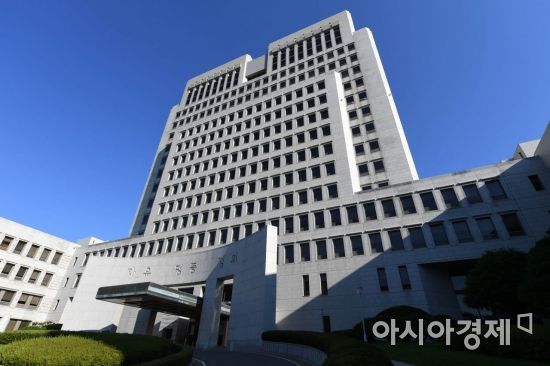
The Supreme Court's 3rd Division (Presiding Justice No Jeong-hee) announced on the 9th that it overturned the lower court's ruling sentencing A (64), the CEO of a construction company indicted for fraud under the Act on the Aggravated Punishment of Specific Economic Crimes and violation of the National Technical Qualifications Act, to 1 year and 6 months imprisonment, and remanded the case to the Busan High Court.
The court stated, "The lower court erred in its legal interpretation regarding the establishment of fraud, which affected the judgment of guilt on this part of the indictment against the defendant."
A was accused of operating a company without a specialized construction business license and subcontracting bridge installation work won by another construction company, carrying out the work using a patented construction method.
Under the Framework Act on the Construction Industry, a company receiving a specialized construction contract must register the relevant specialized construction business, the ordering party must subcontract to a construction business registered for the corresponding work, and the subcontractor must subcontract to a construction business registered for the corresponding work.
However, A's company was registered fraudulently as a specialized construction business by falsely paying capital and registering a certificate lender as a construction technician, thus an unqualified construction business that should not have been able to subcontract specialized construction. Despite this, A signed a patent usage agreement with the ordering agency and subcontract agreements with subcontractors, pretending to be a legitimately registered specialized construction business, which the prosecution alleged was deceptive conduct.
Additionally, A was investigated for readjusting and manipulating the already submitted estimate after receiving information from a local government official that a certain patented construction method had the highest estimate, thereby obtaining the subcontract.
The first and second trials found that A deceived the ordering local government and the company awarded the contract by pretending to meet capital and national technical qualification requirements, and convicted A of fraud.
They reasoned that whether the capital or qualification requirements stipulated by the Framework Act on the Construction Industry were met is an important consideration when concluding construction contracts or subcontract contracts, and if such facts had been disclosed in advance, the contract would not have been made. Therefore, failure to disclose was deception, and payment was a disposition act based on such deception.
However, the Supreme Court's judgment differed.
The court first cited precedent that a mere violation of administrative laws and regulations does not immediately constitute deceptive conduct.
Previously, the Supreme Court ruled, "The protected legal interest of fraud is property rights, so fraud cannot be established solely because national or public legal interests were infringed by deception. Even if there was a violation of administrative laws regulating related business or work, bidding qualifications, or contract procedures at the time of contract conclusion, it cannot be concluded that the act of concluding the contract was deceptive. It must be examined whether the violation was so fundamental that the work's completion was impossible even if performed according to the contract."
The court noted, "All three bridge installation projects subcontracted or contracted by the defendant were completed normally, with no construction defects or flaws in the patented method found during construction," and "The repair works subcontracted by the defendant were also completed normally."
Regarding A's false capital payment, the court pointed out, "There was no evidence that the defendant's company was in a state of capital erosion or had management problems due to insufficient capital when contracts were concluded with the ordering agency or subcontractors after the false payment."
It also stated, "There was no indication of technical problems with the patented construction method for which the defendant and the company hold exclusive license rights, nor issues in the patent acquisition process."
The court reasoned that the 'illegal registration of construction business' under the Framework Act on the Construction Industry, 'prohibition of certificate lending' under the National Technical Qualifications Act, and 'false capital payment' under the Commercial Act are all regulations protecting national or public legal interests. Violations result in sanctions under each law, but cannot be immediately deemed to infringe the property rights protected by fraud law. Furthermore, the bridge installation and repair contracts A signed were contracts for 'completion of work,' and there was no special agreement that all licensed technicians must participate or that external personnel participation via subcontracting was strictly prohibited. Therefore, it is difficult to conclude that A lacked the intention or ability to complete the work solely because of false capital payment or certificate lending to register as a specialized construction business.
The court also pointed out, "Since A's company received payment for the completion of the work from the ordering agencies or subcontractors, even if A concealed certificate lending or false capital payment, it is difficult to recognize a substantial causal relationship between such acts and the payment."
Regarding A's revision of the estimate after receiving information from the local government official, the court said, "That alone does not constitute deceptive conduct regarding contract performance ability toward the contracting official."
In conclusion, the court stated, "It is difficult to regard the defendant's receipt of construction payments from the ordering agencies or subcontractors as misappropriation of property through deception constituting fraud as alleged in the indictment."
However, the Supreme Court dismissed A's appeal, upholding the lower court's guilty verdict on other charges such as embezzlement and bribery under the Act on the Aggravated Punishment of Specific Economic Crimes.
© The Asia Business Daily(www.asiae.co.kr). All rights reserved.
![Clutching a Stolen Dior Bag, Saying "I Hate Being Poor but Real"... The Grotesque Con of a "Human Knockoff" [Slate]](https://cwcontent.asiae.co.kr/asiaresize/183/2026021902243444107_1771435474.jpg)
















