Statistics Korea, Annual Service Industry Production and Retail Sales Trends
Retail Sales Sharply Decline from 5.9% to 0.2%
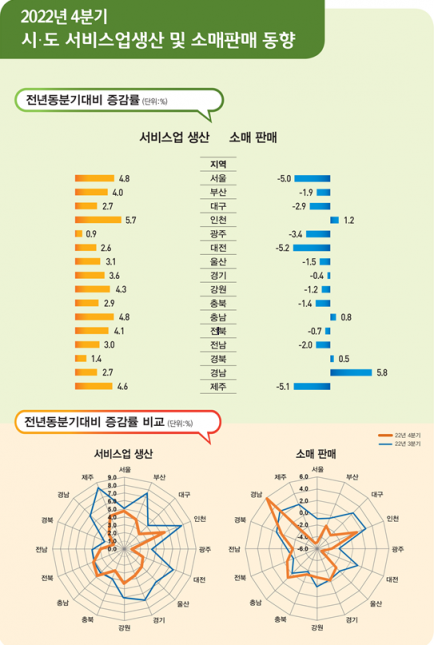
[Asia Economy Sejong=Reporter Song Seung-seop] Last year, domestic service industry production increased in all provinces and cities following the trend in 2021. In particular, Jeju-do, where the number of tourists increased as the COVID-19 surge eased, showed a sharp growth. However, the domestic retail sales sector sharply declined to the 0% range.
According to the '2022 Q4 and Annual Provincial Service Industry Production and Retail Sales Trends' announced by Statistics Korea on the 9th, nationwide service industry production last year rose by 4.8% compared to the previous year. This indicator recorded a negative growth in 2020 due to the impact of COVID-19, then increased by 4.4% in 2021 due to the base effect. Not only did all regions see growth, but the rate of increase also expanded.
The region with the highest growth was Jeju-do. In 2020, Jeju-do's service industry production shrank by 10.4% due to a sharp decline in tourist inflow, which was the largest decrease nationwide. However, as social distancing measures related to COVID-19 gradually eased, Jeju's service industry production jumped by 8.6%. Among these, the accommodation and food service sector led the growth with a 20.5% increase.
In Seoul, the increase was 4.2% year-on-year, below the average. In 2021, financial and insurance services showed a high growth rate of 10.8% due to increased financial transactions such as loans and stocks in Seoul. However, as the financial market cooled rapidly, this shrank sharply to 0.7%, and the real estate market also contracted from 3.4% to -9.6%. Instead, transportation and warehousing grew by 21.1%, and accommodation and food services rose by 25.3%, showing high growth rates.
On the other hand, retail sales were favorable at 5.9% in 2021 but dropped by more than 5 percentage points to 0.2% in one year. The largest decline was in Gwangju, which fell by 2.4%. Specialty stores decreased from 5.8% to -5.3%, and large discount stores' deficit expanded from -1.8% to -7.5%. The department store sector, which had shown an 18.8% increase, also slowed to 5.5% growth.
While most regions recorded negative growth, three areas?Gyeongnam (2.3%), Incheon (2.2%), and Daejeon (0.1%)?showed slight increases.
© The Asia Business Daily(www.asiae.co.kr). All rights reserved.

















