Markets Cheered Powell's Remarks, Then Faltered in a Day
Fed Hawkish Comments Raise Tightening Concerns, Leading to Consecutive Declines
Won-Dollar Exchange Rate Rises to 1260 Level... Volatility Expands
After two recent public remarks by Jerome Powell, Chair of the U.S. Federal Reserve (Fed), the stock market continued its rally but then turned downward after just one day. Although the market focused more on Powell's mention that "inflationary pressures are easing," despite hints at the possibility of further interest rate hikes, investor sentiment weakened again as Fed officials issued hawkish (monetary tightening-favoring) comments. Experts advise that, given the ongoing uncertainty surrounding U.S. monetary policy, investors should focus more on cautious decision-making rather than excessive optimism.
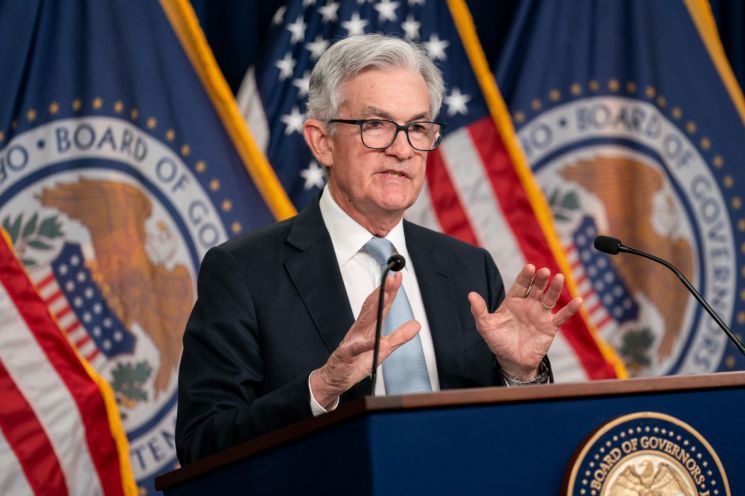
On the 8th (local time) at the New York Stock Exchange (NYSE), the Dow Jones Industrial Average closed at 33,949.01, down 207.68 points (0.61%) from the previous session, while the Standard & Poor's (S&P) 500 index fell 46.14 points (1.11%) to 4,117.86. On the 9th, the KOSPI opened at 2,470.66, down 12.98 points (0.52%), and the KOSDAQ opened at 776.60, down 3.38 points (0.43%). This is a completely different pattern from the "my-way rally" observed in the stock market following Powell's discussion at the Economic Club of Washington DC the previous day.
On the 7th (local time), Powell said in the discussion, "Although price declines have begun, it will take two years to tame inflation, and the employment indicators are too strong, making further rate hikes inevitable." At that time, the market focused more on "price declines" than on "rate hikes." In fact, he also made dovish (monetary easing-favoring) remarks such as "inflation will 'significantly' decrease this year" and "I would 'certainly' use the word disinflation," which the market welcomed as a subtle shift in Powell's stance.
However, the mood changed after hawkish comments from Fed officials. John Williams, President of the Federal Reserve Bank of New York, said at a Wall Street Journal (WSJ) event, "We need to maintain a sufficiently restrictive policy stance for several years," adding, "This could mean higher interest rates to ensure we achieve our goals." Christopher Waller, a Fed Governor, also emphasized, "We are preparing for a longer fight to bring inflation down to target."
There is analysis both inside and outside Wall Street that the market had been overly optimistic despite Powell initially stating that tightening must continue for inflation to approach the 2% target. Powell's remarks were essentially "hawkish-dovish" (a mix of hawkish and dovish tones), but the market took them too positively. U.S. economic media CNBC evaluated the previous day by saying, "Powell was hawkish, but investors were bullish," and explained that the Fed and the market's chicken game is likely to continue for some time.
Compared to last year, inflationary pressures have somewhat eased, but uncertainty remains high, so it is advised not to make premature judgments about the Fed's monetary policy direction. Mohamed Afaabay, a strategist at Citigroup, told Bloomberg that stocks in the U.S., Europe, Hong Kong, and Korea appear overvalued and could decline within the next 3 to 4 months. He said, "For stocks to show strength, the dollar needs to fall another 10% from here, but if the Fed raises rates in a way the market does not expect, that will be difficult."
Within Wall Street, there is also analysis that even the current decline in U.S. inflation is hard to guarantee as sustainable. Kang Hoo, a TIPS trader at New York hedge fund Winshore Capital Partners, told MarketWatch, "We could experience disinflation for another 5 to 6 months, but I cannot be sure what will happen afterward." Earlier, Mohamed El-Erian, economic advisor to global insurer Allianz, advocated a 0.50 percentage point rate hike by the Fed on the 30th of last month (local time), mentioning the "possibility of prolonged inflation."
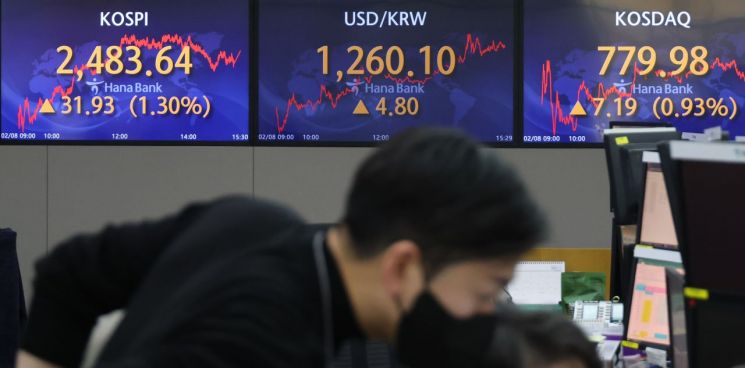
With divergent forecasts on U.S. monetary policy and global geopolitical situations, exchange rates are also becoming more volatile. In the Seoul foreign exchange market, the won-dollar exchange rate opened at 1,261.5 won, up 1.4 won that day. After falling to 1,216.4 won on the 2nd, it rose to the 1,260 won level within a week, showing significant fluctuations. Since the economy is slowing, the exchange rate is likely to decline in the medium to long term, but the Fed's recent series of hawkish remarks could act as a factor strengthening the dollar.
The market is expected to continue fluctuating while awaiting the U.S. January Consumer Price Index (CPI) data to be released on the 14th. Professor Sung Tae-yoon of Yonsei University's Department of Economics pointed out, "There is still pressure for rate hikes due to inflation, but there is some expectation that the speed or magnitude may be adjusted, so this seems to be priced into the stock market." He added, "This itself means that there is still considerable liquidity. However, caution is still needed regarding investments through loans."
© The Asia Business Daily(www.asiae.co.kr). All rights reserved.


















