[Asia Economy Reporter Donghyun Choi] It has been found that 95% of manufacturing SMEs feel burdened by industrial electricity rates.
The Korea Federation of SMEs announced on the 9th that, as a result of conducting an 'Energy Cost Burden Survey' targeting 309 manufacturing SMEs from the 4th to the 27th of last month, 94.9% responded that industrial electricity rates are burdensome. It was also found that 50.2% answered 'very burdensome.'
Regarding plans to respond to electricity rate increases, 'no special measures' was the highest at 69.9%. This was followed by 'reducing non-essential usage such as heating, cooling, and lighting' (30.7%), and 'planning to install or introduce high-efficiency equipment' (7.1%).
Concerning the increase in electricity rates, 51.5% of companies responded that their current energy usage is 'at the absolutely necessary level and cannot be further reduced.' Only 4.2% of companies answered that they would reduce usage by the amount of the increase. Additionally, when asked whether the increased electricity rates are reflected in delivery prices, only 12.9% of responding companies said they do.
The biggest difficulty in reducing electricity costs was 'the continued trend of rising industrial electricity rates (excessive speed)' at 42.4%. This was followed by '24-hour operation is inevitable due to equipment characteristics' (19.7%), and 'unpredictable order patterns from clients' (16.8%).
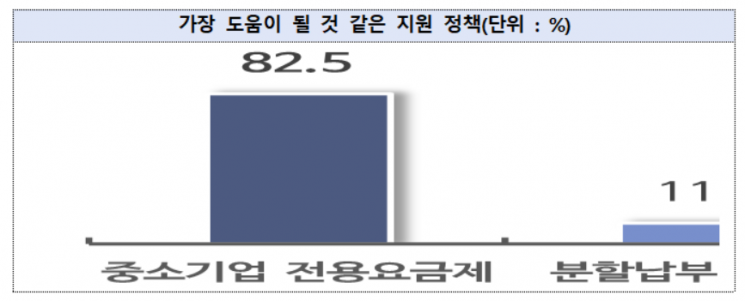
The support policy considered most helpful was 'improvement of rates such as a dedicated rate system for SMEs' at 82.5%. This was followed by 'support for replacing old equipment with high-efficiency equipment' (27.2%), and 'introduction of energy auxiliary facilities such as solar power' (14.2%).
Regarding the most urgent part of electricity rate improvement, 'reduction of the Electricity Industry Infrastructure Fund charge (3.7% of electricity rates)' was highest at 55.7%. This was followed by 'seasonal rate adjustments' (21.6%) and 'time-of-use rate adjustments' (16.1%).
Yang Chan-hoe, Head of the Innovation Growth Division at the Korea Federation of SMEs, stated, “Starting as early as next week, industrial sites will begin receiving electricity bills reflecting the first quarter’s rate increases, raising concerns that this could be the signal of a full-scale manufacturing recession. To alleviate the burden on SMEs, the establishment of a dedicated electricity rate system for SMEs, reduction of the Electricity Industry Infrastructure Fund charge, mid- to long-term structural improvement measures such as support for replacing high-efficiency equipment, and short-term payment burden relief measures such as installment payment introduction must be implemented in parallel.”
© The Asia Business Daily(www.asiae.co.kr). All rights reserved.

















