National Apartment Sales Outlook Index 71.1
National Index Rises Except for Ulsan Region
Sales Price and Volume Outlook Also Turn Upward Trend
[Asia Economy Reporter Kwak Min-jae] This month, there is a forecast that the nationwide apartment pre-sale market will improve compared to last month. However, due to worsening employment conditions and declining consumer indicators, Ulsan's pre-sale outlook index is expected to decrease.
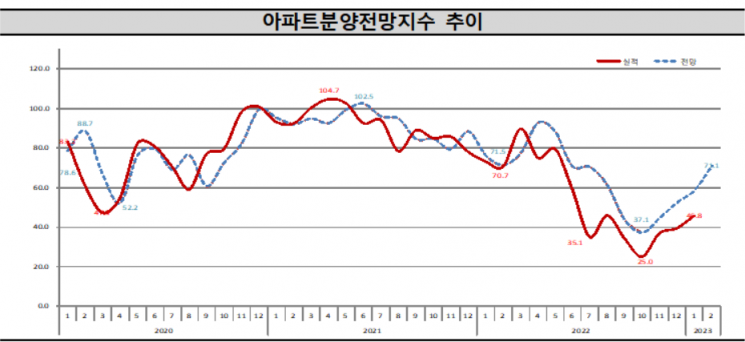
According to the Korea Housing Industry Institute (hereafter KHII) on the 9th, the apartment pre-sale outlook index for February was forecasted at 71.1. This is an increase of 12.4 points from last month’s 58.7. This index is a numerical indicator calculated by surveying about 500 housing businesses on the conditions of complexes that are about to be pre-sold or currently being pre-sold, and ranges from 0.0 to 200.0. An index above 100.0 indicates a positive pre-sale outlook, while below 100.0 indicates the opposite.
The metropolitan area outlook index, which was the only one below 50 last month at 43.9, rose to 61.0. Seoul increased by 18.0 points to 61.9, Incheon rose by 15.3 points to 54.5, and Gyeonggi increased by 18.0 points to 66.7, indicating an increase across all metropolitan areas. KHII explained, “The easing of real estate regulations announced last month, such as restrictions on resale and relaxation of the no-homeowner requirement, appear to have positively influenced the apartment pre-sale outlook in the metropolitan area.”
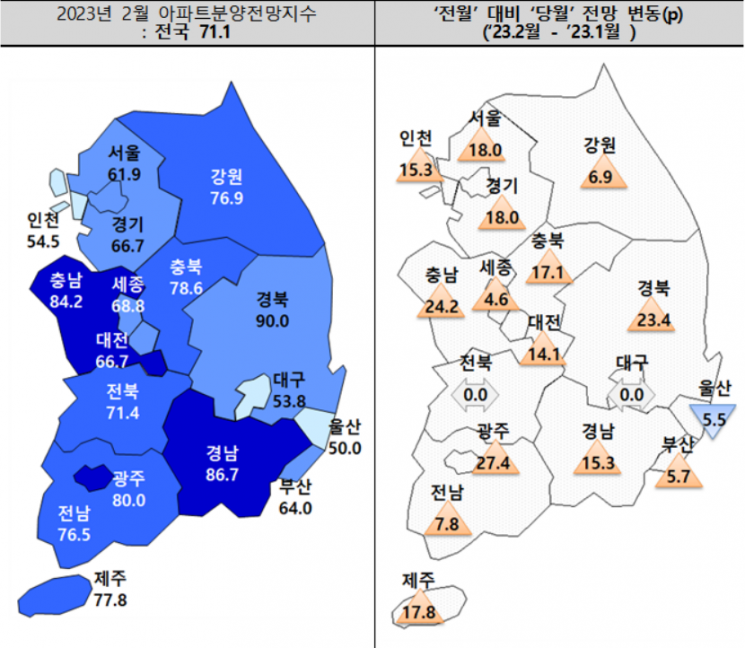
The regional outlook index also rose by 17 points to 73.2. Gwangju increased by 27.4 points to 80.0, Chungnam rose by 24.2 points to 84.2, Gyeongbuk increased by 23.4 points to 90.0, Chungbuk rose by 17.1 points to 78.6, Jeju increased by 17.8 points to 77.8, Gyeongnam rose by 15.3 points to 86.7, and Daejeon increased by 14.1 points to 66.7.
However, Ulsan was the only region where the pre-sale outlook index declined this month, dropping 5.5 points from last month’s 55.5 to 50.0. The worsening employment situation and declining consumer indicators in Ulsan appear to have negatively affected the pre-sale outlook.
KHII analyzed, “Although measures for a soft landing in the housing market, such as deregulation and financial support, have been announced, the pre-sale market still seems to be sluggish due to uncertain economic variables like high interest rates and economic contraction. Going forward, it is expected that the pre-sale market will gradually recover depending on the resolution of external factors such as the Ukraine war and the US base interest rate, as well as the effects of the Korean government’s active soft landing measures.”
The pre-sale price outlook for this month was surveyed at 85.1, an increase of 3.9 points from the previous month. This is interpreted as reflecting the disappearance of government price regulation policies such as the pre-sale price ceiling system, as well as increases in interest rates, land acquisition costs, construction material prices, and labor costs. However, due to the backlog of unsold units and weakened buyer sentiment, actual price increases are expected to be limited.
The pre-sale volume index was 76.7, up 6.6 points from last month, and the unsold inventory outlook was 115.1, down 14.8 points from last month. KHII explained, “This is likely because housing businesses expect the increase in unsold inventory to somewhat ease due to recovering buyer sentiment, falling interest rates, and deregulation.”
© The Asia Business Daily(www.asiae.co.kr). All rights reserved.


















