Introducing proactive heating cost measures... including the adoption of an 'eco-friendly heating system'
Promotion of LPG to city gas conversion support project... cash support for heating costs... other gap support
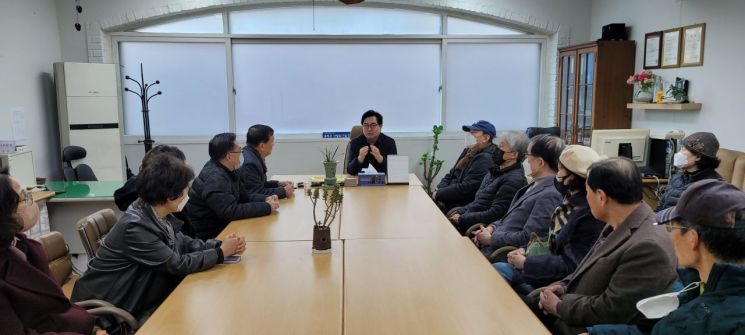 Park Il-ha, Mayor of Dongjak District, is explaining the heating cost support measures at a residents' briefing held on the 5th at Sadang Daerim Apartment.
[Asia Economy Reporter Park Jong-il] Dongjak-gu (Mayor Park Il-ha) announced on the 8th that it has recently established and is implementing short- and long-term measures to stabilize people’s livelihoods in response to the heating cost crisis.
The district will identify blind spots excluded from government or Seoul city support measures and promote institutional support and fundamental measures that residents can feel beyond cash support.
Establishing an Institutional Foundation
First, to prepare a basis for supporting cold wave damage, the district will start by building an institutional foundation.
A new ordinance on the establishment and operation of social welfare funds will be enacted to create social welfare funds that can provide support in case of cold wave damage,
and the ordinance on living stability support for low-income residents will be amended to expand support beyond the existing vulnerable groups to include gap groups.
Pursuing Fundamental Energy Measures
◇ Introduction of ‘Eco-friendly Green Energy Heat Pump’ Heating System
As a fundamental measure against the heating cost crisis, a dual heating system will be introduced by adding a ‘heat pump’ to the existing boiler.
A heat pump is a system that draws heat from the air or underground using electricity for heating, offering higher energy efficiency and lower carbon emissions compared to gas boilers.
The district plans to first install the heat pump system in district-run facilities such as daycare centers and senior centers, and then expand installation to private or individual facilities such as apartment complexes and goshiwons by holding resident briefings and obtaining resident consent.
The project cost will be procured through an ESCO (Energy Service Company) project, where private investment covers installation costs and the investment is repaid through energy savings.
◇ Promotion of LPG to City Gas Conversion Support Project
A support project for converting LPG users among small business owners to city gas will be implemented to reduce heating costs and enhance safety.
Dongjak-gu and KB Kookmin Bank have signed an agreement to provide low-interest loans at 1.5% interest up to 5 million KRW for city gas user facility installation costs to small business owners, utilizing Dongjak-gu’s resident income support and living stabilization fund resources.
Cash Support for Heating Costs
Additional heating cost support will be provided in February to blind spots excluded from government or Seoul city support measures, such as vulnerable groups and daycare centers.
1300 vulnerable households excluding basic livelihood security recipients will receive a fixed payment of 100,000 KRW per household, and 38 senior centers designated as cold wave shelters will receive up to 100,000 KRW monthly exceeding the existing heating cost support amount.
Additionally, 167 district-run, private, and home daycare centers will receive an additional 600,000 KRW for three months of heating costs.
Furthermore, with sponsorship from the Dongjak Welfare Foundation and others, 549 basic livelihood security recipient households affected by flooding will receive 200,000 KRW per household for heating costs, and 500 near-poverty households with overdue city gas bills will receive up to 100,000 KRW in public utility late fees support.
Other Gap Support
The ‘Warm Housing’ project will improve residential environments against cold waves by dispatching repair experts to 50 old and hazardous households to support water thawing and insulation attachment.
In cooperation with the Dongjak Volunteer Center and welfare centers, support activities such as boiler repairs and frozen pipe replacement for basic livelihood security recipients and near-poverty groups will also be conducted.
The ‘Warmth Companion’ project will deliver packages including sleep socks and hot packs to 100 gap-risk households such as single-person households and seniors, and a nighttime safety shelter providing accommodation for up to 10 days will be immediately implemented for residents needing protection from cold wave damage.
Park Il-ha, Mayor of Dongjak-gu, said, “This heating cost crisis requires more fundamental measures than short-term cash support,” adding, “The eco-friendly energy transition encompassing welfare, economy, and environment will be a key driver of new changes in Dongjak-gu.”
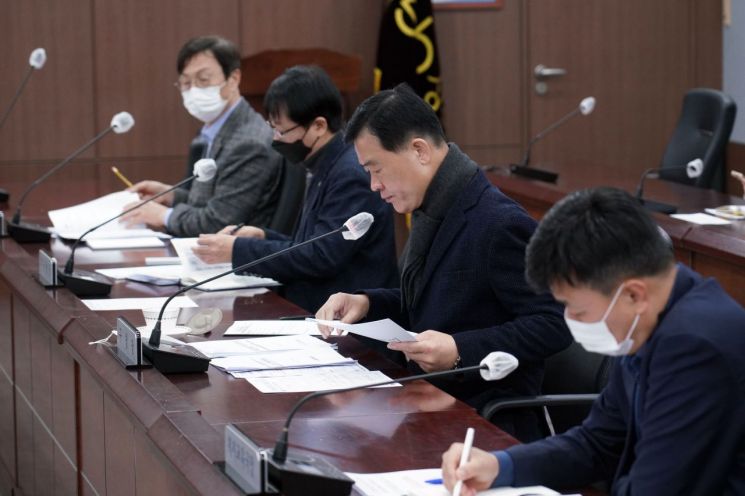 Seungro Lee, Mayor of Seongbuk-gu (second from the right), and district executives are discussing support measures at an emergency meeting to overcome the heating cost crisis.
Seongbuk-gu’s comprehensive 3.6 billion KRW support to overcome heating cost crisis
Up to 518,000 KRW monthly support for 5 months at about 90 district-run and rental apartment senior centers
Temporary heating cost support for 96 private senior centers: 100,000 KRW for 3 months
One senior comprehensive welfare center receives up to 2.5 million KRW for 3 months
Seongbuk-gu (Mayor Lee Seung-ro) is providing a total of 3.633 billion KRW in comprehensive support, including 1.977 billion KRW of its own funds alongside government and Seoul city support, to overcome the heating cost crisis.
Emergency heating cost support is provided not only to vulnerable groups and small business owners but also to childcare and social welfare facilities, with swift responses to energy cost difficulties at welfare facilities used mainly by seniors vulnerable to cold waves.
Seongbuk-gu initially supported up to 370,000 KRW for 5 months for district-run and rental apartment senior centers, but as heating costs surged, it quickly decided to provide an additional 148,000 KRW for the same period. As a result, about 90 district-run and rental apartment senior centers in Seongbuk-gu will receive up to 518,000 KRW in heating cost support over 5 months.
In addition, heating costs are supported for private senior centers and senior comprehensive welfare centers. A total of 96 private senior centers in Seongbuk-gu receive 100,000 KRW monthly for 3 months, and the senior comprehensive welfare center receives 2.5 million KRW for 3 months.
Lee Seung-ro, Mayor of Seongbuk-gu, said, “The recent soaring heating costs combined with the economic crisis and cold waves have caused great suffering across society,” adding, “We are doing our best to create a healthy and happy Seongbuk by providing swift heating cost support to facilities mainly used by seniors vulnerable to cold waves.”
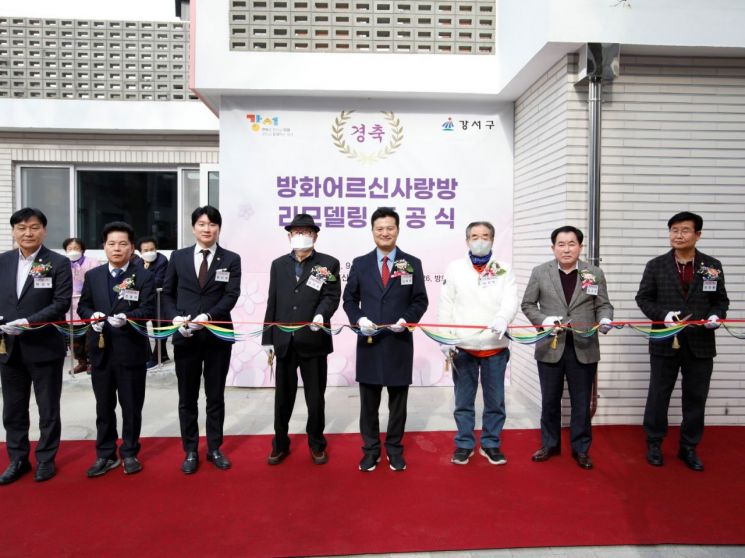
Kim Tae-woo, Mayor of Gangseo-gu: “We will expand energy efficiency projects so seniors don’t worry about heating costs”
Mayor Kim Tae-woo attends ‘Banghwa Senior Love Room Remodeling Completion Ceremony’
Kim Tae-woo, Mayor of Gangseo-gu, Seoul, attended the ‘Banghwa Senior Love Room (23 Gaehwa-dong-ro 26) Remodeling Completion Ceremony’ at 2 p.m. on the 9th and said, “We will gradually expand energy efficiency projects at senior facilities so that seniors can live without worrying about heating and electricity bills.”
Mayor Kim said, “We focused most on improving senior welfare, reducing greenhouse gases, improving energy efficiency, enhancing senior convenience, and improving the energy performance of existing buildings,” adding, “We will work harder to support more seniors with comfortable and convenient facilities.”
The district was selected for the zero-energy transition project in 2021, securing about 220 million KRW in city funds and investing a total of 380 million KRW to transform the Banghwa Senior Love Room into an eco-friendly building.
The Banghwa Senior Love Room has a total floor area of 180.03㎡ and spans from basement level 1 to the 2nd floor. Through this remodeling, it was created as a senior facility utilizing green and renewable energy, including ▲enhanced exterior wall insulation ▲replacement with high-efficiency windows ▲installation of solar panels.
The completion ceremony was attended by about 50 people, including Mayor Kim Tae-woo, the Senior Love Room chairman, and seniors, and proceeded with ▲project progress report ▲rice cake and cake cutting ▲ribbon cutting ▲facility tour.
Mayor Kim Tae-woo said, “Buildings applying green and renewable energy will greatly help reduce energy consumption and improve user convenience,” adding, “We will gradually expand this not only to senior facilities but also to childcare and other facilities for socially vulnerable groups.”
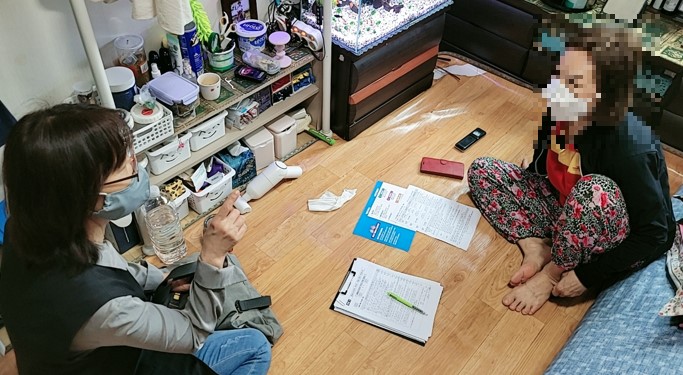
Gwangjin-gu’s ‘Our Neighborhood Care Team’ begins activities to check on neighbors
Local residents check on high-risk solitary death households at least once a week and conduct home visits
Detailed assessment of household crisis situations and linkage to necessary welfare services at community service centers
Gwangjin-gu (Mayor Kim Kyung-ho) has officially started activities of the ‘Our Neighborhood Care Team’ this year.
‘Our Neighborhood Care Team,’ launched to prevent solitary deaths and identify welfare blind spots, is a community human resource network whose main activities include checking on high-risk solitary death households at least once a week and conducting home visits.
Through regular monitoring, they help alleviate loneliness and isolation for each household and play a role in closely assessing household crisis situations and linking necessary welfare services in cooperation with community service centers.
Therefore, the district formed the Our Neighborhood Care Team with local residents who can operate continuously closest to crisis households.
This year, the Our Neighborhood Care Team consists of 20 members selected through document and interview screening. They received preliminary training on January 30 and were deployed to 15 community service centers in February to begin full-scale activities.
The district extended the activity period from 9 months last year to 11 months this year to strengthen continuous management of high-risk solitary death households. It also provides regular training four times a year to enhance the professionalism of the Our Neighborhood Care Team.
In particular, Guui 2-dong, selected for the Ministry of Health and Welfare’s pilot project ‘Social Network Formation for Solitary Death Prevention,’ plans to collaborate with the Our Neighborhood Care Team to provide ‘Happiness Packages’ of daily necessities to solitary death households.
Kim Kyung-ho, Mayor of Gwangjin-gu, said, “We operate the Our Neighborhood Care Team to build a social safety net where neighbors care for neighbors,” adding, “We will expand the scope of activities compared to last year to strengthen the local care system.”
© The Asia Business Daily(www.asiae.co.kr). All rights reserved.
!["The Woman Who Threw Herself into the Water Clutching a Stolen Dior Bag"...A Grotesque Success Story That Shakes the Korean Psyche [Slate]](https://cwcontent.asiae.co.kr/asiaresize/183/2026021902243444107_1771435474.jpg)


















