[Telecom Performance Analysis③] 40GB+ Mid-Tier Plans, Senior Plans Promotion
Minimal Government Intervention Needed for Public Benefit
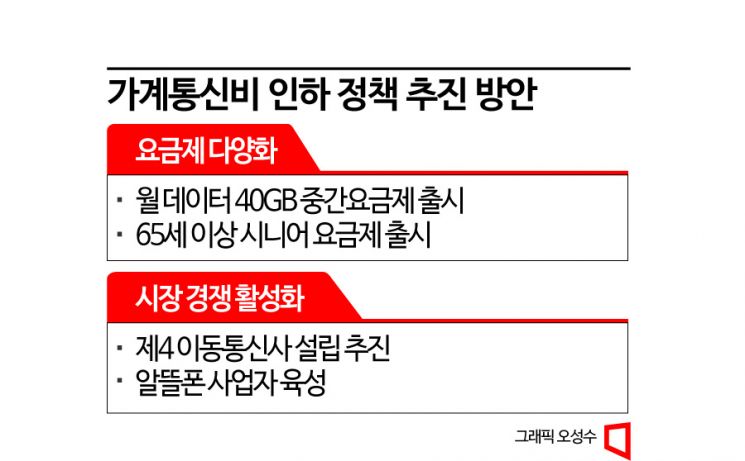
[Asia Economy Reporter Lim Hye-seon] The government is actively promoting policies to reduce household communication costs this year to ease the burden on citizens. To encourage price reductions, it plans to diversify 5th generation (5G) rate plans and has introduced the card of establishing a 4th mobile carrier to revitalize market competition.

Strong Performance of Telecom Companies, Sufficient Room for Price Cuts
The government sees the current strong performance of telecom companies as an opportunity to revise rate plans. Last year, the combined operating profit of SK Telecom, KT, and LG Uplus exceeded 4.5 trillion won, the highest since 2010. Although telecom companies introduced mid-tier 5G plans last year, consumer response was lukewarm due to a significant gap between the monthly data offered and actual consumer preferences. Telecom companies launched mid-tier plans priced between 50,000 and 60,000 won with monthly data of 24 to 31GB. However, a satisfaction survey on mid-tier plans conducted by the National Assembly’s Science, Technology, Information and Broadcasting Committee found that 7 out of 10 respondents felt the data allowance was insufficient.
Compared to plans offering over 150GB of monthly data (priced at 75,000 won), these mid-tier plans were also evaluated as lacking price competitiveness. The average revenue per user (ARPU) increased due to upselling effects from LTE subscribers switching to 5G plans.
An Jeong-sang, senior expert at the Science and Technology Information Broadcasting Committee, criticized, "Mid-tier plans are ineffective and are showy policies disconnected from consumer expectations. Instead of impulsively introducing single-item policies one by one, a comprehensive approach to reducing household communication costs that citizens can feel is necessary." He suggested alternatives such as mid-tier plans with over 40GB, senior plans for those aged 65 and above, and youth-specialized plans.
Find a New 'Catfish'
The government is also pursuing measures to activate market competition through new players. For the establishment of a '4th mobile carrier,' the government has offered substantial benefits. It plans to supply the 28GHz band of 5G frequencies and 800MHz to new operators at a low price for at least three years.
If the operator wishes, allocation of the 3.7GHz band is also under consideration. The 3.7GHz band is adjacent to the 3.5GHz band currently used by telecom companies for 5G services. The burden of base station construction costs has been reduced from trillions of won to around 300 billion won, and, like MVNO operators, new entrants can rent the existing networks of the three telecom companies to provide nationwide service.
Still, no company is willing to compete against the three telecom giants who have divided and ruled the market for decades. There are calls for groundbreaking additional support measures, such as temporarily drastically reducing or eliminating network usage fees until the 4th mobile carrier firmly establishes itself in the market. The environment must be created for a 'catfish' that will invigorate the market to be born and grow.
The telecom market, solidified around the three major companies, has long lost quality and price competition among operators. The Korea Information Society Development Institute has evaluated the domestic mobile telecom market as a "market with insufficient competition" for several years. Fierce competition is necessary to improve service quality and lower prices. As of December last year, market shares were SK Telecom 40.1%, KT 22.3%, and LG Uplus 20.7%.
The government also plans to increase support for MVNOs (16.9%), which trail behind the three major telecom companies. The problem is that the three major companies have subsidiaries that sell MVNO services, and these subsidiaries account for half of the total MVNO sales.
While Searching for Communication Cost Reductions, CEO Salaries Reach Tens of Billions
The CEOs of the three major telecom companies received a combined 4.445 billion won in compensation in the first half of last year. Yoo Young-sang, CEO of SKT, Hwang Hyun-sik, CEO of LG Uplus, and Koo Hyun-mo, CEO of KT, received 1.586 billion won, 1.585 billion won, and 1.274 billion won respectively. Compared to the same period the previous year, Yoo Young-sang received 681 million won more, Hwang Hyun-sik 226 million won more, and Koo Hyun-mo 428 million won more.
It is natural to be evaluated according to performance. However, considering the current situation, there is room to criticize that compensation rises in proportion to communication fees. Although telecom companies claim to invest in new businesses, they have yet to generate significant revenue from these new ventures. In other words, while investing heavily in new businesses amid rising fees, profits are also increasing.
A government official said, "The fact that the operating profits of the three traditional domestic telecom companies have exceeded 4 trillion won for several years can be interpreted as meaning that citizens’ wallets have become thinner. While market-driven competition is important, minimal government intervention for the people is also necessary."
© The Asia Business Daily(www.asiae.co.kr). All rights reserved.
![Clutching a Stolen Dior Bag, Saying "I Hate Being Poor but Real"... The Grotesque Con of a "Human Knockoff" [Slate]](https://cwcontent.asiae.co.kr/asiaresize/183/2026021902243444107_1771435474.jpg)

















