Drought in Southern Regions, Government and Citizens Unite to Overcome
[Asia Economy Reporter Kiho Sung] The cumulative rainfall in the Gwangju and Jeonnam regions over the past year (896.3mm) recorded the second lowest rainfall since 1973. The government announced the 'February Drought Forecast and Warning and National Drought Statistics' containing this information on the 9th.
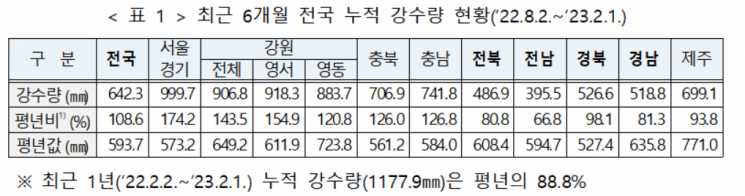
The nationwide cumulative rainfall over the past six months (642.3mm) is 108.6% of the average year, but the cumulative rainfall in the Gwangju and Jeonnam regions is 66.8% of the average, with meteorological drought continuing in some areas. The nationwide average reservoir storage rate for agricultural use is 98% of the average year, which is normal, but Jeonbuk and Jeonnam, which have experienced low rainfall for more than six months, have low levels at 82% and 80%, respectively.
Accordingly, for reservoirs expected to face water shortages during the farming season, measures such as filling water through river water pumping and storage, and trapping water in rivers and drainage channels are being implemented to additionally stockpile and secure water. The storage rates of multipurpose dams (20 sites) and water supply dams (14 sites), which are major water sources for domestic and industrial water, are at 102% and 99% of the usual levels, respectively.
The government announced that it will promote various measures to overcome drought in the southern regions.
The Ministry of the Interior and Safety is promoting a ‘Drinking Water Donation Relay’ to donate bottled water and other supplies to residents of southern island areas facing severe water supply restrictions. The Ministry of Agriculture, Food and Rural Affairs is filling reservoirs with low storage rates by pumping river water in preparation for farming, and is promoting rural water development (12 sites), water system connections (3 sites), and large-scale agricultural development (2 sites) as permanent drought countermeasures, mainly through partial completion, planning to gradually increase the water supply area annually. The Ministry of Environment is actively encouraging water conservation through the ‘Voluntary Water Saving Demand Adjustment System,’ which involves 12 local governments in Jeonnam that receive tap water from Juam Dam and Pyeongnim Dam (as of January 30). The Ministry of Trade, Industry and Energy is reducing water usage by coordinating factory maintenance schedules* and minimizing external discharge of cooling water in consultation with companies located in the Yeosu and Gwangyang industrial complexes.
The ‘2021 National Drought Information Statistics (Joint Ministries),’ a nationally approved statistic, will also be provided through the National Statistical Portal starting tomorrow.
Lee Hangyeong, Director of the Disaster Management Office at the Ministry of the Interior and Safety, said, “The effects of water-saving practices in the Gwangju and Jeonnam regions and participation in drinking water donations in island areas are showing results, so we ask for a little more effort until the drought is resolved.” He added, “The government will also work closely with related agencies to ensure thorough implementation of drought countermeasures, including expanding water supply in areas expected to face water shortages.”
© The Asia Business Daily(www.asiae.co.kr). All rights reserved.

















