President Directly Chairs 'Central Integrated Defense Meeting' for the First Time in 7 Years
"Civilian, Government, Military, and Police Must Unite to Establish Security Posture"
[Asia Economy Reporter Baek Kyunghwan, Military Specialist Reporter Yang Nakgyu] President Yoon Suk-yeol on the 8th instructed, "Check whether there are any gaps in the integrated defense posture according to the types of provocations by North Korea." This directive was to prepare in advance for recent incidents such as North Korea's unmanned aerial vehicle provocations, reflecting internal and external assessments that North Korea's provocations will diversify beyond missiles.
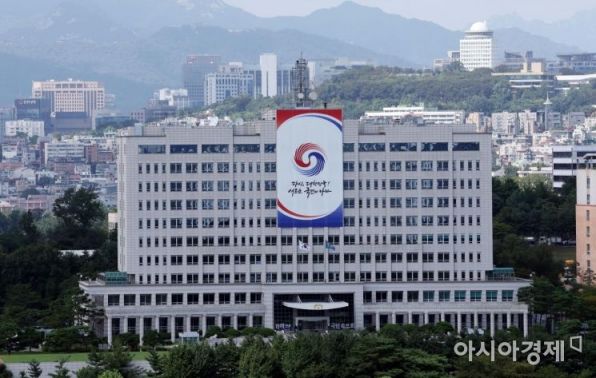
On the morning of the same day, President Yoon presided over the 56th Central Integrated Defense Meeting at the Blue House State Guest House, reviewing the national integrated defense posture with key officials from civilian, government, military, and police sectors, and gave these instructions. A presidential office official explained, "Recently, North Korea has explicitly defined us as a 'clear enemy' and openly demonstrated its willingness for a nuclear preemptive strike," adding, "In a severe security situation where threats to citizens' safety are increasing through unmanned aerial vehicles, terrorism, and cyberattacks, it was conducted with the recognition that it is important to establish a unified security posture centered on the president."
The Central Integrated Defense Meeting is a forum where key officials from civilian, government, military, and police sectors gather to review the national integrated defense posture and discuss development measures in preparation for national security threat situations such as enemy infiltration and provocations. It originated from the 1968 'Emergency Security Meeting' initiated to respond to frequent infiltrations and provocations by North Korea, and has since been held under the chairmanship of the president or prime minister considering the security situation.
This was the first time in seven years since 2016 that the president personally presided over the meeting. This indicates that North Korea's provocations have become bolder and more diverse, necessitating comprehensive government-wide countermeasures. More than 160 key officials from the central government, local governments, the National Intelligence Service, various military branches, the National Police Agency, the Korea Coast Guard, the Fire Agency, and related civilian experts attended in large numbers for this reason.
At the meeting, President Yoon instructed a review of North Korea's provocation types and emphasized "the government's emergency preparedness system maintenance." He further stated, "The civilian sector, government, military, and police must unite with one strength to establish a firm all-out security posture and make every effort to protect the people in case of emergencies." This reflects the growing concern over civilian damage from North Korea's unmanned aerial vehicle provocations and the judgment that civilian cooperation is essential to establish a next-generation preparedness system.
The National Intelligence Service also reported the current security situation to President Yoon, and the Integrated Defense Headquarters announced the direction for military readiness and integrated defense posture. In the subsequent thematic discussion, specific topics such as ▲strengthening response capabilities and citizen protection measures against North Korea's nuclear and missile threats and high-intensity provocations ▲counter-terrorism and cyber threat preparedness and capability enhancement plans were discussed.
In particular, the military presented plans to designate private companies as national critical facilities. Currently, 12 locations such as KT Guro Branch and KT Geoje Undersea Relay Station are designated as level B, and 10 locations such as SK Telecom Incheon Office and LGU+ Busan Choryang Office are designated as level A. There are 533 national critical facilities, of which 56 are information and communication facilities. However, following the fire incident at the SK C&C Pangyo Data Center in October last year, there is a plan to consider designating data centers directly related to citizens' lives as national critical facilities.
Protection facilities against North Korea's nuclear and missile threats will also be strengthened. A representative measure is to mandate the installation of evacuation facilities when constructing apartments and schools. Support measures are also expected to include allowing these facilities to be used as swimming pools, libraries, etc., during peacetime. Additionally, considering that nationwide civil defense drills have not been conducted, civil defense drills will be implemented starting in May.
Meanwhile, before the meeting, President Yoon awarded presidential citations to five institutions including Jeju Provincial Office, the 35th and 56th Army Divisions, Jeonbuk Police Agency, and Kori Nuclear Power Headquarters, commending their contributions to the efficient operation of national defense elements and the establishment of an integrated defense posture. A presidential office official stated, "As threats to citizens' safety are becoming increasingly diverse, a government-wide preparation is now necessary," and added, "The Yoon administration will check and prepare various defense postures accordingly."
© The Asia Business Daily(www.asiae.co.kr). All rights reserved.
![From Hostess to Organ Seller to High Society... The Grotesque Scam of a "Human Counterfeit" Shaking the Korean Psyche [Slate]](https://cwcontent.asiae.co.kr/asiaresize/183/2026021902243444107_1771435474.jpg)
















