Voices for "Financial Support" Reach Seoul City from Both Ruling and Opposition Parties
Some People in the People Power Party Also Say "Supplementary Budget and Seoul City Support Needed"
Han Duck-soo and Choo Kyung-ho Opposed Due to Fiscal Soundness
Pressure on the Ministry of Economy and Finance Likely to Increase as the General Election Approaches
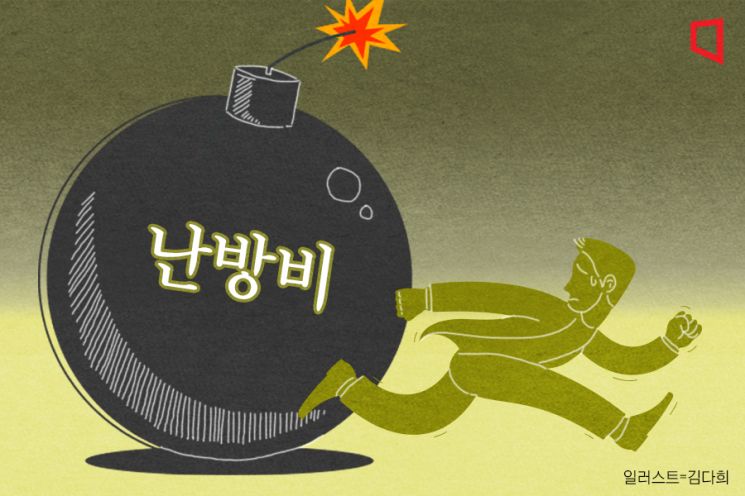
[Asia Economy Sejong=Reporters Song Seung-seop and Kim Young-won] Calls for expanding fiscal support are growing louder. Not only the opposition parties but also local governments, including Seoul City, are demanding increased financial input to support vulnerable groups. Although voices within the ruling party are also suggesting the need for an additional supplementary budget, the Ministry of Economy and Finance, the fiscal authority, is maintaining its stance of refusal. As next year’s general election approaches, pressure on the Ministry of Economy and Finance is expected to intensify further.
According to the government and the National Assembly on the 8th, the ruling party and government are currently considering plans to expand heating cost support to the middle class and ways to secure the necessary funding. This follows President Yoon Suk-yeol’s directive at the Chief Secretary meeting on the 30th of last month to “actively review measures to reduce the heating cost burden for the middle class and low-income households.” The government has decided to allocate 100 billion KRW from contingency funds and 80 billion KRW from the existing budget to support heating costs for vulnerable groups.
Opposition: "Windfall Tax, 30 Trillion Supplementary Budget" vs Government: "Priority Support for Vulnerable Groups, No Populism"
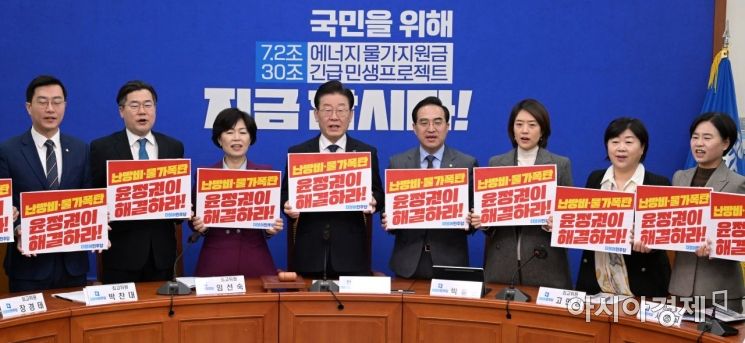 Lee Jae-myung, leader of the Democratic Party of Korea, along with other Supreme Council members, is holding placards related to heating costs and shouting slogans ahead of the Supreme Council meeting held at the National Assembly on the 1st. Photo by Yoon Dong-joo doso7@
Arguments for increasing support have been persistently raised since the controversy over the “heating cost bomb” erupted. The Democratic Party of Korea has proposed imposing a windfall tax on oil companies that have earned huge profits to provide 7.2 trillion KRW in support funds. During the government questioning session at the National Assembly the day before, Lee Sung-man, a Democratic Party lawmaker, asked Deputy Prime Minister and Minister of Economy and Finance Choo Kyung-ho, “Since oil companies profited from price increases rather than efforts, do you have any intention to consider a windfall tax?” The Democratic Party has also proposed a supplementary budget of around 30 trillion KRW.
Seoul City is requesting the Ministry of Economy and Finance to compensate for losses caused by free subway rides. According to the Ministry of Land, Infrastructure and Transport, in 2021, Seoul Metro spent 283.1 billion KRW on free transportation services. Seoul Metro, which has the highest number of passengers, is running a deficit of up to 1 trillion KRW. In response, Seoul Mayor Oh Se-hoon said at a New Year press conference on the 30th of last month, “If the Ministry of Economy and Finance changes its stance on compensating for free rides with national funds, we can adjust the increase rate of public transportation fares.”
The Ministry of Economy and Finance is reluctant to accept demands for a windfall tax, expanded heating cost support, public utility fee compensation, and supplementary budget execution. Their argument is that a windfall tax contradicts market principles, heating cost support should prioritize vulnerable groups, and universal support is close to populism. Regarding the supplementary budget, they maintain that it would harm national fiscal soundness and could stimulate inflation, so it is not being considered at all.
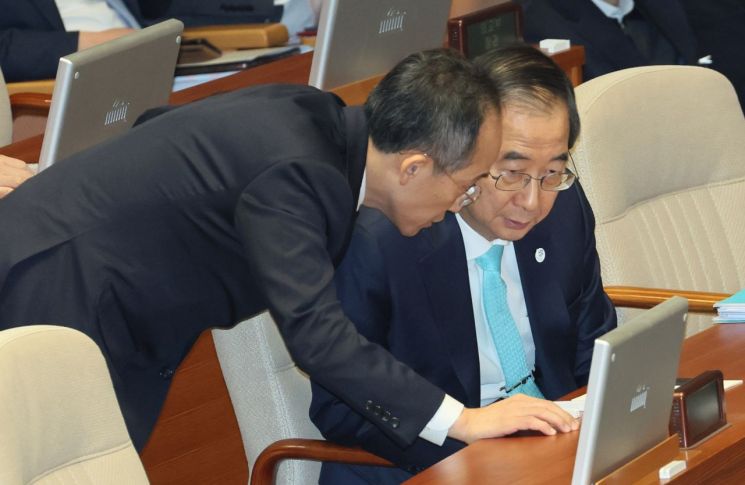 Prime Minister Han Duck-soo and Deputy Prime Minister and Minister of Economy and Finance Choo Kyung-ho are conversing during the government economic sector questioning session held at the National Assembly yesterday afternoon.
 [Image source=Yonhap News]
On the previous day, Prime Minister Han Duck-soo also responded bluntly to a question at the National Assembly about plans for a supplementary budget, saying, “I currently do not think it is necessary.” He added, “It has only been about a month and a half since the budget was passed and execution began. The government is fully committed to properly executing the budget approved by the National Assembly.” Deputy Prime Minister Choo also asserted, “Now is absolutely not the time to consider a supplementary budget.”
Regarding Seoul City’s request for compensation for free subway rides, Deputy Prime Minister Choo made a pointed remark. He said, “The logic is that local governments operate their own facilities and then say, ‘We have a deficit, so the country should support us.’ If a local government with a fiscal independence rate exceeding 80%, the best in the country, claims financial difficulties, then where would local governments with less than 30% fiscal independence, such as Jeollanam-do and Gyeongsangbuk-do, get the funds to cover their financial support needs?” He also clearly opposed the request, stating, “The subway operated by Seoul is a local government affair of Seoul City, so the local government should be responsible for operating it with its own budget.”
Subtle Differences Between Ruling Party and Government: "Possibility of Supplementary Budget and Free Ride Support"
The issue is that the view that the Ministry of Economy and Finance should change its current stance is emerging not only from the opposition but also within the ruling party. On the 3rd, Joo Ho-young, floor leader of the People Power Party, said after a floor strategy meeting, “We will discuss with the government how to distribute the deficit from free rides,” adding, “There is recognition that it is not right for local governments to continue bearing deficits of several hundred billion KRW annually.”
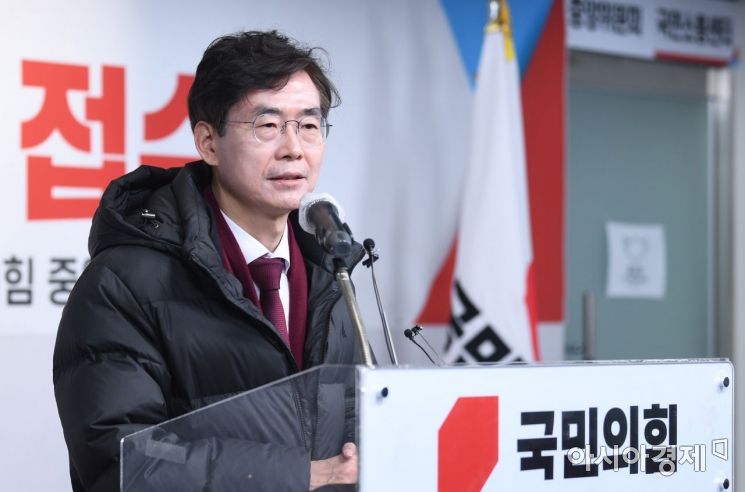 On the 2nd, Rep. Cho Kyung-tae of the People Power Party is expressing his thoughts after completing the registration as a candidate for party leader at the central party office in Yeouido, Seoul. Photo by Yoon Dong-joo doso7@
Opinions calling for the preparation of a supplementary budget have also already surfaced. Cho Kyung-tae, a People Power Party presidential candidate, urged a supplementary budget on the 29th of last month to provide heating cost support worth about 100,000 KRW per household. Cho explained, “Additional tax revenue has averaged about 15 trillion KRW over the past five years, so about 6.4 trillion KRW is quite feasible,” adding, “Concerns about inflation can be addressed by using immediate deduction methods such as voucher systems, which have no relation to inflation.”
Some cautiously predict that the Ministry of Economy and Finance will find it difficult to maintain its stance as energy price hikes become inevitable and the issue of summer electricity bills overlaps. As soon as heating bills arrive at households last month, public opinion is bound to demand an expansion of support. Moreover, as next year’s general election approaches, pressure to provide financial support is likely to come from lawmakers considering running for office.
People Power Party lawmaker Han Moo-kyung said, “Now is not the time for a supplementary budget issue, but rather a study on the system should be conducted,” while leaving the possibility open by adding, “To support gas purchase costs with government funds, a review may be needed, and I also requested a review during government questioning since the fiscal authorities oppose it.” Lawmaker Yoo Kyung-joon pointed out, “Free elderly fares are part of overall welfare policy and can be compensated with taxes,” adding, “If local governments provide free rides for the elderly, they have no choice but to raise fares to compensate for losses.”
© The Asia Business Daily(www.asiae.co.kr). All rights reserved.



















