Korean Air Plans to Develop Unmanned Formation Aircraft and Stealth Reconnaissance Drones
[Asia Economy Yang Nak-gyu, Military Specialist Reporter] Stealth unmanned aerial vehicles (UAVs), whose development accelerated after North Korean drones violated South Korea's airspace, are expected to make their first flight in formation two years from now.
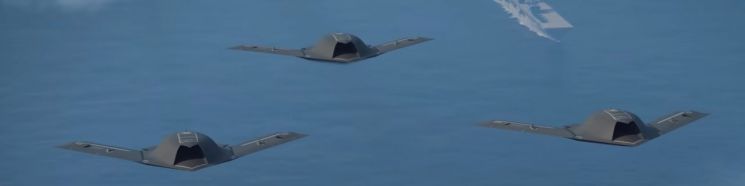
In pre-seminar materials for the seminar on the establishment and response directions of manned-unmanned combat systems, hosted by People Power Party lawmaker Shin Won-sik of the National Defense Committee and organized by the Korea Defense Security Forum (KODEF) and the Defense Technology Quality Institute, held on the 8th at the National Assembly Members' Office Building in Seoul, Korean Air disclosed its stealth UAV development plan.
Kim Kyung-nam, Vice President of Korean Air's Aircraft Technology Research Institute, stated that the multipurpose stealth UAV is currently under test development and is scheduled to make its first flight as a "low-observable unmanned formation aircraft" around 2025.
The UAV that will fly alongside the KF-21 will be handled by Korean Air. Korean Air developed the unmanned drone Gaori-X1 in 2014. The Gaori-X1, a large unmanned combat aircraft scaled down to 46% of the original with a length of 10.4m, wingspan of 14.8m, and weight of 10 tons, flew 50 km in 1 hour and 30 minutes, opening the possibility for unmanned combat aircraft development.
Korean Air plans to further develop the "unmanned formation aircraft" and "stealth unmanned reconnaissance aircraft" using the Gaori-X1. The unmanned formation aircraft will have manned-unmanned cooperative capabilities called "Multi." With such manned-unmanned integrated systems, various air operations including Intelligence, Surveillance, and Reconnaissance (ISR), electronic warfare, Close Air Support (CAS), Suppression of Enemy Air Defenses (SEAD), air superiority, airfield attacks, and escort missions are expected to be possible.
Before sending manned fighter jets into enemy territory, stealth unmanned formations will take the lead. They can engage in combat or perform reconnaissance missions ahead of manned aircraft. Protecting the lives of fighter pilots is a given. Since unmanned aircraft are deployed simultaneously with manned aircraft, they can respond to sudden situations. The unmanned formation aircraft is scheduled for its first flight in 2025, and in 2027, joint manned-unmanned operations with government-owned manned aircraft will be tested.
In line with this, the next-generation fighter KF-21 is also preparing for a manned-unmanned integrated system. The project duration varies depending on the block version of the fighter. The KF-21 system development (Block I) is being developed from 2015 to 2026 with an investment of 8.1 trillion KRW in partnership with Indonesia. Subsequently, additional weapons testing (Block II), pursued solely by South Korea, will be invested with 700 billion KRW from 2026 to 2028. The manned-unmanned integrated combat system is expected to follow Block II.
Kim Kyung-rim, Director of the Defense Innovation Technology Division at the Ministry of National Defense, emphasized the need for a unified plan while mentioning the "Defense Unmanned System Development Plan for AI (Artificial Intelligence) Science and Technology Strong Army." The military currently has about 3,100 unmanned systems in service and plans to introduce an additional 4,400 units by 2027. Among the current unmanned systems, aerial unmanned systems account for the majority with about 3,000 units, of which approximately 800 are weapon systems and the rest are support systems.
Kim Seok-hwan, Head of the Manned-Unmanned Integrated Systems Office at Hyundai Rotem, revealed that the next-generation tank succeeding the K2 "Black Panther" will aim to develop unmanned turrets, hydrogen energy-based electrification devices, 130mm smoothbore guns, multipurpose missiles, stealth systems, autonomous driving, and remote operation capabilities.
He also disclosed plans to develop combat vehicles equipped with up to 100 kW laser guns based on wheeled command vehicles, battalion- and company-level ground tactical electronic warfare equipment, and long-range communication devices utilizing tropospheric scatter waves.
Jo Myung-seop, Director of Hanwha Systems Marine Research Institute, discussed the "Development Status of Marine Manned-Unmanned Integrated Systems," stating that marine manned-unmanned integrated systems can be operated in missions such as mine detection and clearance for anti-mine warfare, surface surveillance reconnaissance and combat missions, and anti-submarine warfare.
© The Asia Business Daily(www.asiae.co.kr). All rights reserved.
![Clutching a Stolen Dior Bag, Saying "I Hate Being Poor but Real"... The Grotesque Con of a "Human Knockoff" [Slate]](https://cwcontent.asiae.co.kr/asiaresize/183/2026021902243444107_1771435474.jpg)
















