[Asia Economy New York=Special Correspondent Joselgina] "Let's start with an easy question. Did you expect the January employment report to be that strong? If you did, would you have raised interest rates by 0.25 percentage points?" (David Rubenstein, Founder of Carlyle Group)
"The message we wanted to send at the last Federal Open Market Committee (FOMC) was that disinflation is in its early stages. Of course, this will take a very long time. The disinflation process will not be smooth." (Jerome Powell, Chairman of the Federal Reserve)
At the Economic Club of Washington DC on the 7th (local time), the first question Chairman Powell received was as expected. This was because the strong employment report was released immediately after the February FOMC, where he diagnosed the 'entry into disinflation,' raising market uncertainty surrounding the Fed's monetary policy. Therefore, the market sought to confirm whether there would be any change in Powell's tone that day.
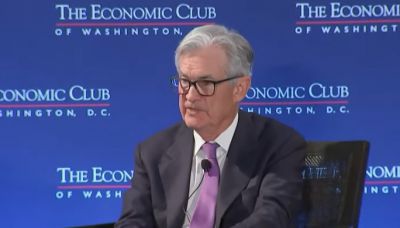
Powell, who burst into a smile as soon as he received the first question, avoided a direct answer but reaffirmed his previous statement that "disinflation has begun." He explained, "It started in the goods sector, which accounts for about a quarter of our economy. It is a very early stage," adding, "Of course, it will take a long time. Therefore, we intend to respond by maintaining interest rates at a restrictive level."
However, Powell warned that this process "will not be smooth" and that there could be pain. Unlike the goods sector, he diagnosed that there are no signs of inflation slowing in the housing and services sectors yet. He reiterated, "Interest rate hikes will continue," emphasizing, "It is necessary to achieve the inflation target of 2% through this."
Regarding the January employment report released after the FOMC, he evaluated, "No one expected it to be this strong." He also emphasized that such strong employment indicators show why a considerable tightening period is necessary to lower inflation. Initially, the market had expectations that the Fed would end the rate hike cycle early right after the February FOMC, but the employment report released on the 3rd, which far exceeded expectations, immediately reversed the mood. The early termination theory lost momentum, and based on these indicators, there is even speculation that the Fed may resume large-scale rate hikes.
When asked whether the market, which had expected rate cuts within the year, was wrong, Powell said, "If the data is strong, we have no choice but to raise rates higher than we predicted." He predicted that 2023 would be a year when inflation significantly eases. Regarding whether unemployment would rise during this process or if there is an unemployment rate criterion that would affect monetary policy changes, he drew a line, saying, "Our goal is to lower inflation, not the labor market."
About the U.S. labor market, he evaluated, "Job demand is really strong," calling it a "state of full employment." When asked whether he would still use the term disinflation even with a strong labor market, he said, "I do. There is no change in that," explaining, "It literally means that inflation is decreasing." Powell assessed, "It is good that inflation is falling without harming the labor market," adding, "The labor market is strong because the economy is strong." Additionally, when asked if he had received employment data in advance, he replied, "Sometimes I do receive it in advance. It is delivered only to me."
That day, Powell repeatedly emphasized the inflation target of 2%. When asked why the target is 2% and not 3%, he dismissed the question, saying, "2% is the global standard," and "There are no plans to change it." Regarding the balance sheet reduction plan, he said, "We have not set a specific target," but added, "It is continuously being reduced. Various approaches are underway." As of the previous day, the balance sheet was confirmed at $8.4 trillion.
As concerns for the future, he again mentioned the collapse of global supply chains and the lack of signs of inflation easing in the housing and services sectors. He emphasized the need to be patient and watch the sectors where disinflation is not progressing. Furthermore, he repeatedly said, "Everything will be responded to based on data," and "It inevitably takes time to lower inflation."
Since Powell's remarks that day were not as hawkish as expected, the market appeared relieved. The New York stock market, which started lower that day, turned to an upward trend after Powell's statement on the 'start of disinflation' was released. Although the gains narrowed somewhat afterward, as of 2:25 p.m., all three major indices were showing an upward trend.
© The Asia Business Daily(www.asiae.co.kr). All rights reserved.

















