Special Self-Governing Province Vision and Four Major Regulatory Innovations Reflect Future Development
Governor Kim Jin-tae Requests Legislative Support for Bill Passage in National Assembly
[Asia Economy Reporter La Young-cheol] Gangwon Province announced on the 7th that "to increase the possibility of the Gangwon Special Act amendment passing the National Assembly plenary session in April, it plans to undergo review by the Administrative Safety Committee in March."
The province intends to include core special cases centered on four major regulations and regional issues in this amendment, while tasks requiring additional review and research will be gradually pursued through subsequent legislation.
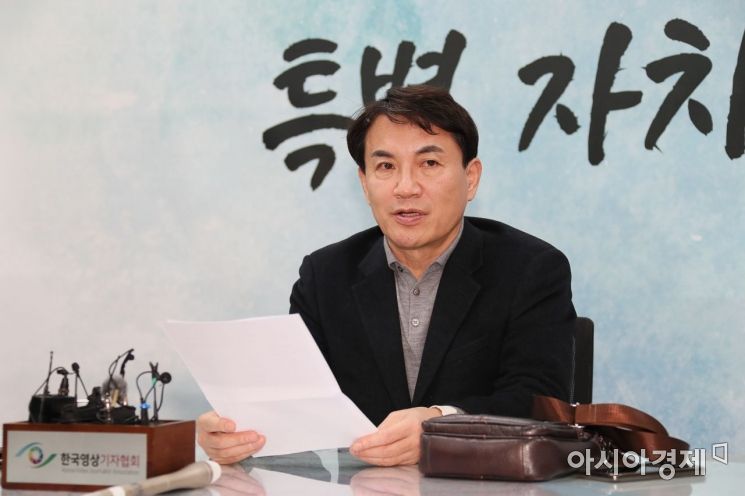 Governor Kim Jin-tae of Gangwon Province held a press conference on the 6th and said, "We ask for continuous interest and support from lawmakers of both parties until the Gangwon Special Act passes the National Assembly."
 [Photo provided by Gangwon Province]
The Gangwon Special Act amendment was jointly proposed on the 6th by Heo Young, a member of the National Assembly from the Democratic Party of Korea (representing Chuncheon, Cheorwon, Hwacheon, and Yanggu-gab). The joint proposal involved bipartisan cooperation mainly among National Assembly members representing Gangwon constituencies.
The amendment includes ▲ the vision for Gangwon Special Autonomous Province ▲ expansion of autonomy in organizational and personnel matters ▲ improvement and delegation of authority regarding the four core regulations (farmland, national defense, forestry, and environment) ▲ customized support for fostering future industries ▲ promotion of sustainable development responding to scientific and technological innovation and climate change ▲ and fostering internationally competitive talent through improvements in the education autonomy system.
Part 1, General Provisions, clearly states that Gangwon Special Autonomous Province is a new driving force and turning point for national development ushering in the era of local autonomy. Part 2 mainly covers special cases related to autonomy in organizational rights and educational autonomy. The responsibility for fiscal soundness reflects Governor Kim Jin-tae’s commitment to a sound fiscal policy from the beginning of his term.
Part 3 focuses on matters related to establishing a comprehensive plan to outline the future industry global city and infrastructure development. It includes special cases for creating advanced science and technology complexes such as the semiconductor industry, rational use and conservation plans for mountainous areas, and special cases for nurturing future industry talent.
Part 4 is filled with special cases concerning domestic duty-free shops, total volume control of domestic casinos in mining-closed areas, military meal supply contracts in border areas, environmental impact assessments, unused military land, deep ocean water, and Gangwon National Cemetery. Parts 5 and 6 consist of supplementary provisions and penalty regulations, respectively.
Governor Kim Jin-tae of Gangwon Province said, "At this critical time for the future of Gangwon Special Autonomous Province, I would like to express my deep gratitude on behalf of the people of Gangwon to Representative Heo Young, who took the lead in proposing the bill, and the National Assembly members who co-sponsored it," adding, "We ask for your passionate interest and support until the bill passes."
© The Asia Business Daily(www.asiae.co.kr). All rights reserved.

















