[Asia Economy Reporter Lee Gwan-joo] Gas and water bill arrears will also be used in the future to identify 'welfare blind spots.' The addresses and contact information of the discovered at-risk households will be linked to strengthen location tracking.
The Ministry of Health and Welfare announced on the 7th the legislative notice of a partial amendment to the Enforcement Decree of the Act on the Use and Provision of Social Security Benefits and the Discovery of Beneficiaries, focusing on these contents. This amendment is a follow-up measure to the government's welfare blind spot discovery and support system improvement plan established following the 'Suwon Three Mothers' case last August, where three women died together due to financial hardship.
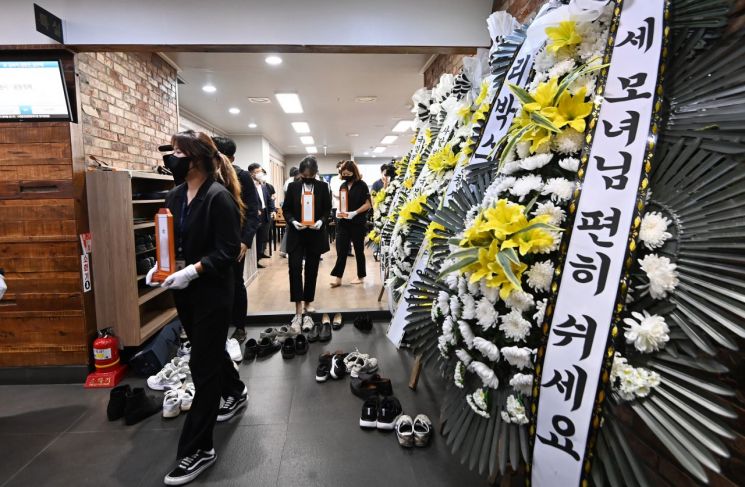 At the funeral ceremony of the 'Suwon Three Mothers,' who were tragically found dead last August, the memorial tablets of the three mothers are being moved. On one side of the funeral hall, wreaths sent by citizens are placed.
 [Image source=Yonhap News]
First, to improve the accuracy of discovering at-risk households, the acquisition of crisis information such as medical and debt information of support recipients will be expanded. Notably, arrears information on water and gas bills will be included among the information that can be processed to identify support recipients. Previously, confirmation was only possible if water and gas services were cut off, but now those who have been in arrears for three months can be targeted. In fact, after the Suwon Three Mothers case, in November last year, a mother and daughter suffering from financial hardship were found dead in Seodaemun-gu, Seoul. Although they were not basic livelihood security recipients, it was confirmed that their city gas bill had been overdue for more than five months, adding to the tragedy. This is interpreted as a measure to resolve such blind spots.
At-risk individuals will also be selected using information such as those with severe diseases (special cases for severe diseases), long-term non-users of medical institutions, and recipients of catastrophic medical expense support. By combining this information, cases where severely ill patients have not used medical institutions for a long time can be identified. The government's plan is to discover health blind spots through this. Financial delinquency information will also be expanded from arrears amounts between 1 million KRW and 10 million KRW in the past two years to between 1 million KRW and 20 million KRW.
Location tracking of suspected at-risk households will also be strengthened. During the annual resident registration fact-finding survey, those whose registered address and actual residence do not match will be actively identified and linked to the discovery system. This was also one of the issues raised during the Suwon Three Mothers case. At that time, the three mothers' registered address was Hwaseong-si, Gyeonggi-do, but their actual residence was Suwon-si. This led to criticism that the crisis discovery was not properly conducted. Additionally, contact information of discovery targets held by telecommunications companies will also be utilized.
Along with this, to prevent child abuse, the amendment allows the acquisition of suspected abuse disease information, including sexually transmitted infections. Previously, information that could be obtained related to at-risk children was limited to injuries and mental illnesses, leaving child sexually transmitted infections suspected of sexual abuse in a blind spot. This has been expanded to 'diseases' to broaden the scope of suspected abuse disease information acquisition.
The legislative notice will proceed until the 21st of next month. The Ministry of Health and Welfare explained, "We aim to expand the acquisition of crisis information such as diseases and debts and strengthen location tracking of suspected at-risk households by newly linking the addresses and contact information of discovered at-risk households. Also, by confirming the status of children with sexually transmitted infections that could not be infected unless through sexual abuse or molestation, we intend to quickly identify abused children and provide necessary measures and services."
© The Asia Business Daily(www.asiae.co.kr). All rights reserved.

















