[Muan=Asia Economy Honam Reporting Headquarters, Reporter Yoon Jamin] Kim Young-rok, Governor of Jeonnam Province, instructed, “Develop sound reasoning and respond so that some processed agricultural and marine products such as kimchi stored in low-temperature storage facilities by farmers and fishermen are included in the list of items eligible for agricultural electricity.”
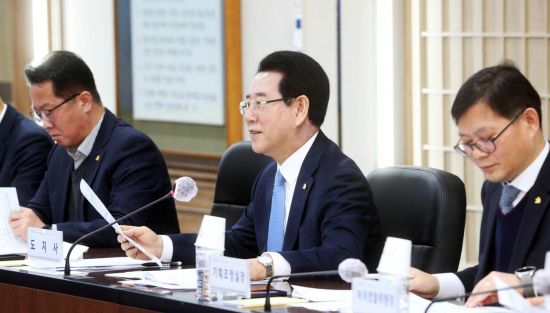
Governor Kim stated at the policy meeting of the relevant departments on the 7th, “Although the gift limit for agricultural and marine products under the Improper Solicitation and Graft Act is 100,000 won, in the past, during holiday periods, it was relaxed to 200,000 won, and some processed foods were also included.”
Agricultural electricity was introduced to support small-scale farmers and fishermen. However, recently, Korea Electric Power Corporation (KEPCO) has detected multiple violations in Gurye, citing that processed foods such as kimchi, tofu, and meju stored in low-temperature storage facilities eligible for agricultural electricity are not subject items, and imposed penalties amounting to about 20 million won, causing backlash.
In response, KEPCO announced that it will establish a fair and rational comprehensive plan regarding the usage standards for agricultural electricity, which is sold at a lower rate than general electricity.
Governor Kim emphasized, “Since KEPCO has stated it will improve the usage standards for agricultural electricity, the relevant departments such as agriculture, marine, and energy industries should collaborate thoroughly to develop preemptive reasoning reflecting the opinions of farmers and fishermen and make proposals.”
He added, “In the case of dried seaweed, traditionally fishermen produced and dried water seaweed, but now only produce it. However, the previous method is recognized, and the seaweed processing plants receive agricultural electricity by arguing that it should be recognized as marine products, not processed products. Also, during the holiday period, there was a case where processed products using more than 50% raw agricultural and marine products were included in the relaxation of the Improper Solicitation and Graft Act for agricultural and marine products.”
Furthermore, he requested, “Although some processed agricultural and marine products, including kimchi, which recently caused issues in Gurye, can generally be classified as processed products, please handle the situation on-site so that they are classified as agricultural and marine products in accordance with public sentiment, considering the cases during the relaxation of the Improper Solicitation and Graft Act.”
He also emphasized the province’s active efforts to propose measures regarding the post-utilization of the Yeosu World Expo site.
Governor Kim said, “The Expo site, which had no utilization plan for over ten years, now has conditions for public development following the amendment of the ‘Special Act on Management and Post-Utilization of the Yeosu World Expo’ in October last year. The province should actively participate in the development plan to ensure early promotion and that regional opinions, such as the construction of an international convention center, are reflected.”
Regarding forest fires, he stated, “Even small forest fires can spread into large-scale fires at any time, so do not respond based only on the damage area at the time of occurrence. Instead, carefully assess whether the risk is high in advance and ensure sufficient and practical measures are implemented.”
He added, “For Jeonnam to leap forward as a global vaccine industry hub, the ‘Global Bio Campus’ must be attracted to the vaccine industry special zone. Let us proactively propose this before the government ministries announce their plans.”
© The Asia Business Daily(www.asiae.co.kr). All rights reserved.

















