Acorns Collected as Food by a Woodpecker
Acorns gathered by a woodpecker were found in large quantities inside the wall of a house in the United States.
On the 6th (local time), according to foreign media including ABC News, Nick Castro, who runs a pest control company, recently discovered over 317 kg of acorns inside the wall of a house in California, USA.
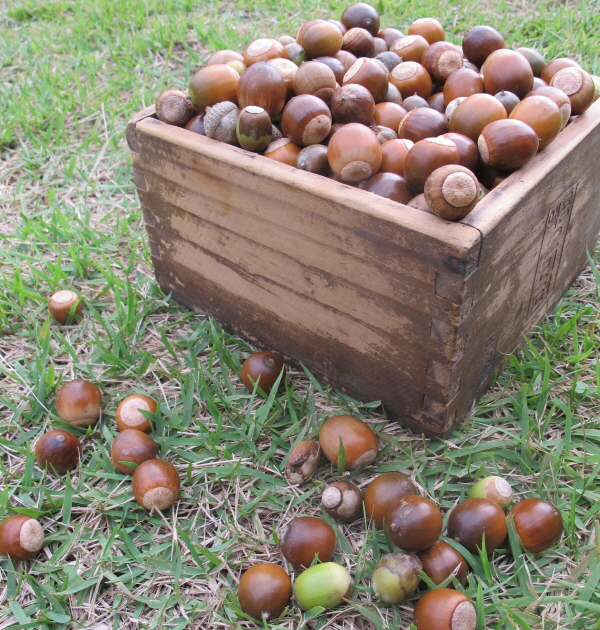
Nick visited the house after receiving a request that "a woodpecker had made holes all over the exterior walls of the house" and witnessed this scene.
He made a small hole in the wall to check for pests, and a large amount of acorns continuously poured out from there.
To see the situation behind the wall in more detail, Nick made a bigger hole in the wall. The acorns he took out were enough to cover the entire floor of the room.
Nick shared this story on Facebook, writing, "The amount of acorns gathered by the woodpecker was enough to fill eight garbage bags. I have never seen such an unreal amount of acorns before."
In response to this post, netizens commented, "The woodpecker went bankrupt in an instant," "It must feel like a millionaire suddenly losing all their money," and "If the acorns had been left inside the wall, they would have made good insulation."
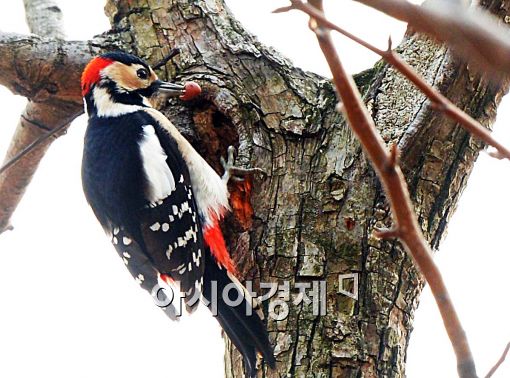 Woodpecker. The photo is not related to the specific content of the article. [Photo by Asia Economy]
Meanwhile, it is not uncommon for woodpeckers to make holes in exterior walls made of concrete and other materials. In 1995, a woodpecker even made holes in a spacecraft fuel tank, delaying its launch.
At that time, the Kennedy Space Center in southern Florida was conducting inspections before a spacecraft launch when they discovered about 200 large and small holes in the insulation of the fuel tank. A pair of woodpeckers had pecked at the foam insulation, which had hardened, considering it suitable for nesting.
In response, NASA installed owl models and balloons, natural predators of woodpeckers, around the space center and stationed guards at the launch pad 24 hours a day.
They also increased bird detection radar and remotely controlled noise cannons around the runway, and refrained from cutting the grass around the launch site so that ants and insects, which are food for birds, would not be visible to the birds. Due to all these measures, the spacecraft originally scheduled for launch in May was only able to launch again in July.
© The Asia Business Daily(www.asiae.co.kr). All rights reserved.

















