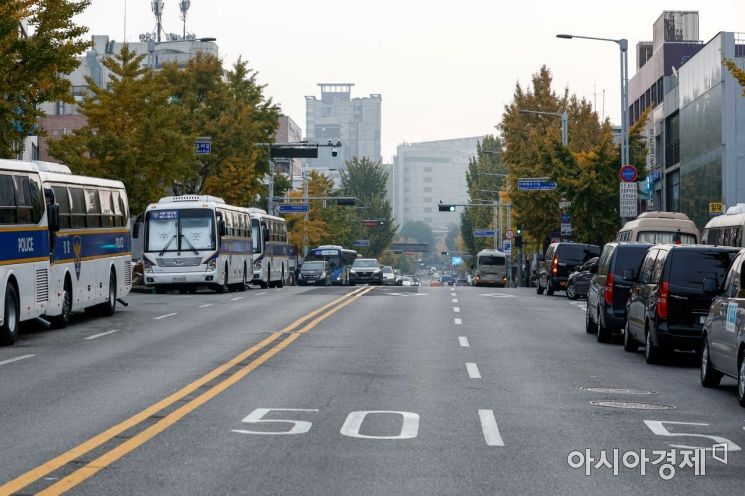
[Asia Economy Reporter Seongpil Jo] Starting as early as the second half of the year, the police are expected to be able to ban assemblies and demonstrations on 'Itaewon-ro' in front of the Presidential Office.
According to the police on the 7th, the National Police Commission (Police Commission) held a plenary meeting the day before and approved a revision of the Enforcement Decree of the Assembly and Demonstration Act (Assembly Act) with such content. The revised enforcement decree, which passed the Police Commission, added 11 roads including Itaewon-ro near the Yongsan Presidential Office to the 'major roads' defined in Article 12 of the Assembly Act. Article 12 of the current Assembly Act stipulates that assemblies can be prohibited or restricted on 'major roads' in major cities designated by Presidential Decree for traffic flow reasons.
Once the revision is implemented, assemblies and demonstrations on Itaewon-ro, which experiences heavy traffic on weekends and during commuting hours, are expected to be virtually completely banned. Itaewon-ro is a 3.1 km road connecting Samgakji Station, Noksapyeong Station, Itaewon Station, and Hangangjin Station on the subway. It is also the route used to travel to and from President Yoon Seok-yeol’s residence and the Presidential Office. The revision excludes 12 existing roads where assemblies and demonstrations have not been held in the past five years or where traffic has improved compared to before.
The revision also strengthens noise control standards for assemblies and demonstrations near residential areas, schools, general hospitals, and public libraries. The current Enforcement Decree of the Assembly Act allows sanctions if assemblies or demonstrations held in such areas exceed the maximum noise standard more than three times in one hour or if the noise measured over 10 minutes exceeds the average noise standard. In contrast, the revision reduces the number of maximum noise standard violations to two or more times within one hour and shortens the average noise measurement time to 5 minutes. The strictest maximum noise standards near residential areas are 85 dB during the day, 80 dB at night, and 75 dB during late night (midnight to 7 a.m.). The average noise standards are 65 dB during the day, 60 dB at night, and 55 dB during late night.
The revision is scheduled to be implemented in the second half of this year after legislative notice, review by the Prime Minister’s Regulatory Reform Committee, examination by the Ministry of Government Legislation, and deliberation by the Cabinet.
© The Asia Business Daily(www.asiae.co.kr). All rights reserved.
![Clutching a Stolen Dior Bag, Saying "I Hate Being Poor but Real"... The Grotesque Con of a "Human Knockoff" [Slate]](https://cwcontent.asiae.co.kr/asiaresize/183/2026021902243444107_1771435474.jpg)
















