'Adjacent to Disaster Site', 'Daylighting up to Basement Level 4 with Hollow Cylindrical Design' Advantages
'Surrounded on All Sides Limitation', 'Close to Ticket Gates and Platforms, Lacking Solemnity' Disadvantages
[Asia Economy Reporter Choi Taewon] Basement level 4 of Noksapyeong Station. In September 2017, the Seoul Metropolitan Government and Seoul Metro launched the 'Seoul is a Museum Project,' remodeling public spaces so that citizens can experience art in their daily lives. Noksapyeong Station was selected as one of the sites and was reborn as the 'Underground Art Garden,' attracting public interest. However, this time, Noksapyeong Station is in the spotlight due to an unexpected issue regarding a memorial altar. The bereaved families and the Seoul city government have been in conflict for four days over the location of the memorial altar for the Itaewon tragedy victims, as the city proposed the basement level 4 of Noksapyeong Station as the site for the altar. The reporter visited the site and gathered opinions from citizens.
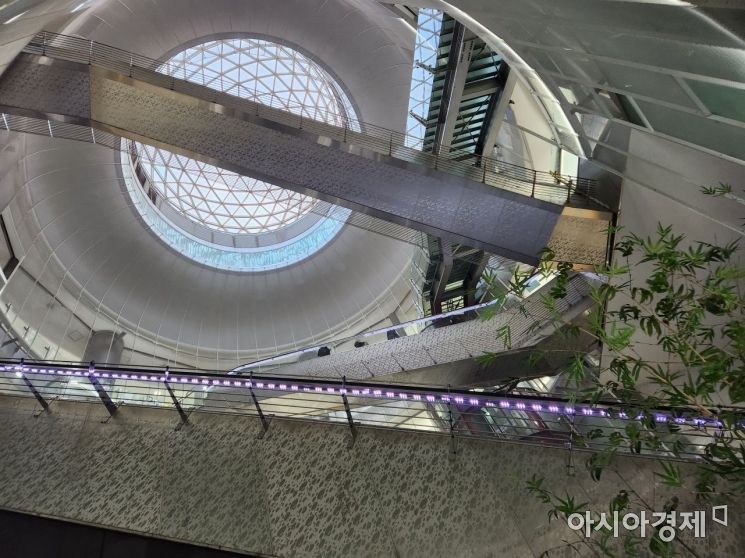 At around 8 a.m. on the 7th, the ceiling viewed from the 4th basement floor of Noksapyeong Station. Natural light is coming through the transparent ceiling. Photo by Taewon Choi skking@
At around 7:30 a.m. on the 7th, the basement level 4 of Noksapyeong Station felt quite different from a typical underground space. Thanks to its empty cylindrical design, natural light coming through the transparent ceiling reached down to the fourth basement level. The 'Garden of Time,' created by utilizing natural light at Noksapyeong Station, was an element that made it hard to believe it was underground. Through the transparent ceiling, tree branches cast shadows alongside clouds. Although the weather was chilly, close to 0 degrees Celsius, the indoor environment prevented any feeling of cold. It was also a 10-minute walk, about 700 meters away, from the site of the tragedy.
However, the enclosed space gave a somewhat stifling feeling that could not be completely erased. Its proximity to the ticket gates was both an advantage and a disadvantage. While it was easily visible to passing passengers, the sounds of ticket scanning and subway trains were frequently heard, making it difficult to maintain a solemn atmosphere.
Opinions among citizens passing through Noksapyeong Station about the location of the memorial altar were divided. Some citizens were favorable toward installing the altar at Noksapyeong Station, citing good installation conditions and its proximity to the site of the tragedy. Kim (48), who was heading toward the ticket gate, said, “The lighting is good, and it’s easily visible to people passing by, so it seems like a good place to set up the memorial altar. Above all, it is adjacent to Itaewon, where the tragedy occurred.” Another office worker, Kim (31), said, “Considering symbolism and accessibility, this place (Noksapyeong Station) seems good. Rather, if the altar is set up in politically interpretable places like Seoul Plaza, it might dilute the essence of mourning.”
Since the opinions of the bereaved families, who are the direct victims of the sorrow, are important, there were also skeptical views about installing the altar at Noksapyeong Station. Im (55) said, “I don’t think the location is inappropriate for installation,” but added, “However, if the families do not want it, it is right to install the altar where they desire.” Nearby resident Jeong (66) also supported this, saying, “The most important thing is where the families want it. Even if it is in front of the Presidential Office, if the families want it, it should be allowed.”
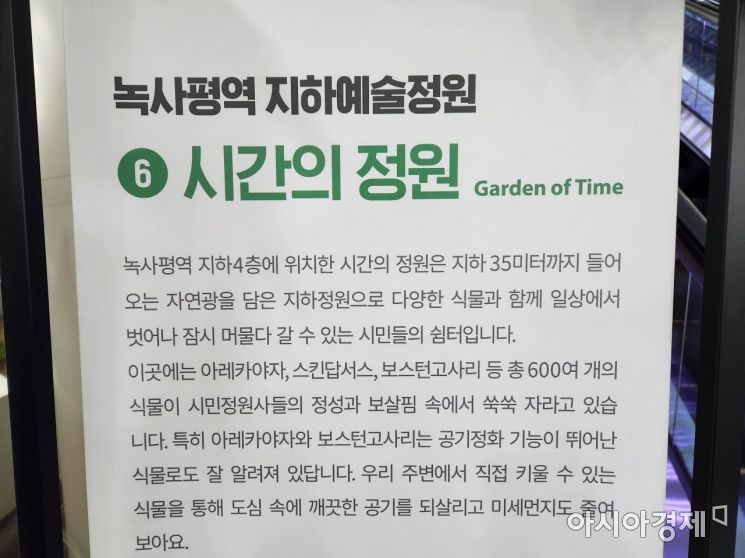 'Garden of Time' information sign installed on the 4th basement floor of Noksapyeong Station / Photo by Tae-won Choi skking@
Meanwhile, according to the Seoul city government and others, the city plans to classify the memorial altar hastily installed at Seoul Plaza in Jung-gu as an illegal facility and respond according to regulations. Earlier, on the 4th, the Itaewon Tragedy Bereaved Families Association and the Citizens’ Countermeasure Committee suddenly installed a memorial altar in front of Seoul Library in Jung-gu, Seoul. The city delivered warning notices twice, on the day of and the day before the altar’s sudden installation, to the Citizens’ Countermeasure Committee, stating that if the altar was not voluntarily removed, administrative enforcement would be carried out. The city’s position is that instead of the citizens’ memorial altar at Seoul Plaza, a condolence space should be created at basement level 4 of Noksapyeong Station near Itaewon, where the tragedy occurred.
On the other hand, the bereaved families argue that an underground location is morally inappropriate as a place for the victims who were crushed to death and that it seems like an attempt to isolate the victims from the citizens. They demand that the memorial altar be installed at Seoul Plaza or other locations. Lee Jongcheol, representative of the Bereaved Families Association, said at a press conference the day before, “Our children died unable to breathe in a cramped space. Are you saying they should die unable to breathe deep underground?” He added, “What we are demanding is a natural right and duty as citizens.”
© The Asia Business Daily(www.asiae.co.kr). All rights reserved.


















