"Not a Situation to Worry About Interest Rate Gap Between Korea and the U.S."
Special Meeting of the American Chamber of Commerce in Korea
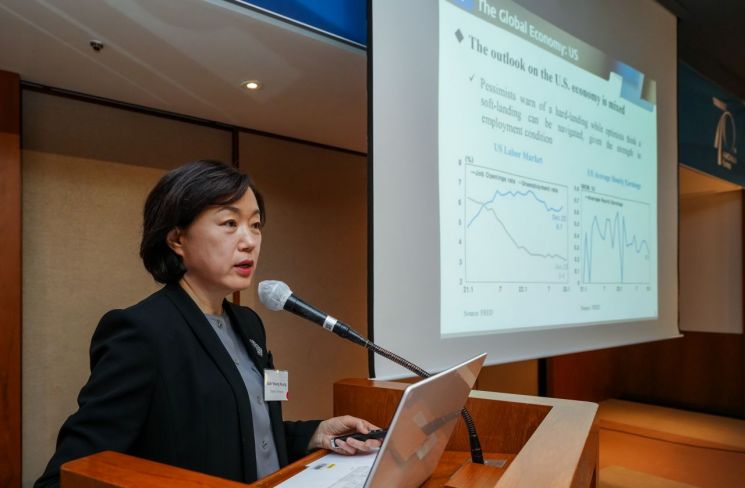
[Asia Economy Reporter Seo So-jeong] "South Korea's monetary policy is already tight, and this situation will continue for a considerable period."
Seo Young-kyung, a member of the Financial Monetary Policy Committee of the Bank of Korea, stated this on the 7th at a special meeting held by the American Chamber of Commerce in Korea (AMCHAM) at the Grand Hyatt Seoul Hotel regarding the future of South Korea's monetary policy, saying, "South Korea's monetary policy is already in a tight situation."
Seo said, "The current base interest rate in South Korea is 3.5%, which has already exceeded the neutral interest rate range," adding, "Maintaining this interest rate level is also considered somewhat tight." Since upward inflationary pressures remain significant, it is interpreted that the tightening stance will continue for the time being, maintaining the current level above the neutral rate rather than raising rates further.
Seo said, "The Bank of Korea will maintain a tightening stance for a considerable period," and added, "Although the consumer price inflation forecast for this year is about 3.6%, indicating a decline in inflation, there are still considerable upside risks to inflation."
However, Seo maintained the view that a pivot (policy change) to cut rates within the year is premature. He said, "The increase in gas and electricity prices is higher than last year, and secondary ripple effects are also a concern," adding, "Upward inflation risks are quite high due to factors such as the rise in international oil prices following China's reopening (resumption of economic activities)."
Seo emphasized, "We have no choice but to continue the tightening stance for a considerable period," and said, "Whether to freeze or raise rates at this month's Monetary Policy Committee meeting will be decided with other committee members, but South Korea's monetary policy is already tight, and this situation will continue for a considerable period."
Regarding concerns about capital outflows as the interest rate gap between South Korea and the U.S. widens to 1.25 percentage points, Seo said, "Although the U.S. Federal Reserve (Fed) is likely to raise policy rates a couple more times, which could further widen the current 1.25 percentage point interest rate gap between South Korea and the U.S., it is not a situation to be greatly concerned about."
He explained, "There are concerns that a widening interest rate gap between South Korea and the U.S. could lead to foreign capital outflows and a depreciation of the Korean won due to differences in inflation situations between the two countries," but added, "However, 60-70% of Korean bond investments are by long-term investors who invest based on fundamentals, so they are not sensitive to domestic and foreign interest rate differences."
He predicted, "Even if the interest rate gap between South Korea and the U.S. widens beyond 1.25 percentage points in the future, it is expected not to be sensitive," and judged, "Pressure on the exchange rate will not lead to currency depreciation unless inflation rises further or inflation expectations in South Korea are more severe than in the U.S."
Seo added, "The rapid depreciation of the currency (rise in the won-dollar exchange rate) experienced from August to October last year was partly due to expectations that South Korea's monetary policy would turn accommodative, but if inflation expectations are managed, cases of currency depreciation will not occur."
Regarding the South Korean economy this year, he diagnosed, "Exports are sharply decreasing, and the recovery trend in consumption is weakening, causing domestic economic growth to slow." Seo said, "The global economy will continue to face difficulties this year with persistent inflation and a decline in growth rates compared to the previous year," but added, "However, conditions have somewhat improved recently due to the slowdown in tightening by major countries, easing of the European energy crisis, and recovery of the Chinese economy."
Regarding the South Korean government's long-term challenges, Seo said, "The global economy is rapidly transitioning to an eco-friendly economy, so it is necessary to actively respond to the global business environment," and added, "The widening differences in growth rates by sector after COVID-19 is also an important implication." He explained that worsening income inequality negatively affects stable growth.
Furthermore, he said, "The biggest structural problem facing the South Korean economy is demographic change," and added, "The dependency ratio of the elderly population on the younger generation is higher in South Korea than in other advanced countries." He continued, "Although global growth is expected to bottom out and inflation to decrease this year, uncertainty remains high," and added, "We must actively prepare for both upside and downside risks."
© The Asia Business Daily(www.asiae.co.kr). All rights reserved.
!["The Woman Who Threw Herself into the Water Clutching a Stolen Dior Bag"...A Grotesque Success Story That Shakes the Korean Psyche [Slate]](https://cwcontent.asiae.co.kr/asiaresize/183/2026021902243444107_1771435474.jpg)
















