Twitter, Losing 5 Billion Won Daily,
Undergoes Massive Restructuring After Acquisition
Musk: "Heading Towards Break-Even Point"
"There are still challenges remaining on Twitter, but we are now heading toward breakeven."
These were the words Elon Musk, Tesla CEO, posted on his Twitter account on the 6th (local time). Last year, he claimed that Twitter was losing "$4 million (about 5 billion KRW) per day." If Twitter has reached breakeven, it means it has saved expenditures amounting to 1.8 trillion KRW annually.
So, how close is Musk's 'breakeven' declaration to reality? Is there really a way to fill Twitter's 'deficit hole'?
A company losing '5 billion KRW' every 24 hours
Twitter, acquired by Musk for about $44 billion last year, is now a private company rather than a publicly listed one. Therefore, it does not publish quarterly earnings reports. The only information available to gauge Twitter's current financial status is the Q2 2022 (April-June) report.
Looking at the Q2 financials, Twitter's operating losses are enormous. From April to June, it recorded revenue of $1.1766 billion (about 1.47 trillion KRW), but the pre-tax operating loss reached $343.76 million (about 431.9 billion KRW). Musk pointed out last year that Twitter was "losing $4 million per day" in operating terms. Accumulated over three months, $4 million per day amounts to $360 million. Musk's statement at the time aligns with the facts.
After acquisition, Musk started with mass layoffs
Musk claims to have alleviated Twitter's deficit problem within just a few months. Is that really possible? First, Musk carried out massive staff cuts in October last year. About 50% of all employees were laid off, and an additional 1,000 reportedly resigned. According to the tech media 'The Verge' in November last year, Twitter's workforce shrank from 7,500 to 2,700 employees?a 64% reduction.
Looking again at Twitter's quarterly report, expenses that worsen operating profit are divided into four categories: cost of revenue, research and development (R&D), sales and marketing, and corporate administrative costs. Among these, administrative costs generally refer to expenses related to employing workers. Assuming administrative costs decreased by 64% through restructuring, they would have dropped from $216.58 million (about 272.1 billion KRW) to $77.97 million (about 97.9 billion KRW). This means a saving of $138 million (about 173.3 billion KRW).
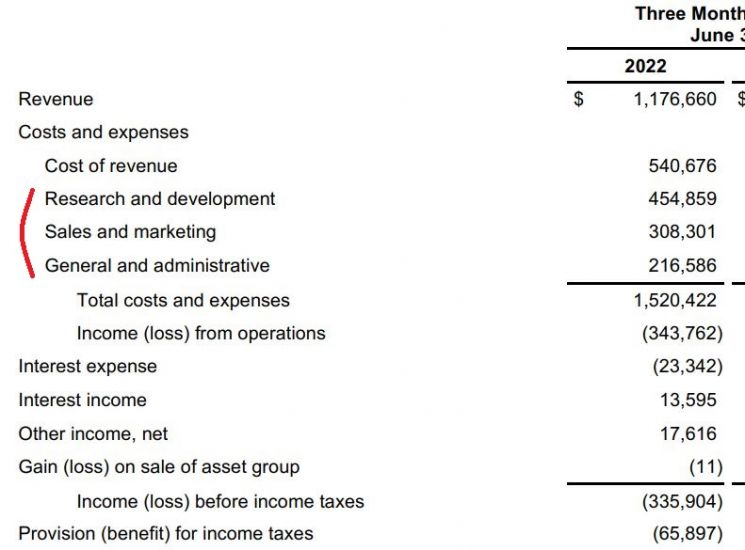 Excluding the cost of revenue involved in service sales, Twitter's losses mainly stem from three areas: high research and development expenses, advertising costs, and operating expenses. /
 [Photo by Twitter 2022 Q2 Quarterly Report]
However, it is unclear whether the deficit was successfully reduced through mass layoffs. After Musk acquired Twitter, many advertisers severed contracts with the platform. Twitter is an advertising-centric social networking service (SNS) company, with advertising accounting for nearly 90% of total revenue. Even if advertising revenue dropped by only 10% after Musk's acquisition, operating losses would return to their original level.
The cause of Twitter's deficit: an excessively large R&D proportion
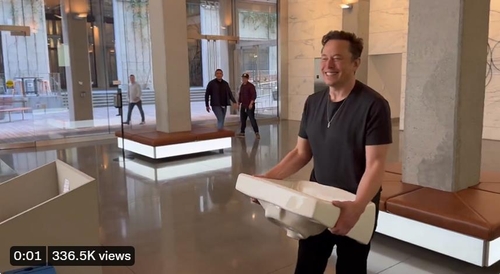 Last year, CEO Musk was seen carrying a washbasin when visiting Twitter's U.S. headquarters. Since then, CEO Musk has laid off several departments responsible for marketing, engineering, and ethical artificial intelligence. / Photo by Yonhap News
If Musk truly solved Twitter's chronic deficit problem, the core cost reductions would have occurred not through mass layoffs but in other areas?specifically marketing and R&D. R&D, in particular, accounts for nearly half of Twitter's quarterly expenditures.
In fact, Twitter has had a high R&D proportion since its founder Jack Dorsey served as CEO. Essential recommendation algorithms and the latest optimization technologies for SNS companies, as well as experimental new service development, were likely conducted within the R&D department.
However, at some point, Twitter's R&D proportion far exceeded the typical level of IT companies, impacting the company's financial structure. Most of the so-called U.S. 'big tech' companies like Amazon, Google, and Microsoft spend about 10-15% of their revenue on R&D. In contrast, Twitter's R&D budget surpassed 25% of revenue as early as 2013 and now approaches 38%. At that time, economic media such as 'Fortune' evaluated that "Twitter is taking risks for rapid growth."
Former founder Dorsey attributed Twitter's spending structure problem to his "premature growth ambition." In November last year, when Musk announced mass layoffs, Dorsey apologized, saying, "I apologize to everyone for the current situation. I grew the company too quickly," and added, "I don't know if (employees) will forgive me now or later, but I understand."
'Frugal' Musk's expertise to shine?
Ultimately, Twitter's success or failure depends on Musk's strength as a manager in 'cost efficiency.' Tesla, the electric vehicle company Musk led to success, also survived liquidity crises by ruthless restructuring and is now famous for its meticulous management with no wasted money even as a large corporation.
For example, Tesla has no internal advertising or public relations department. Its own advertising budget for car sales is effectively zero. Instead, Tesla focuses all expenditures on factory investments, giga batteries, production efficiency, and design to enhance customer satisfaction. Musk's immediate push for mass layoffs after acquiring Twitter appears to be groundwork to make Twitter a 'leak-free' company like Tesla. However, whether Musk's drastic measures will be effective for Twitter, an SNS company rather than a manufacturer, remains uncertain.
© The Asia Business Daily(www.asiae.co.kr). All rights reserved.



















