Civil War Continues Since 2014... No Relief Capacity
Fuel and Electricity Supply Also Hampered by Government Bankruptcy and Currency Collapse
[Asia Economy Reporter Hyunwoo Lee] As a massive earthquake struck the border region between Turkey and Syria, the death toll in both countries is reported to be approaching 4,000, raising concerns in the international community. In particular, Syria, which has been embroiled in a prolonged civil war since 2014, is facing economic difficulties including government bankruptcy and currency collapse, resulting in inadequate supply of fuel, electricity, and daily necessities.
According to the Associated Press (AP) on the 6th (local time), a magnitude 7.8 earthquake that occurred in the early morning in the southeastern Turkish city of Gaziantep has so far claimed 2,379 lives in Turkey, and 1,444 deaths have been reported in Syria. Many residents who were asleep during the surprise quake around 4 a.m. were unable to evacuate in time and were buried under building debris, causing a high number of casualties. The death toll is expected to continue rising.
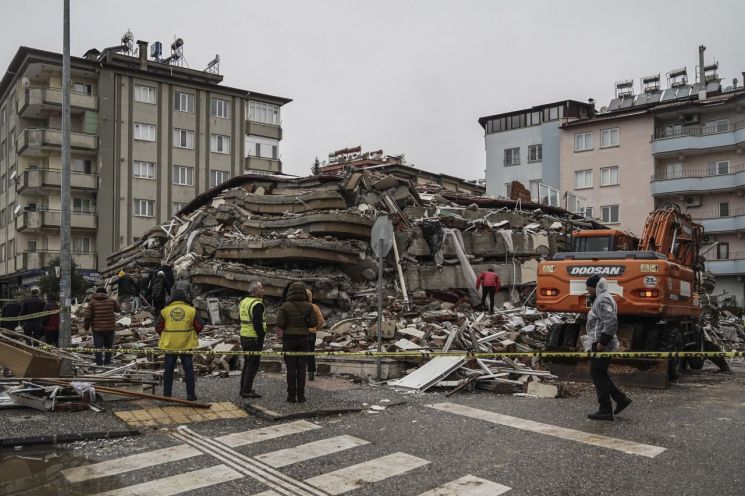
Especially in Syria, where infrastructure has already been severely damaged due to the long civil war, more residents are expected to be victims. According to The New York Times (NYT), the main affected area in northwestern Syria is a region where 4.6 million refugees had gathered to escape the prolonged civil war centered in southern Syria since 2014. Among them, over 2.7 million people were living in shelters, all of which were lost due to the earthquake.
Under the prolonged civil war and Western sanctions, Syria’s gross domestic product (GDP) has already fallen to less than half of its 2010 level, and the government’s finances have collapsed, making it difficult to supply basic infrastructure such as fuel, food, and electricity, NYT pointed out. In some areas, electricity supply lasts less than an hour a day, leading to an increase in deaths from cold during winter.
The poor condition of buildings due to the war and the absence of earthquake-resistant structures?since no earthquake had occurred for over 200 years?were also cited as reasons for the high number of casualties. Kishore Zaiswal, a structural engineer at the U.S. Geological Survey (USGS), explained, “The upper floors of buildings collapsed onto the lower floors like pancakes, stacking layer upon layer,” adding, “This is evidence that the buildings absorbed no shock at all.”
© The Asia Business Daily(www.asiae.co.kr). All rights reserved.
![Clutching a Stolen Dior Bag, Saying "I Hate Being Poor but Real"... The Grotesque Con of a "Human Knockoff" [Slate]](https://cwcontent.asiae.co.kr/asiaresize/183/2026021902243444107_1771435474.jpg)
















