Research Team at Bundang Seoul National University Hospital Develops
Simple and Cost-Effective Test
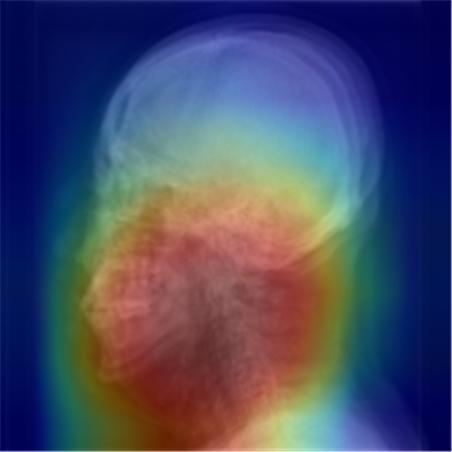 An example of diagnosing sleep apnea using head and neck X-ray images. The location of anomalies (in red) can be seen in the image where the deep learning algorithm classifies the presence of sleep apnea.
 [Photo by Bundang Seoul National University Hospital]
[Asia Economy Reporter Lee Gwan-joo] A research team led by Neurosurgery Professors Jeong Han-gil and Kim Taek-gyun, and Neurology Professor Yoon Chang-ho at Bundang Seoul National University Hospital announced on the 7th that they have developed an artificial intelligence (AI) model that diagnoses sleep apnea by analyzing head and neck X-ray images.
Sleep apnea refers to a condition where breathing temporarily stops or decreases during sleep. If this condition persists, it lowers sleep quality, causing chronic fatigue and drowsiness that affect daily life, and if left untreated for a long time, it significantly increases the risk of cardiovascular and cerebrovascular diseases such as hypertension, myocardial infarction, and stroke.
When sleep apnea is suspected, a screening test is conducted, and based on the results, the standard diagnostic method, polysomnography, is performed. Although various screening tests have been developed so far, they have limitations such as low accuracy and are not recommended in environments where multiple people live together.
The research team developed a deep learning-based AI model using head and neck X-ray image data from 5,591 sleep apnea patients who visited Bundang Seoul National University Hospital. The accuracy of this model was excellent, with an AUROC score of 0.82. AUROC is an indicator used to evaluate the performance of AI models, with values closer to 1 indicating better performance. Notably, this model can distinguish subtle differences that are not visible to the naked eye, focusing on the tongue and surrounding structures, which are highly related to sleep apnea.
 Professors Jeong Hangil, Kim Taekgyun, and Yoon Changho at Bundang Seoul National University Hospital (from left).
Head and neck X-ray imaging has the advantages of being relatively simple in procedure and low in cost, so utilizing the AI model is expected to contribute to improving the diagnosis and treatment rates of sleep apnea, where early treatment is crucial. Professor Yoon Chang-ho said, "The global prevalence of sleep apnea is estimated to be about 1 billion adults aged 30 to 69, and this number continues to increase." He added, "If sleep apnea is detected early and treatment is started, further symptom deterioration can be prevented, and quality of life can also be improved."
This study, supported by the Medical Artificial Intelligence Center at Bundang Seoul National University Hospital, was conducted as a collaborative research with Professor Lee Seung-hoon of the Department of Otorhinolaryngology at Korea University Ansan Hospital and Professor Robert Thomas of Harvard Medical School, and the research results were published in the Journal of Clinical Sleep Medicine.
© The Asia Business Daily(www.asiae.co.kr). All rights reserved.
!["The Woman Who Threw Herself into the Water Clutching a Stolen Dior Bag"...A Grotesque Success Story That Shakes the Korean Psyche [Slate]](https://cwcontent.asiae.co.kr/asiaresize/183/2026021902243444107_1771435474.jpg)

















