[Asia Economy Sejong=Reporter Dongwoo Lee] As the government proposes expanding support up to the middle class as a follow-up measure to the 'heating cost crisis,' the Ministry of Economy and Finance, responsible for fiscal policy, is facing deep concerns. The Ministry of Economy and Finance holds the position that since support has already been strengthened for basic livelihood security recipients and the lower-income bracket, expanding the target group would impose an unbearable fiscal burden. While the political sphere is pushing for the formation of a supplementary budget (supplementary budget) for heating cost support, experts warn that inflationary pressures caused by the supplementary budget could prolong.
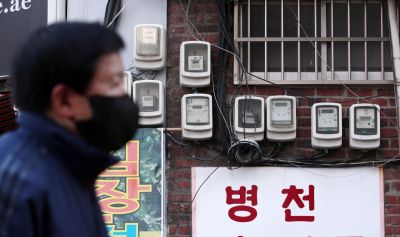 An electric meter of a multi-family house in Seoul on the 30th, as the government is scheduled to announce the electricity and gas rate adjustment plan to be applied in the first quarter of next year. The Ministry of Trade, Industry and Energy will announce the electricity and gas rate adjustment plan for the first quarter of next year on this day. Photo by Kim Hyun-min kimhyun81@
According to the government and related ministries on the 7th, the ruling party People Power Party, the Ministry of Economy and Finance, and the Ministry of Trade, Industry and Energy are discussing whether to provide heating cost support to the middle class. They plan to finalize the details by the end of this month when the January heating bills are distributed in earnest to each household. Earlier, the government doubled the energy voucher support amount for 1.18 million vulnerable households affected by the unexpected heating cost surge. This involved urgently injecting a general reserve fund of about 100 billion KRW in addition to the existing budget of 80 billion KRW. At the beginning of this month, additional measures were announced to provide 592,000 KRW each to basic livelihood security recipients and the lower-income bracket, focusing on minimizing the burden on low-income households.
The background for the Yoon Seok-yeol administration's plan to expand heating cost support to the middle class is the concern that the January bills distributed this month will mark the peak of the heating cost crisis. According to the National Statistical Portal (KOSIS) of Statistics Korea, fuel prices such as electricity and gas soared by 31.7% year-on-year in December. During the same period, city gas prices rose by 36.2%, and electricity rates increased by 29.5%, marking the highest increase in 24 years and 9 months since April 1998 (38.2%) during the foreign exchange crisis. As nationwide dissatisfaction spread due to the sharp rise in heating costs, the plan is to minimize the shock of fees by expanding the support scope to the middle class.
Middle-Class Heating Cost Support, Trillions Expected; Supplementary Budget May Cause Inflation and Fiscal Deterioration
The problem lies in the cost required to support the middle class. Recently, about 300 billion KRW was spent to support approximately 2 million vulnerable households, and if the support scope is expanded to the middle class, the estimated budget is expected to reach trillions of KRW. According to the Korea Development Institute (KDI), the middle class accounted for 61.1% as of 2021, based on disposable income between 50% and 150% of the median income. In other words, 6 out of 10 households would qualify for heating cost support. This makes it impossible to cover the support funds with the existing budget and reserve funds alone. The opposition party, the Democratic Party of Korea, mentioned a supplementary budget of 7.2 trillion KRW for energy price support, reflecting the judgment that the allocated government budget alone cannot handle this.
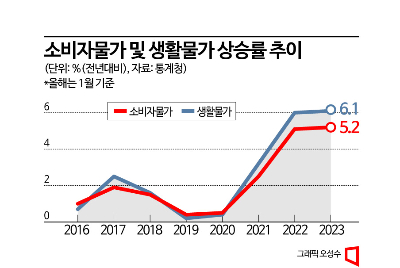
For this reason, even within the ruling party, there are demands for supplementary budget formation, but the Ministry of Economy and Finance remains negative about the supplementary budget, citing fiscal soundness. The biggest problem with the supplementary budget is that if a large amount of money is released, the consumer price inflation rate could further increase. The Ministry of Economy and Finance holds the position that since the consumer price inflation rate recorded a high level in the 5% range last month, fiscal support should be restrained and fiscal soundness strengthened. Deputy Prime Minister and Minister of Economy and Finance Choo Kyung-ho also repeatedly stated earlier this year that he would not consider forming a supplementary budget, judging that the national debt situation, which has increased to over 1,000 trillion KRW, is serious.
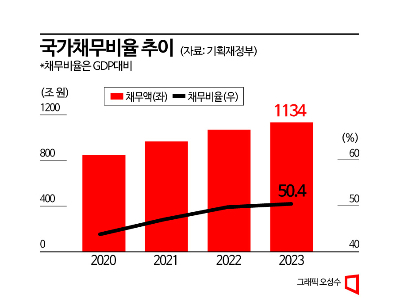
According to the Ministry of Economy and Finance, as of the end of April last year, the central government's national debt balance exceeded 1,000 trillion KRW for the first time in history. Considering the 62 trillion KRW second supplementary budget for small business COVID-19 loss compensation at that time, the year-end national debt was 1,068.8 trillion KRW, and the national debt-to-GDP ratio reached 49.7%. The forecast for this year's national debt ratio is 50.4%, and the Ministry of Economy and Finance's position is that national fiscal management must be prioritized immediately.
Experts Urge Restraint on COVID-19-Induced Supplementary Budgets: "Selective Support is Best"
Even within the Ministry of Economy and Finance, the possibility of a supplementary budget for heating cost support is considered slim. This is because supplementary budgets should be limited to situations requiring revisions to existing budgets due to disasters such as war or large-scale unemployment. Some criticize that the perception of supplementary budgets has become widespread since the COVID-19 crisis. Even considering the COVID-19 situation, the Moon Jae-in administration formed supplementary budgets 10 times totaling 150 trillion KRW, which has been criticized as excessive. Deputy Prime Minister Choo also emphasized at a press briefing last month, "The ink on the budget plan is not even dry," and said, "Talking about a supplementary budget in January is not appropriate."
Experts also expressed concerns about inflation and fiscal deterioration related to middle-class heating cost support. Professor Kang Sung-jin of Korea University’s Department of Economics said, "Rather than deciding on a supplementary budget for heating cost support, freezing gas prices or selective support for low-income households would be more effective," adding, "The biggest problem with supplementary budgets is that they lead to price increases, which could further burden low-income households. We should proceed in a way that does not increase liquidity." Professor Yang Jun-mo of Yonsei University’s Department of Economics also warned, "Supporting the middle class itself is controversial, but if supplementary budgets increase national bond issuance, interest rates and inflation will rise, worsening the pain for low-income households," adding, "Ultimately, the impact could spread to the stock and real estate markets."
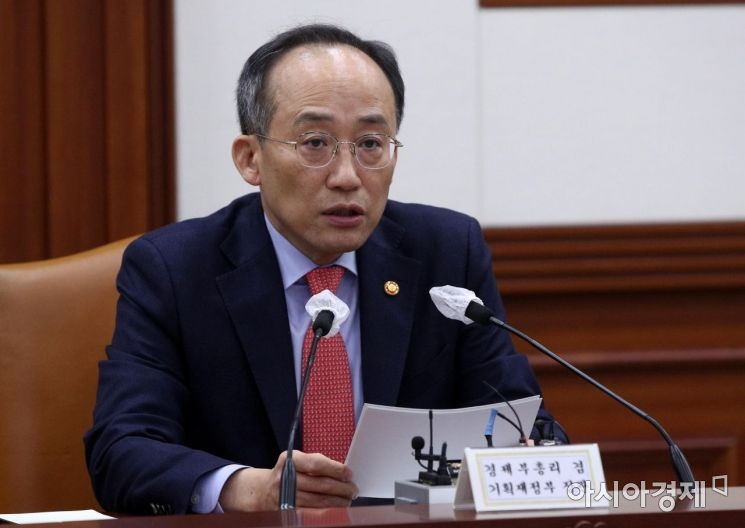 Deputy Prime Minister and Minister of Economy and Finance Choo Kyung-ho is presiding over the Emergency Economic Ministers' Meeting held at the Government Seoul Office in Jongno-gu, Seoul on the 3rd. Photo by Hyunmin Kim kimhyun81@
© The Asia Business Daily(www.asiae.co.kr). All rights reserved.

![Clutching a Stolen Dior Bag, Saying "I Hate Being Poor but Real"... The Grotesque Con of a "Human Knockoff" [Slate]](https://cwcontent.asiae.co.kr/asiaresize/183/2026021902243444107_1771435474.jpg)

















