Most Amendments by Country: Canada and Japan
Revising Standards for Residual Pesticides and Caffeine Content
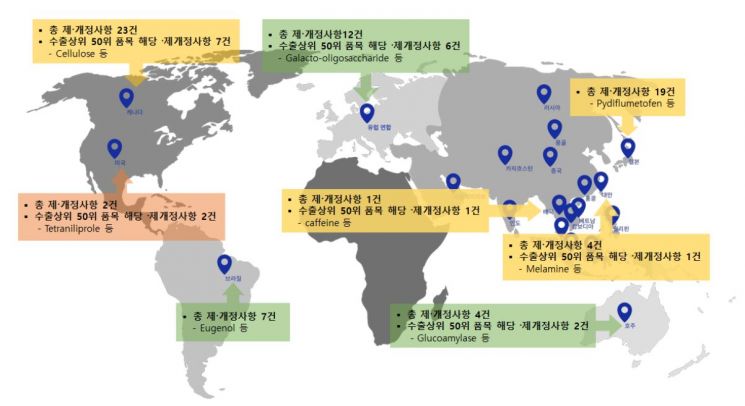 Changes in National Standards for Food Additives and Harmful Substances by Country in 2022. Data provided by Korea Agro-Fisheries & Food Trade Corporation
As protectionism expands in countries around the world including Europe, the United States, and Australia, these countries are strengthening their standards for pesticide residues and food additives in Korean export foods. Accordingly, domestic food companies must quickly identify changes in each country and respond accordingly.
According to the report titled '2022 Annual Trends and Key Implications of Food Additives and Hazardous Substances in Major Export Countries' published by the Korea Agro-Fisheries & Food Trade Corporation on the 6th, a total of 72 revisions and amendments related to food additives and hazardous substances in processed foods were recorded last year across 21 surveyed countries.
Among these, 19 cases (26%) of revisions and amendments corresponded to the top 50 export items of Korean processed foods, with Canada (23 cases) and Japan (19 cases) being the countries with the most revisions and amendments by country.
By food type, revisions and amendments were most frequent in general processed foods and agricultural processed products, with general processed foods mainly involving changes related to snacks, bread, and beverages.
In particular, the United States and the European Union (EU), which export agricultural products and simply processed agricultural products as food raw materials, are strengthening safety management by establishing new standards for pesticide residues and expanding inspections for these foods.
In Canada and Australia, the use of food additives and processing aids produced by new technologies to support their domestic food industries has notably expanded. Australia has authorized the use of glucoamylase and phospholipase, which regulate the expression of specific microbial genes during food manufacturing, as processing aids; however, Korea currently does not have established usage standards for these.
Thailand recently set maximum allowable caffeine levels depending on the type of beverage, whereas Korea has only established usage standards for high-caffeine beverages, so it is necessary to check the standards of the destination country when exporting beverages.
The EU set the maximum residue limit of amidosulfuron, a herbicide used on crops, in coffee at 0.05 mg/kg starting August 17 last year. Korea has not yet established residue limits for this substance in coffee, so caution is needed when exporting coffee-derived products.
The report emphasized, “To support the export of Korean foods, it is necessary to expand the use of domestic processing aids and promptly share information on strengthened safety management measures in other countries.”
© The Asia Business Daily(www.asiae.co.kr). All rights reserved.

![Clutching a Stolen Dior Bag, Saying "I Hate Being Poor but Real"... The Grotesque Con of a "Human Knockoff" [Slate]](https://cwcontent.asiae.co.kr/asiaresize/183/2026021902243444107_1771435474.jpg)















