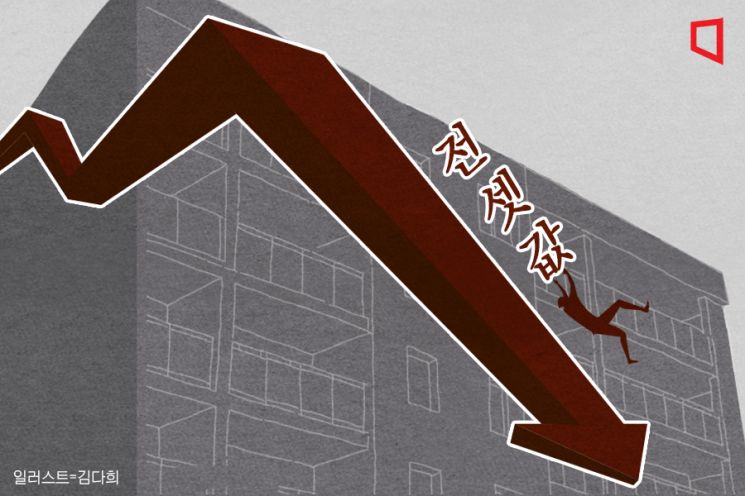
[Asia Economy Reporter Cha Wanyong] Last month, the jeonse-to-sale price ratio (the ratio of jeonse price to sale price) for apartments in Seoul was recorded at its lowest in 10 years and 8 months. Due to the burden of loan interest, the number of people seeking jeonse has decreased, while the number of landlords offering jeonse instead of urgent sales has increased, leading to a sharper decline in jeonse prices. Some predict that the real estate market will continue to adjust with falling sale prices following the decline in the jeonse-to-sale price ratio.
According to KB Real Estate on the 6th, last month the jeonse-to-sale price ratio for Seoul apartments was 52.0%. This is a 0.9 percentage point (P) drop from 52.9% in December last year and 4.0 percentage points lower than 56.0% a year ago. It is the lowest figure since May 2012 (51.9%).
In fact, the jeonse-to-sale price ratio for major large apartment complexes in Seoul remains around 50%. For example, an 84㎡ unit in Helio City, Garak-dong, Songpa-gu, was sold for 1.76667 billion KRW on the 3rd, but the jeonse market price is around 940 million KRW.
An 84㎡ unit in SK Bukhan Mountain City (3,830 households), a large complex in Mia-dong, Gangbuk-gu, was sold for 697.5 million KRW in November last year, but a jeonse contract was signed for 380 million KRW on the 3rd.
The decline in the jeonse-to-sale price ratio is even more pronounced in complexes with large-scale upcoming move-ins. The 84㎡ unit in Gaepo Xi Residence, Gangnam-gu, with 3,375 households scheduled for move-in this March, had a move-in right traded for 2.45 billion KRW last month, but currently, jeonse listings are available around 900 million KRW.
As jeonse prices continue to fall, the number of tenants exercising their renewal rights has also significantly decreased. According to Jiptos, a real estate brokerage, which analyzed actual transaction prices of jeonse and monthly rent in the metropolitan area through the Ministry of Land, Infrastructure and Transport's real transaction price disclosure system, the number of renewal contracts using the renewal right in December last year was 6,574, marking an all-time low. This is a 47% decrease compared to the same month the previous year.
Some analysts believe that the decline in the jeonse-to-sale price ratio is likely to lead to a drop in housing prices. This is because the jeonse-to-sale price ratio is considered an indicator that affects sales demand. For buyers who want to purchase a house with jeonse, if the jeonse-to-sale price ratio is too low, the initial cost increases, making it difficult to decide to buy. Conversely, if the ratio is high, ‘gap investment’ can become active.
Han Mundo, an adjunct professor in the Department of Finance and Real Estate at Yonsei University Graduate School of Economics, said, “The decline in jeonse prices has always been followed by a drop in sale prices,” adding, “The current real estate market, where the jeonse-to-sale price ratio continues to fall, has not yet entered the adjustment phase, but it is highly likely that sale price adjustments will occur in the future.” He further stated, “In areas like Gangnam, where excessive move-in volumes are scheduled, the significant drop in the jeonse-to-sale price ratio suggests a sharp decline in sale prices is expected.”
© The Asia Business Daily(www.asiae.co.kr). All rights reserved.
!["The Woman Who Threw Herself into the Water Clutching a Stolen Dior Bag"...A Grotesque Success Story That Shakes the Korean Psyche [Slate]](https://cwcontent.asiae.co.kr/asiaresize/183/2026021902243444107_1771435474.jpg)
















