[Asia Economy Beijing=Special Correspondent Kim Hyunjung] It has been forecasted that China’s related industry competitiveness could lag behind by more than 20 years due to the impact of U.S. semiconductor equipment export restrictions. It is pointed out that not only the supply and demand of high-performance semiconductors but also the ability to establish self-production capabilities will be affected, potentially causing significant damage to the industrial ecosystem.
Hong Kong’s South China Morning Post (SCMP) cited industry insiders on the 5th, reporting, "Due to the U.S. export restriction offensive, China’s artificial intelligence (AI) and semiconductor industries could fall behind by decades," and added, "Without overseas technology, it could take at least 20 years just to regain the lost foundation."
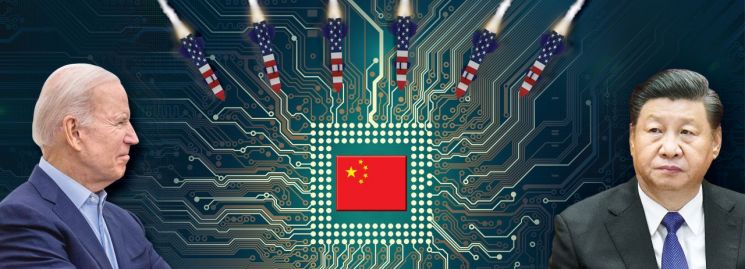
This reflects the current situation where Japan and the Netherlands have joined the U.S. semiconductor regulation alliance against China, increasing pressure. Previously, in October last year, the U.S. announced measures banning the sale of advanced U.S.-made semiconductor equipment to Chinese semiconductor manufacturers and restricting exports of semiconductors used in AI and supercomputers. The U.S. has urged the Netherlands and Japan, which possess the top five advanced semiconductor equipment exporters, to join the effort. Although specific details have not been disclosed, it is known that the three countries reached an agreement on this matter at the end of last month. The U.S. targeted advanced semiconductor technology below 14 nanometers (nm, one billionth of a meter) for regulation, and Japan plans to take similar measures.
The news of the Netherlands’ participation is also critical for China. The Dutch company ASML is well known as the only global supplier of extreme ultraviolet (EUV) lithography equipment. If the agreement is implemented, it is expected that China’s imports of ASML’s deep ultraviolet (DUV) lithography equipment will also be halted. The New York Times (NYT) reported that the U.S. has already blocked the export of EUV lithography equipment to China and has requested the Netherlands to extend export controls to DUV equipment as well.
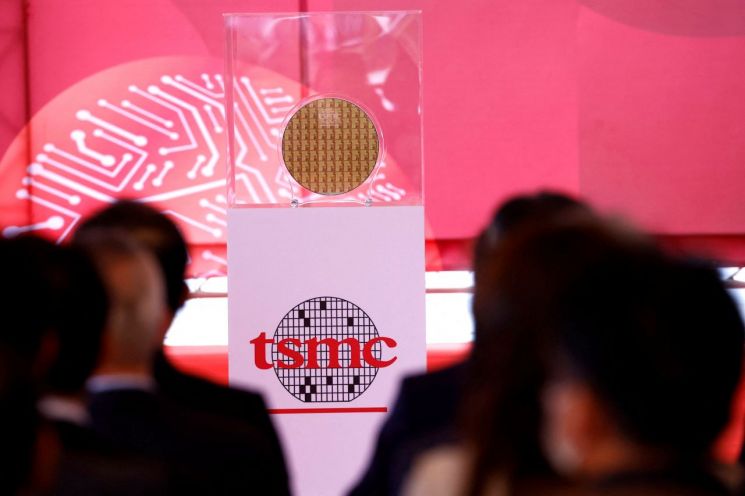
Lesley Wu, ESG (Environmental, Social, and Governance) Deputy General Manager and industry consultant at Jin Hong Ti Chi, a Chinese semiconductor specialty gas company, diagnosed, "The agreement among the U.S., the Netherlands, and Japan officially closes the door on non-U.S. equipment supply, which China’s semiconductor industry has relied on for the past two years." After the U.S. regulation announcement in October last year, Taiwan’s TSMC, the world’s largest foundry, temporarily suspended production of AI graphics processing units (GPUs) supplied to Chinese startups.
Deputy General Manager Wu forecasted, "Chinese companies pursuing semiconductor independence will start at a significantly disadvantageous position compared to global competitors and will fall further behind due to sanctions," adding, "China could lag by about three generations." She also noted, "As competing companies approach existing limits, it will become increasingly difficult for latecomers like China to catch up through technological development."
A founder of a Chinese AI software startup told SCMP, "A shortage of high-performance chips is imminent due to sanctions," explaining, "Inventory prices have surged, causing related purchasing costs to increase five to six times, and profitability has plummeted." He further stated, "In the long term, concerns over sanctions violations may lead large companies to redesign products or even withdraw, while small and medium-sized enterprises face serious concerns, with some potentially going bankrupt," and warned, "Remaining companies will also reduce research and development (R&D) investments and weaken innovation capabilities, leading to an overall contraction of the industry."
China plans to actively support the ‘independence’ of the semiconductor sector, which is central to the U.S.-China hegemonic competition. The Chinese government is reportedly preparing a semiconductor support law worth 1 trillion yuan (approximately 183 trillion won). Deputy General Manager Wu pointed out, "The support law will likely provide subsidies to the industry," adding, "This is the only possible escape route but is a very inefficient approach."
© The Asia Business Daily(www.asiae.co.kr). All rights reserved.


















