Nearly 500 Satellites Active in China
"Reconnaissance Balloons Have Limited Tactical Value"
[Asia Economy Reporter Hyunwoo Lee] As diplomatic tensions escalate between the United States and China over the incident in which a Chinese reconnaissance balloon was shot down in U.S. airspace, suspicions are growing about why China launched reconnaissance balloons despite already operating hundreds of satellites. Some analysts suggest that China deliberately launched the reconnaissance balloon to showcase its reconnaissance capabilities and gauge the U.S. response ahead of diplomatic negotiations with the United States.
According to the British BBC on the 5th (local time), the reconnaissance balloon discovered on the 4th in U.S. airspace and shot down by a U.S. military F-22 fighter jet is considered to have little tactical value. Given that China already operates nearly 500 commercial satellites, it is unnecessary to launch reconnaissance balloons that can be easily detected by the U.S. military.
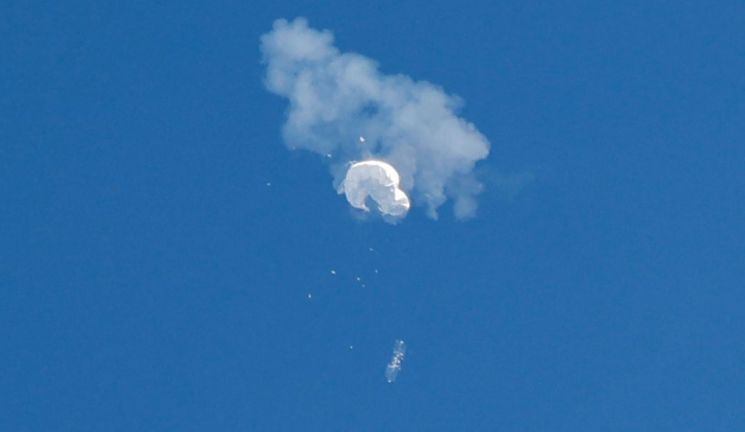
According to the U.S. Department of Defense, as of last year, China had 497 commercial satellites, the second highest number in the world after the United States (1,425 satellites). Moreover, most of these satellites were launched after the 2000s and are equipped with more advanced imaging technology compared to U.S. satellites launched during the Cold War. Even though reconnaissance balloons are cheaper and can perform low-altitude precision imaging, they are considered to have little tactical value.
Rather, there is an analysis that this is a strategy to provoke a reaction from the United States ahead of U.S. Secretary of State Tony Blinken’s visit to China. Dr. Benjamin Ho, a China expert at the Rajaratnam School of International Studies (RSIS) at Nanyang Technological University in Singapore, told the BBC, "China has sufficient other means to spy on U.S. infrastructure or the information they seek," adding, "The reconnaissance balloon is to see how Americans react." It is explained as a strategy to showcase China’s reconnaissance capabilities and gauge the U.S. response without excessively provoking the United States through an unarmed reconnaissance balloon.
Meanwhile, the U.S. government is rejecting China’s explanation that the reconnaissance balloon was a civilian observation balloon that accidentally drifted into U.S. airspace. The Washington Post (WP), citing a senior U.S. official, reported, "The balloon had advanced communication equipment and changed direction multiple times using a propeller," adding, "The balloon did not drift; it intentionally entered U.S. airspace according to China’s plan."
© The Asia Business Daily(www.asiae.co.kr). All rights reserved.

















