Main Business Meets Korean Green Classification System Standards
[Asia Economy Reporter Moon Chaeseok] It has been revealed that businesses meeting the Ministry of Environment's Korean Green Taxonomy (K-Taxonomy) standards account for half of Hyundai Rotem's sales. The company explained that its core businesses, such as railway vehicles and hydrogen, comply with the K-Taxonomy criteria.
On the 6th, Hyundai Rotem announced that it had disclosed its business status based on the K-Taxonomy standards on its website. It posted sales and research and development (R&D) status for railway vehicle and signaling system solution supply, as well as hydrogen energy facility manufacturing and supply businesses.
Among all businesses, the proportion of consolidated sales related to K-Taxonomy in 2021 was 48.2%. Projects in the Rail Solution division, including high-speed trains, electric trains, and trams, met the K-Taxonomy standards. Businesses such as hydrogen charging stations and hydrogen extractors also met the criteria.
The proportion of R&D investment suitable for K-Taxonomy was 45.6%. The national project hydrogen electric tram project accounted for the largest share at 18.1% of total R&D. This was followed by railway vehicle information and communication technology solutions (9.3%) and hydrogen extractors and charging stations (7%) R&D.
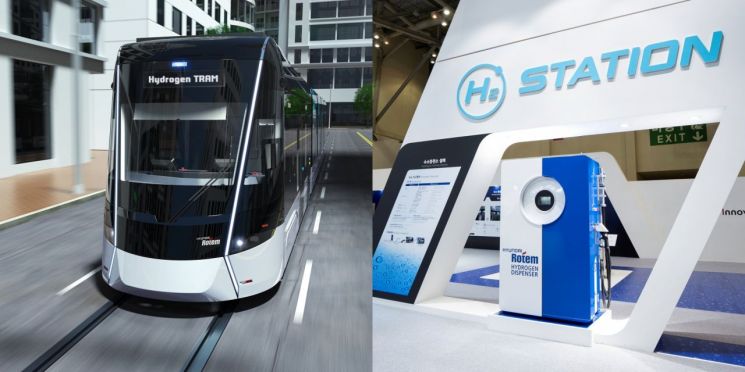 Perspective view of Hyundai Rotem hydrogen electric tram and hydrogen refueling facility. [Photo by Hyundai Rotem]
K-Taxonomy presents six exclusion criteria: greenhouse gas reduction, climate change adaptation, water conservation, transition to a circular economy, pollution prevention and control, and biodiversity conservation. Hyundai Rotem stated that it does not violate these regulations.
As a result, it reduced greenhouse gas emissions per sales unit by an average of 12.3% annually. Wastewater was reduced by 38.6%. The waste recycling rate recorded 55.9%. Air and water pollutants are managed at levels below 50% of the legally permitted standards.
A Hyundai Rotem official said, "We will establish a mid- to long-term carbon neutrality roadmap to develop hydrogen fuel-based railway and defense products and contribute to the activation of carbon dioxide capture and utilization and green hydrogen."
Earlier, on the 3rd, Hyundai Rotem was invited to the Samsung Securities 'Global Taxonomy Application Cases and Response Strategy Seminar' due to its large proportion of K-Taxonomy-compliant sales. It presented excellent cases to investors, pension funds, and corporate officials.
Among KOSPI 200 companies, Hyundai Rotem was the first in the machinery and steel sectors to report greenhouse gas Scope 3 emissions. Scope 3 covers carbon emissions generated upstream before product production, such as raw material purchasing, raw material transportation, business trips, and employee commuting, as well as downstream emissions after production, including customer company finished product processing, consumer product use and disposal, and investment processes.
Recently, it announced the development of the 'Propulsion Control Device Durability (Zero Speed) Regenerative Braking' technology, which received green technology certification and contributed to reducing carbon emissions from electric trains.
© The Asia Business Daily(www.asiae.co.kr). All rights reserved.

















