KEPCO Faces Worst Deficit, Electricity Supply Cuts Followed by Lawsuits
Bankrupt Self-Employed Say "Lawsuits Filed Immediately After Closing"
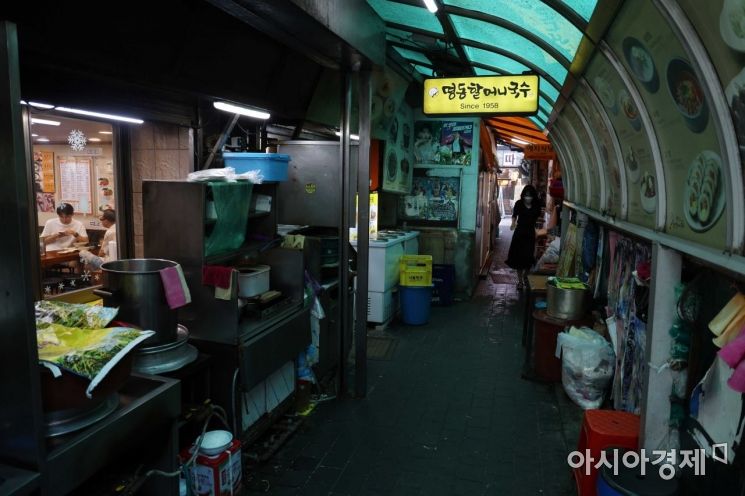 On the 3rd, a restaurant in Myeongdong, Seoul, where self-employed people’s worries are deepening, was quiet. Photo by Mun Ho-nam munonam@
[Asia Economy Reporter Jang Sehee] As Korea Electric Power Corporation (KEPCO) files lawsuits against electricity bill defaulters, self-employed individuals facing bankruptcy are struggling because they currently lack the ability to repay. There are also criticisms that KEPCO, which posted a deficit of 30 trillion won last year, sharply raised electricity rates, passing the burden directly onto consumers.
Mr. Kim Geun-woo (pseudonym, 50) said in an interview with Asia Economy on the 6th, "KEPCO issued a payment order and, when the premises were found to be closed and unreachable (closed door absence), they immediately filed a lawsuit," adding, "I have filed for bankruptcy after closing my business and am waiting for the verdict, but the future looks bleak." Mr. Kim had overdue electricity bills amounting to about 2 million won over three months. Last month, his store was closed, and since KEPCO could not deliver the notice, they filed a lawsuit. Despite informing them that repayment was impossible and providing the case number, he was sued. Ms. Kim Mi-soon (pseudonym, 41), a self-employed person, said, "I am preparing for bankruptcy but received a payment order from KEPCO."
There are also cases of lawsuits due to overdue gas bills. Ms. Choi Eun-hee (pseudonym, 47), a self-employed individual, said, "The amount is about 1.1 million won, but perhaps because the months overdue are many, even though I have been paying steadily, a summons arrived," adding, "I filed an objection and waited, but after six months with no changes, a hearing date was set earlier this month."
Criticism is emerging that lawsuits from public institutions are excessive, even though self-employed people are suffering from a recession and comprehensive price pressures on electricity, gas, water, and food ingredients, and have even filed for bankruptcy. Mr. Shim Hyun-chul (48), who runs a chicken restaurant in Seongbuk-gu, Seoul, expressed dissatisfaction, saying, "Electricity and heating costs have roughly doubled, which is a huge burden," and "Although the COVID-19 situation is said to be normalizing, compared to before COVID, customers have been almost halved." Mr. Lee Young-min (36), who runs a meat restaurant in Gangnam-gu, Seoul, said, "Gangnam has expensive rent, and with all public utility fees rising, I don't even dare to run my business," adding, "Public utility fees should increase step-by-step, but since they all rose at once, the burden is too great."
Electricity, Gas, and Water Prices Up 28.3% Compared to Last Year... KEPCO: "Legal Actions Handled Individually by Each Business Office"
According to Statistics Korea, consumer prices in January rose 5.2% compared to a year ago, and electricity, gas, and water prices increased by 28.3%, marking the highest since separate statistics began in 2010. From the first quarter of this year, electricity rates increased by 13.1 won per kWh following government adjustments.
KEPCO may terminate electricity usage contracts if customers fail to pay their bills by the day two months after the due date. In such cases, KEPCO must notify the customer of the termination seven days before the scheduled termination date and urge payment. A KEPCO official explained, "Legal action is a last resort, so each business office assesses the situation and responds individually."
There are calls for the government to carefully prepare policies considering the growing economic difficulties of small self-employed business owners.
Professor Jung Se-eun of the Department of Economics at Chungnam National University said, "KEPCO may be following management guidelines by issuing payment orders and filing lawsuits," but added, "Policy authorities need to discuss how to handle lawsuits related to unpaid public utility fees." Professor Jung further stated, "Filing for bankruptcy means being in an extreme situation and unable to repay debts, so filing lawsuits for each unpaid public utility fee seems problematic."
© The Asia Business Daily(www.asiae.co.kr). All rights reserved.
![Clutching a Stolen Dior Bag, Saying "I Hate Being Poor but Real"... The Grotesque Con of a "Human Knockoff" [Slate]](https://cwcontent.asiae.co.kr/asiaresize/183/2026021902243444107_1771435474.jpg)
















