[Hydrogen Economy at a Crossroads]
World's First Blue Hydrogen Supply Chain Established
Urgent Need to Secure Cost-Effective Hydrogen Production Technology
[Asia Economy Reporter Oh Hyung-gil] Saudi Arabian Oil Company (Aramco) obtained the world's first certification for "Blue Hydrogen and Ammonia" from the global verification institution Germany's T?V Rheinland in August last year. Approximately 45,000 tons of hydrogen and ammonia were produced as byproducts at refining facilities, and by successfully capturing a significant amount of the carbon dioxide emitted during this process, the hydrogen and ammonia were recognized as clean energy. Aramco has set an ambitious goal to produce up to 11 million tons of blue ammonia annually by 2030.
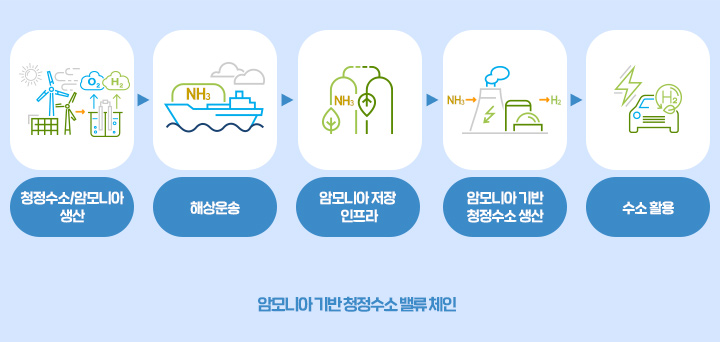
The blue hydrogen and ammonia produced by Aramco were all imported into South Korea through Ulsan Port last December. The importer is Lotte Fine Chemical, which holds the largest ammonia distribution share in Asia. The company is currently conducting a national project to advance technology that converts ammonia into hydrogen. Success in producing clean hydrogen based on ammonia is expected to accelerate the transition to a hydrogen economy.
Hydrogen is gaining attention as an eco-friendly future energy source. Hydrogen exists everywhere in the world. When combusted, it emits only water instead of harmful substances like carbon dioxide. It holds great promise as a substitute for petroleum and gas in vehicles and power plants. However, domestic production still has a long way to go. There are even bleak forecasts that, following fossil fuels, hydrogen will also have to be imported.
In fact, hydrogen is produced domestically as well, like Aramco. Hydrogen is generated as a byproduct during petrochemical production. The problem is that the quantity is insufficient. Moreover, the contradiction of producing hydrogen, an eco-friendly energy, while emitting a large amount of carbon dioxide has yet to be resolved.
More than 94% of global hydrogen production is extracted from natural gas using high-temperature steam. This is so-called gray hydrogen. It can be produced cheaply and in large quantities, but emits a staggering 11 kg of carbon dioxide per 1 kg of hydrogen. Using carbon capture and storage (CCS) technology to capture this carbon dioxide produces blue hydrogen. The problem is that the capture equipment is very expensive, increasing hydrogen production costs. Additionally, handling the captured carbon dioxide is also an issue.
The ultimate eco-friendly hydrogen is green hydrogen. It is produced by electrolyzing water using electricity generated from solar or wind power. However, with current technology, the electricity consumption exceeds the energy obtained from hydrogen, making it inefficient. This is why countries worldwide are intensively developing green hydrogen technologies. Simply put, if a technology is developed to convert water into hydrogen at low cost, South Korea could be hailed as a resource-rich country comparable to Middle Eastern oil producers.
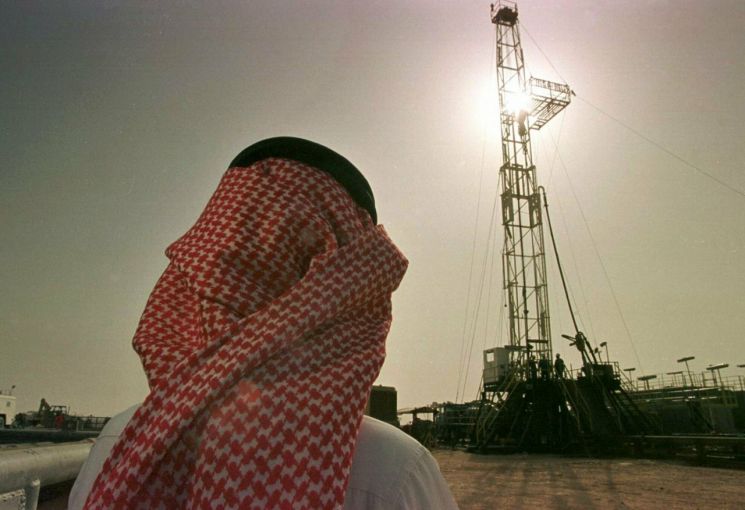
Interestingly, Middle Eastern countries are actively developing technology. The United Arab Emirates (UAE) has set a goal to capture 25% of the global low-carbon hydrogen market by 2030. Saudi Arabia, led by Crown Prince Mohammed bin Salman, is promoting the NEOM Green Helios Fuel Project to supply green hydrogen and ammonia to NEOM City.
The reason Middle Eastern countries are proactive about hydrogen is that their crude oil reserves may soon be depleted. They are preparing for a post-oil era with the money earned from selling oil. Also, the arid Middle Eastern region is advantageous for securing renewable energy such as solar power, which is why they believe hydrogen has a future.
Due to geographical constraints such as limited land area, it is difficult for South Korea to secure sufficient renewable energy, meaning green hydrogen production is not easy.
South Korea has entered the ranks of hydrogen-advanced countries, recording the highest global sales of hydrogen fuel cell vehicles. From January to November last year, Hyundai Motor sold 18,457 hydrogen fuel cell vehicles, far surpassing Toyota Mirai’s 3,238 units. However, hydrogen may also have to be mostly imported like gasoline or diesel. The country is turning its eyes overseas to produce green hydrogen.
Samsung Engineering, Lotte Chemical, and POSCO are conducting the Sarawak project in Indonesia. This project aims to produce green hydrogen using hydropower, which emits no carbon dioxide, with commercial production targeted by the end of 2027.
Of course, several projects are underway domestically as well. SK E&S is building a hydrogen production base in Boryeong utilizing LNG (liquefied natural gas) cold energy. POSCO plans to produce blue hydrogen by applying CCS technology by 2030. Green hydrogen production using renewable energy is also being promoted in Jeju Island and Saemangeum.
However, securing efficient green hydrogen production technology is crucial. Recently, domestic researchers have been exploring eco-friendly hydrogen production by developing electrolyte membranes that improve the performance of water electrolysis devices and catalysts capable of mass-producing hydrogen. South Korea is a resource-poor country, but hydrogen can be obtained simply by splitting water. The future lies in technologies that produce hydrogen cheaply and environmentally friendly.
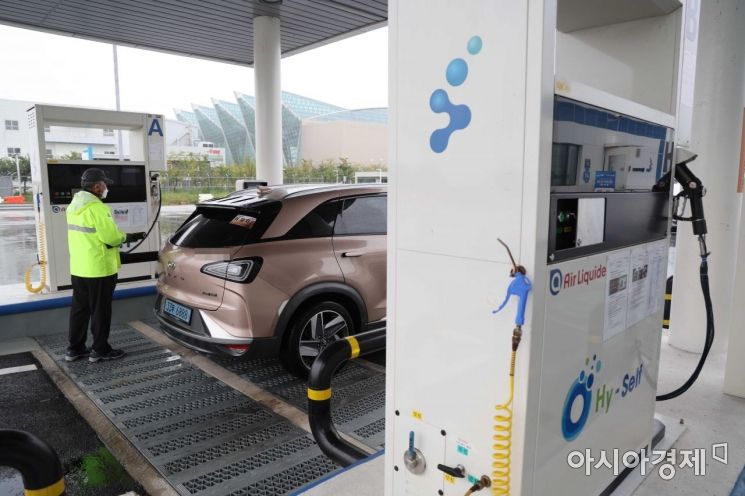 On the 30th, an official is refueling a vehicle with hydrogen at the Incheon International Airport Terminal 2 hydrogen refueling station, the first self-service hydrogen station in Korea. In Korea, hydrogen gas has been regulated under the High-Pressure Gas Safety Control Act, preventing drivers from refueling by themselves. However, the Ministry of Trade, Industry and Energy approved a regulatory sandbox exemption at the 6th Industrial Convergence Regulatory Special Committee in December last year, on the condition that a safety management system for safe demonstration is established and safety training is followed. The self-service hydrogen refueling demonstration project will be conducted until December 2023. Photo by Moon Honam munonam@
© The Asia Business Daily(www.asiae.co.kr). All rights reserved.
![Clutching a Stolen Dior Bag, Saying "I Hate Being Poor but Real"... The Grotesque Con of a "Human Knockoff" [Slate]](https://cwcontent.asiae.co.kr/asiaresize/183/2026021902243444107_1771435474.jpg)













