Point-by-Point Rebuttal to the Ministry of Economy and Finance's Opposition to Deficit Compensation
[Asia Economy Reporter Kiho Sung] The Seoul Metropolitan Government has directly refuted the Ministry of Economy and Finance's opposition to central government support related to free subway rides.
On the 5th, Seoul issued a statement criticizing the Ministry of Economy and Finance's position point by point. Previously, the Ministry had stated opposition to deficit compensation, arguing that ▲subways are autonomous affairs and the overall fare system is the responsibility of local governments, ▲loss compensation due to free rides should be borne by local governments, and ▲supporting free subway rides could expand to areas such as water supply and sewage and waste management.
Seoul first countered the claim that subways are autonomous affairs and that local governments are responsible for the overall fare system by asserting that "free subway rides for the elderly are a national affair applied to all citizens."
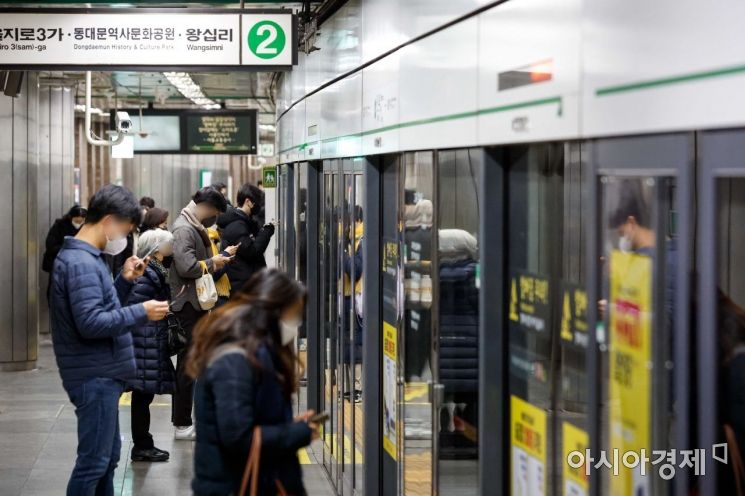
Additionally, Seoul stated that free rides are a mandatory regulation and not a matter for local governments to decide. According to legal advice on Article 26 of the Elderly Welfare Act and its enforcement decree, which stipulate free rides for those aged 65 and over, free rides are mandatory provisions that local governments cannot decide upon. If local governments decide on whether to apply or the discount rate, it is highly likely to violate the law.
Seoul also emphasized that the National Assembly recognizes the national responsibility for free rides, noting that on November 24 last year, the National Assembly's Land, Infrastructure and Transport Committee approved 358.5 billion KRW in national funds as public service costs to local governments.
Regarding the claim that loss compensation due to free rides should be borne by local governments, Seoul refuted this by stating that the state should compensate for a certain portion.
The reason given was the principle of causation-based burden. This means that the party causing the cost should be responsible for it. Seoul cited Article 32 of the Framework Act on the Development of the Railroad Industry, which states that "costs arising from the provision of public services shall be borne by the party causing them."
For example, Korail not only receives compensation contracts with the Ministry of Land, Infrastructure and Transport for national railways but also for metropolitan urban railways, receiving compensation for about 70% of total free rides. Furthermore, this is not only Seoul's position but also that of other local governments; in 2021, six metropolitan local governments, and last year, 13 metropolitan and basic local governments operating urban railways jointly submitted a petition to the National Assembly and government.
In response to the concern that support for free subway rides could expand to water supply, sewage, and waste management, Seoul refuted this by stating that unlike other local government autonomous affairs, the government intervenes in subway operations.
For example, in the public policy area of waste management, the government supports construction costs but does not intervene in operations. However, subways involve the government's welfare policy of free rides, limiting local governments' ability to bear losses.
A Seoul city official urged the Ministry of Economy and Finance to "withdraw its short-sighted stance and think progressively," adding, "As seen in the recent heating cost crisis, difficult issues require complementary roles between central and local governments."
He continued, "The most fundamental solution is legislative," and stated, "We will urge the National Assembly to expedite discussions on revising the Elderly Welfare Act and legislating the PSO (Public Service Obligation) system."
© The Asia Business Daily(www.asiae.co.kr). All rights reserved.

















