Mobile and Internet Banking Fee Waivers Extended to Branch Fees as Well
[Asia Economy Reporter Yoo Je-hoon] Major domestic commercial banks in South Korea are competing to waive fees. Following the five major commercial banks consecutively waiving various transfer fees, recently, some banks have even started waiving teller fees.
According to the financial sector on the 5th, Shinhan Bank decided to fully waive teller remittance fees for customers aged 60 and above starting from the 10th. This follows their earlier move on January 1st, when they became the first commercial bank to fully waive mobile and internet banking transfer and automatic transfer fees.
Shinhan Bank explained that this teller remittance fee waiver service is a measure considering the characteristics of elderly customers who find it difficult to use digital channels for financial transactions. The bank expects that about 250,000 customers will benefit from the teller fee waiver, which ranges from 600 to 3,000 KRW per transaction.
Recently, the banking sector has been engaged in a competition to waive fees. After Shinhan Bank waived mobile and internet banking transfer and automatic transfer fees at the beginning of the year, KB Kookmin Bank also eliminated mobile and internet banking interbank transfer fees, and NH Nonghyup Bank decided to waive mobile banking transfer fees. Woori Bank is also scheduled to waive mobile and internet banking interbank transfer fees starting from the 8th and 10th of this month, respectively.
The reason banks have entered this fee reduction competition is interpreted as a response to growing demands for 'social responsibility' during a period of rising interest rates. According to the financial sector, the consensus forecast for last year's performance of the four major financial holding companies (KB, Shinhan, Hana, Woori) was about 16.5 trillion KRW, which is an all-time high.
In particular, political pressure has intensified recently. President Yoon Seok-yeol stated at the Financial Services Commission's work report discussion on the 30th of last month, "Banks have a public utility aspect," and added, "I do not think it is a problem of government intervention for the government to show interest in establishing fair and transparent governance."
However, there are also considerable concerns within the industry. A financial sector official said, "To maintain profitability, reduced costs in one area will inevitably have to be compensated for in other areas," adding, "Of course, banking is a regulated industry, but it is also worth considering whether it is appropriate to intervene in detailed management issues such as interest rates and fees."
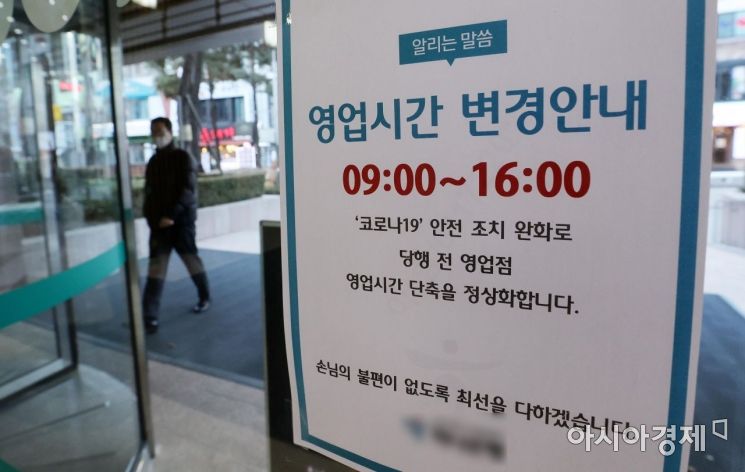 As the shortened banking hours due to COVID-19 have ended, a notice about the change in business hours is posted at a bank in downtown Seoul on the 30th. Major commercial banks and savings banks have stopped shortened operations after about a year and a half, opening at 9 a.m. and closing at 4 p.m. starting today. Photo by Kim Hyun-min kimhyun81@
© The Asia Business Daily(www.asiae.co.kr). All rights reserved.

















