[Asia Economy Reporter Kim Eunha] It has been predicted that the elderly poverty rate may remain high even in 2085, when infants born in 2020 become elderly.
According to the 'NPRI (National Pension Research Institute) Poverty Projection Model Study' (An Seoyeon·Choi Kwangseong) report released on the 5th, the elderly poverty rate, which was 38.97% in 2020, is expected to gradually decrease from 37.68% in 2025 to 26.34% in 2075, then rise again to 29.80% in 2085.
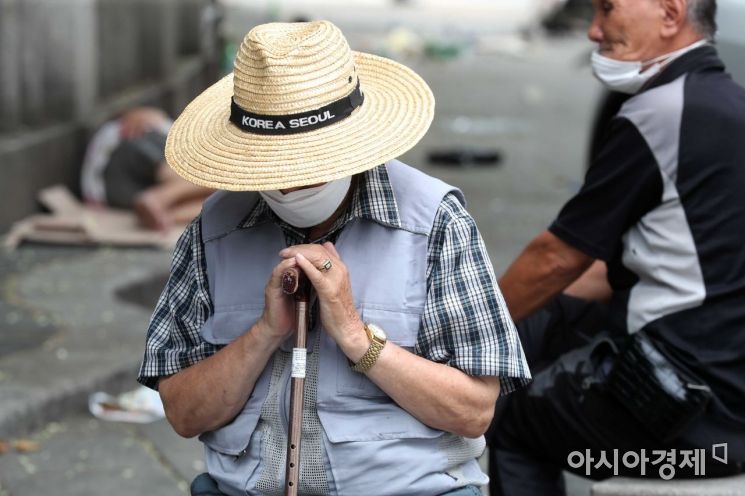 On the 29th, when the heatwave was at its peak, elderly people were cooling off near Tapgol Park in Jongno-gu, Seoul, where access is prohibited to prevent the spread of COVID-19. Photo by Mun Ho-nam munonam@
The elderly poverty rate refers to the proportion of elderly people whose income is below 50% of the median income (relative poverty line). South Korea has the highest elderly poverty rate among OECD member countries. In 2020, South Korea's elderly poverty rate was 2.9 times higher than the OECD average of 13.5% (based on 2019 data). Even in 2085, South Korea's elderly poverty rate is expected to be about twice as high as the OECD average projection (15-16%).
The report cited the low proportion of public transfer income in elderly income as a cause. As of 2020, the share of public transfer income in elderly income in South Korea was 25.51%, which is lower compared to other OECD countries. Even countries like Japan and Australia, which have relatively high elderly poverty rates, have shares reaching 60%.
It also predicted that the outlook for future generations could become more difficult considering the increasing trend of single-person households and elderly couple households. The report stated, "Cases where elderly caregivers do not live together within the household may increase, exposing them to a higher risk of poverty."
The report identified securing income above the poverty line solely through public transfer income as the most certain way for single elderly households to escape poverty. It emphasized, "While National Pension benefits are expected to significantly contribute to reducing future elderly poverty rates, the absolute elderly poverty rate is still expected to remain high. Improvement of overall old-age income security policies, including not only public pensions but also public assistance and basic pensions, is necessary."
© The Asia Business Daily(www.asiae.co.kr). All rights reserved.
!["The Woman Who Threw Herself into the Water Clutching a Stolen Dior Bag"...A Grotesque Success Story That Shakes the Korean Psyche [Slate]](https://cwcontent.asiae.co.kr/asiaresize/183/2026021902243444107_1771435474.jpg)
















