Jung-gu, Seoul, Mobilizes Public and Private Resources to Identify At-Risk Households in Welfare Blind Spots
[Asia Economy Reporter Park Jong-il] Jung-gu, Seoul (Mayor Kim Gil-seong) is mobilizing all public and private resources to identify at-risk households located in welfare blind spots.
With the severe cold wave compounded by an economic downturn, this winter is particularly harsh, and on top of that, the COVID-19 pandemic has increased the number of people isolating themselves from society. Especially, Jung-gu ranks first among Seoul’s autonomous districts in the proportion of single-person households aged 65 and older relative to its population, and second in the number of unregistered residents, necessitating a more meticulous welfare safety net.
The district recognizes that the current Ministry of Health and Welfare’s big data-based system has limitations in identifying new types of blind spots and has therefore prepared a comprehensive plan to supplement it.
As in the case of the three mothers and daughters who died in Suwon last August, it is difficult to identify subjects if they move residences without registering their move. The district will carefully identify subjects based on actual residents to prevent blind spots and will implement a three-stage “timely measures” plan starting this year.
The first timely measure is at the moment a lease contract is made. The district plans to coordinate with real estate agencies to inform contract holders about Jung-gu’s welfare service policies. The second timely measure is at the time of moving-in registration, when neighborhood office staff introduce the district’s welfare benefits and provide on-the-spot consultations if needed. The third timely measure is during the resident registration fact-finding survey period, when the assigned community leader visits each household to check if there are any households facing difficulties.
Households struggling to make a living due to the impact of COVID-19 and economic recession are rapidly increasing, but welfare staffing is slow to increase, making it difficult to identify and respond on the ground. The district plans to supplement this by closely communicating with residents and the private sector and exchanging information about at-risk households.
They have produced and distributed “At-Risk Household Reporting and Support” brochures and videos and expanded the honorary social welfare officers to include neighborhood autonomy committees, which are residents who know the local situation well, fostering a culture where “neighbors watch out for neighbors.”
The Our Neighborhood Care Team, which actively seeks out neighbors in need, will be expanded starting this year. The number of participating neighborhoods will increase from 6 to 15, the number of active members from 16 to 32, and the activity period from 9 months to 1 year, with each member required to manage 40 households.
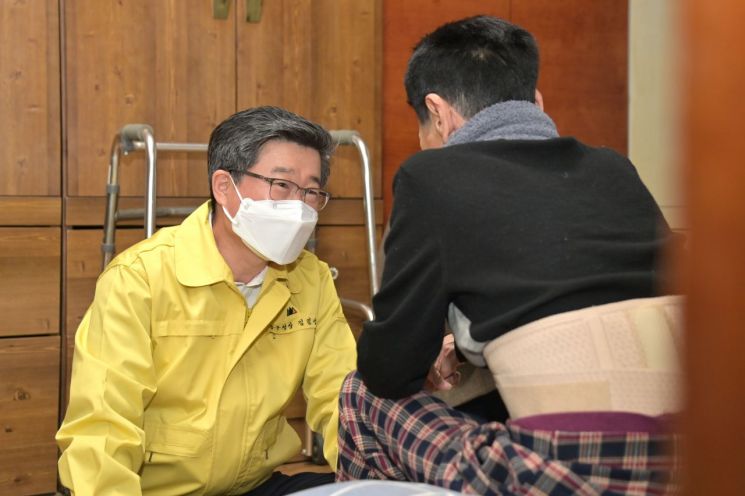 Kim Gil-seong, Mayor of Jung-gu (left), is visiting a solitary elderly person and having a conversation.
In the first half of this year, the district will increase contact points capable of detecting signs of crisis by signing agreements with businesses closely related to residents’ daily lives, such as pharmacies and real estate agencies. Institutions that have signed agreements will immediately connect the district office if they encounter elderly living alone with severe illnesses who are not receiving proper treatment, or residents suspected of financial hardship due to poor housing conditions and overdue rent.
In the second half of the year, agreements will be signed with local public institutions (Korea Electric Power Corporation, Waterworks Office, City Gas Corporation, Police Station) to share information on households with large amounts of accumulated bills or sudden drops in electricity, water, or gas usage. In particular, for subjects whose homes are vacant or who cannot be contacted, the district plans to cooperate with the police station to check on their well-being.
Additionally, rewards will be given to those who report at-risk households to encourage interest in neighbors. Related ordinances are also planned to be enacted in the first half of this year.
Furthermore, the district will continue to monitor and follow up on subjects whose welfare support has been suspended or terminated. Even if they have just exited emergency welfare or basic livelihood security programs, they may still struggle to maintain their livelihood independently, so the district will share situations through case meetings it hosts and find ways to continue support and connect services.
Last year, a neighborhood community center in the district found a struggling elderly person living alone thanks to the efforts of a community leader. Although the elderly person had children, they were not supported and suffered from depression and financial hardship. The district provided stable housing through public rental housing and arranged for counseling at the Mental Health Welfare Center and health management by visiting nurses.
In this way, 597 Jung-gu residents were able to emerge from deep shadows last year with the help of their community.
Kim Gil-seong, Mayor of Jung-gu, said, “We will work with residents to build an even tighter safety net so that no at-risk household loses the will to seek help and hides away due to lack of information or knowledge of how to get assistance,” adding, “We will do our best to support them until they receive the welfare benefits they deserve and recover their daily lives.”
© The Asia Business Daily(www.asiae.co.kr). All rights reserved.

















