Court Recognizes Children's Admission Fraud to Foreign Language High School, University, and Graduate School
"Repeated Crimes Over Several Years Using Professor Position... Heavy Guilt"
[Asia Economy Reporter Heo Kyung-jun] Former Minister of Justice Cho Kuk, who is accused of involvement in his children's admission corruption, was sentenced to two years in prison in the first trial, with most of Cho's claims rejected.
The Seoul Central District Court Criminal Division 21-1 (Presiding Judge Ma Seong-young) on the 3rd sentenced former Minister Cho to two years in prison and ordered a fine of 6 million won on charges including falsification and use of false official documents and obstruction of business.
The court recognized most of the charges related to Cho's children's admission corruption as guilty. However, it acquitted him of charges such as violating the Public Officials Ethics Act by failing to submit a blank trust declaration and falsely reporting assets when appointed as Senior Secretary for Civil Affairs at the Blue House, and instructing private banker (PB) Kim Kyung-rok to hide the hard disk of his home PC (evidence concealment instruction). It also partially acquitted him of charges of abuse of authority and obstruction of rights for covering up the inspection of former Busan Deputy Mayor Yoo Jae-soo while serving as Senior Secretary for Civil Affairs.
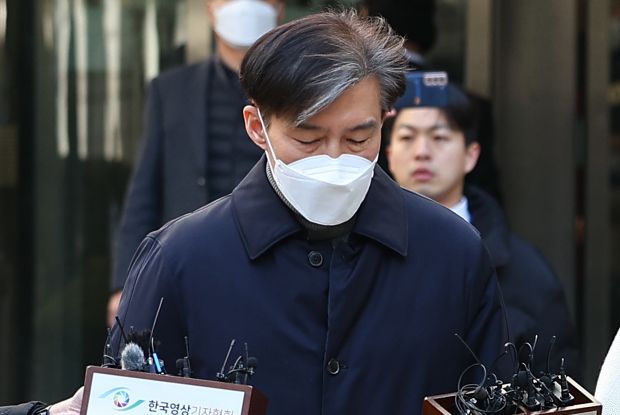 Former Minister of Justice Cho Kuk, who was indicted on charges of admission fraud involving his children and covering up an inspection, is leaving the court after being sentenced to two years in prison at the first trial sentencing hearing held at the Seoul Central District Court in Seocho-gu, Seoul, on the afternoon of the 3rd.
 [Image source=Yonhap News]
First, the court rejected Cho's claim that the prosecutor exercised the right to prosecute illegally. The court stated, "The prosecutor's indictment cannot be considered an abuse of the right to prosecute by exceeding discretionary prosecution authority," and "The bribery charges in this case were sufficiently specified so as not to substantially hinder the defendants' exercise of the right to defense."
The court acknowledged that Cho and his wife obstructed the preparation of school records and grade evaluations at Han Young Foreign Language High School and George Washington University, which their son attended. It also found that they obstructed admission screening by attaching falsely prepared internship certificates from Seoul National University Public Interest and Human Rights Law Center and scholarship certificates from George Washington University to their son's application documents for graduate schools at Korea University and Yonsei University.
Additionally, the court recognized that Cho and his wife obstructed the admission process to the Law School at Chungbuk National University for their son. However, it found it difficult to conclude beyond reasonable doubt that Cho, in collusion with his wife, former Dongyang University professor Jung Kyung-shim, forged an internship confirmation letter in the name of Choi Kang-wook, a then-lawyer and current Democratic Party lawmaker, and submitted it to Chungbuk National University Law School while being aware of the forgery.
Furthermore, the court found Cho and his wife guilty of fraudulent acts related to their daughter's admission to Seoul National University Medical School. However, it ruled that although former Busan Medical Center Director Noh Hwan-jung provided scholarships of 2 million won three times to Cho's daughter after Cho was appointed Senior Secretary for Civil Affairs, this constituted a violation of the Anti-Graft Act but did not amount to bribery.
The court acquitted Cho and his wife of violating the Public Officials Ethics Act. It also acquitted them of instructing the forgery of fund operation status reports related to Coringk PE employees.
The court stated, "The crimes of admission corruption involving the children were repeated over several years by abusing the status of a university professor, with bad motives and nature, seriously damaging social trust in the fairness of the admission system, thus the culpability is heavy." It added, "The violation of the Anti-Graft Act involved a high-ranking public official repeatedly receiving a considerable amount of money, engaging in acts that cast doubt on his fairness and integrity, so the responsibility is not light."
It further said, "The abuse of authority and obstruction of rights involved neglecting duties as Senior Secretary for Civil Affairs and halting the inspection of a misconduct suspect that was proceeding normally due to political requests, which is of bad nature and heavy culpability." However, it considered favorable circumstances such as no prior criminal record and that the children's admission corruption crimes were led by the wife with the husband participating as a spouse.
© The Asia Business Daily(www.asiae.co.kr). All rights reserved.
!["The Woman Who Threw Herself into the Water Clutching a Stolen Dior Bag"...A Grotesque Success Story That Shakes the Korean Psyche [Slate]](https://cwcontent.asiae.co.kr/asiaresize/183/2026021902243444107_1771435474.jpg)
















