Price Decline of Five Grains and Bureom for Jeongwol Daeboreum
Traditional Markets 29.8% Cheaper Than Large Supermarkets
As Jeongwol Daeboreum, our traditional Korean holiday, approaches in one day, a survey has revealed that the prices of representative foods such as Ogok (five-grain rice) and Bureom (nuts) have become cheaper compared to last year.
According to the survey results on 10 major items including ingredients for Ogokbap and Bureom by Korea Price Information, a price research organization, purchasing 1 doe (approx. 180ml) each of these items for a family of four costs 125,300 KRW at traditional markets and 162,660 KRW at large supermarkets. The Ogok consists of glutinous rice, sorghum, millet, red beans, and black beans, while the Bureom includes pine nuts, chestnuts, walnuts, ginkgo nuts, and peanuts.
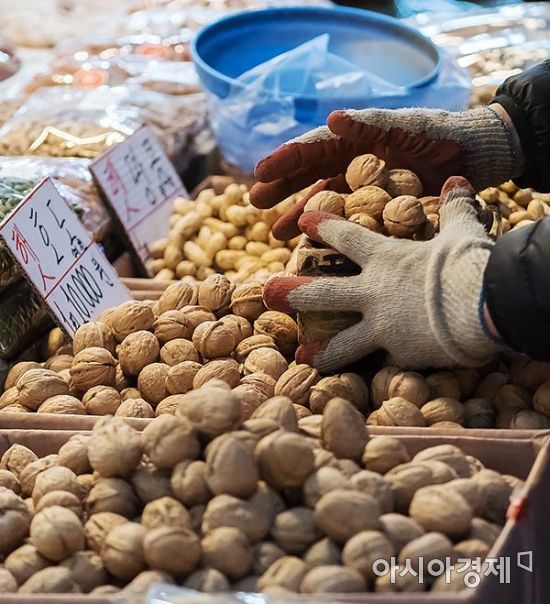 On the 25th, ahead of Jeongwol Daeboreum, citizens visiting Gyeongdong Market in Dongdaemun-gu, Seoul, are looking at bureom. Bureom refers to the custom of eating nuts such as pine nuts, raw chestnuts, walnuts, ginkgo nuts, and peanuts on the morning of the 15th day of the first lunar month. People bite these nuts to wish for a year of safety and to prevent skin ailments. Photo by Yoon Dong-ju doso7@
Compared to last year (128,100 KRW), traditional markets saw a 2.2% price decrease, and large supermarkets experienced a 4% drop from last year’s 169,350 KRW. It was also found that purchasing at traditional markets is about 29.8% cheaper than at large supermarkets.
Until 2021, prices of all Ogok and Bureom items were on the rise, but last year most items turned to a downward trend. This year, prices fell for all items except peanuts. The production of Ogok increased due to good harvests last year and this year, while demand declined, leading to a steady price decrease. Among Bureom items, peanuts were the only ones to see a price increase, which is analyzed to be due to reduced domestic production and imports, causing imported peanut prices to rise and affecting domestic prices as well.
A representative from Korea Price Information stated, "The grain crops, which had high prices due to poor harvests caused by adverse weather such as monsoons, had good harvests for two consecutive years. Especially, the large increase in production two years ago led to high stock levels, and reduced consumption due to COVID-19 lowered demand, which is the main reason for the price decline."
Jeongwol Daeboreum refers to the 15th day of the first lunar month every year. It is the day when the moon appears the largest in the year and is a traditional Korean holiday to pray for a bountiful harvest and well-being throughout the year. On Jeongwol Daeboreum, traditional rituals such as cracking Bureom nuts, selling heat, and drinking Gwibalgisul (ear-brightening liquor) are performed, along with folk games like Jisinbalgi (stepping on the earth god) and Jwibunori (rat fire play). Cracking Bureom nuts involves biting hard nuts such as chestnuts, walnuts, and peanuts with molars, symbolizing the prevention of scabies and strengthening of teeth for the coming year.
© The Asia Business Daily(www.asiae.co.kr). All rights reserved.
![Clutching a Stolen Dior Bag, Saying "I Hate Being Poor but Real"... The Grotesque Con of a "Human Knockoff" [Slate]](https://cwcontent.asiae.co.kr/asiaresize/183/2026021902243444107_1771435474.jpg)















