Promotion of 5 Key Focus Areas and 34 Implementation Tasks
Head Choi Min-cheol: "Focusing on Securing Situational Responsiveness"
[Asia Economy Honam Reporting Headquarters Reporter Yoon Jamin] The Jeonbuk Fire Headquarters is promoting 34 execution tasks in five key areas?strengthening on-site response, citizen-centered 119 services, spreading safety culture, creating growth foundations, and enhancing organizational vitality?to realize a "safe and happy Jeonbuk."
▲ On-site centered response system... swift and effective response
Jeonbuk Fire has established a Special Response Unit, a dedicated team for large-scale and special disasters, and plans to complete fire stations in Muju-gun and Imsil-gun to achieve the goal of "one fire station per city/county" within the province.
Additionally, new 119 Safety Centers will be established in Guimyeon, Wanju-gun, and Jochon-dong, Jeonju-si, to minimize gaps in firefighting capabilities.
To respond to frequent wildfires due to climate change, complex urban disasters, and electric vehicle fires, response equipment such as one wildfire specialized firefighting vehicle, two small ladder trucks, four portable flood pumps, and three negative pressure ambulances for infectious disease response will be introduced.
Efforts will also be made to expand the operation of medium-sized helicopters and enhance aerial rescue and emergency medical mission capabilities. A medium-sized fire helicopter, introduced with an investment of 23 billion KRW, will commence operations. The helicopter's performance has been upgraded for long-distance and long-duration operation, enabling 24-hour dispatch (including night flights), increasing rescue capacity (from 2 to 8 people), and expanding mission scope (from one mission per day within the province to two consecutive missions), thereby protecting more citizens' lives and property.
To improve firefighters' job competencies and on-site response capabilities, a fire education center will be established in Gyenam-myeon, Jangsu-gun. After design this year, educational facilities including the main building, live fire training ground, and comprehensive training tower will be installed by next year.
▲ High-quality 119 services trusted and sought by citizens
In four remote villages and 15 forest-adjacent villages where initial fire response is difficult due to population decline and aging, firefighting facilities such as emergency fire extinguishing devices will be installed, and residents will be regularly educated on their use to establish an initial fire response system.
Support for daily recovery will continue this year, including 119 Happiness Houses (new construction), 119 Safety Houses (home repairs), temporary accommodation costs (up to 500,000 KRW), and emergency livelihood support (500,000 KRW per household) for residents affected by fire damage to residential facilities.
From June to October last year, 23 cardiac arrest patients recovered (40.4%) through smart medical mapping, leading to the expansion of this project from seven fire stations to ten, including Namwon, Gimje, and Buan fire stations.
As the scope of paramedics' duties expands to include administration of painkillers and epinephrine, and umbilical cord clamping, special training courses for paramedics will be continuously conducted to provide high-quality emergency services to citizens.
To create a safe environment conducive to business, a dedicated TF team for fire safety will be operated.
System improvements and reduction of complaint processing times will be pursued, with on-site visits for safety consulting and joint fire drills conducted. For the Asia-Pacific Masters Games and the Saemangeum World Scout Jamboree held in Jeonbuk this year, a thorough prevention, preparedness, and response system will be established from before the events until their conclusion to prevent safety accidents. Following the crowd accident in Seoul, active support will be provided by operating consultative bodies with city and county authorities during local festivals and events.
▲ Creating a safety society led by citizens and 119
To prevent large-scale fires in the province, fire safety managers will be mandatorily assigned to construction sites meeting certain criteria, and the installation of temporary fire facilities such as gas leak detectors, emergency lights, and fire blankets will be expanded (from 4 types to 7 types).
Fire safety investigation results will be publicly disclosed on fire department websites for more than 30 days, allowing any citizen to easily verify whether a facility is safe from fire, which is expected to strengthen autonomous management by related parties.
An ordinance on support for fire prevention enhancement zones in Jeollabuk-do will be enacted to strengthen fire prevention and safety management in areas expected to suffer significant damage in case of fire.
City and county elderly care personnel (2,098 people) and retired firefighters (7 people) will visit elderly living alone and others to provide home safety inspections, fire safety education, and installation of fire alarms as part of door-to-door safety services.
To ensure multicultural families do not face difficulties in reporting 119 due to language barriers, multilingual fire safety education materials and home safety checklists will be distributed, and safety camps will be held to provide safety experience education. Additionally, a special promotion team for fire safety education for the disabled will be operated in cooperation with disability organizations and experts, expanding safety education targets to include helpers for the disabled and facility personnel, ensuring no blind spots in fire safety for vulnerable groups in the province.
Furthermore, to effectively respond to disasters such as the crowd accident in Seoul, CPR education will be expanded to all citizens.
CPR professional instructors will operate experience booths at festivals and events, and provide customized education to citizens visiting safety experience centers and fire stations. Intensive promotional periods will be held in spring and autumn, and emergency treatment videos will be produced and repeatedly broadcast on large electronic billboards.
At the 119 Safety Experience Center, virtual and augmented reality safety experience zones themed on location reporting, natural radiation, and electrical safety have been enhanced. An "Safety Education Kiosk" will also be installed to allow visitors to experience CPR and fire smoke escape training independently.
Since signing a business agreement with the Provincial Office of Education in 2015, safety experience education has been conducted every three years for students in the province, fostering self-survival skills from young children to adults through water safety experience and survival swimming education.
▲ Establishing a growth foundation integrating advanced technology to respond to environmental changes
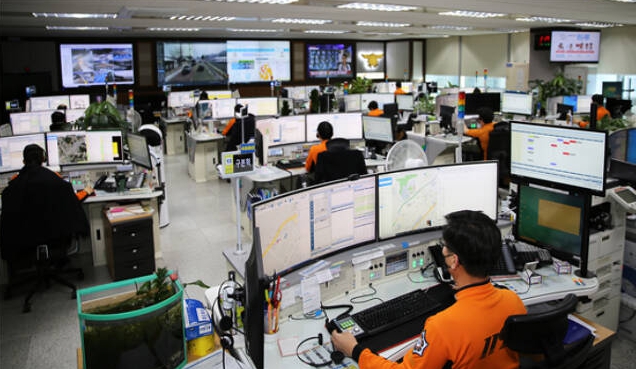
When 119 calls surge, calls that cannot be answered directly by operators are transferred to an ARS system and are handled sequentially by callback regardless of urgency, which can delay immediate response in emergencies and cause casualties.
To improve this, the first AI-based intelligent callback system in the nation will be established. During call surges, ARS voice reports will be converted to text, and trained AI will assess urgency, allowing operators to prioritize handling. This will ensure no emergency calls are missed even during surges.
Also, as navigation services end at apartment complex entrances during dispatch, making it difficult to accurately locate individual buildings within complexes, collaboration with the Korea Land and Geospatial Informatix Corporation (LX) will build spatial information for dispatch routes in multi-family housing complexes to provide uninterrupted navigation and reduce dispatch times.
This will be completed for 47 sites this year and 24 sites next year for complexes without ground vehicle access.
A priority signal control system to secure golden time will also be operated.
The "Priority Signal Control System" automatically controls traffic signals at the Traffic Information Center when fire vehicles make emergency dispatches, shortening response times. The system was established last year in Jeonju and Iksan and will undergo pilot operation this month before full operation.
There are cases where no location markers exist on highway ramps and national roads, making it difficult for callers to provide accurate accident locations during disasters.
To eliminate these blind spots, collaboration with Korea Expressway Corporation, LX, and the National Land Management Office will install location markers on highways and national roads, reflecting each location in the system for operation.
The 119 Integrated Situation Room will link Korea Expressway Corporation's highway tunnel and road CCTV video systems with each city and county's smart city CCTV integrated platform to secure real-time disaster site footage. Information on disaster scale and patterns obtained from the footage will be shared to enable dispatch teams to respond quickly and accurately.
▲ Accelerating the creation of an organizational culture dedicated to citizen safety
Each fire station will secure one counselor to focus on high-risk groups for mental health, operate stress resilience programs to develop and relieve stress management skills, and support mental health counseling, examinations, and medical expenses for firefighters to encourage voluntary mental health treatment. Group psychological counseling for new recruits and emergency psychological crisis support will also be provided to prevent extreme choices.
With a goal of zero line-of-duty deaths and a 10% reduction in safety accidents, disaster site safety management measures centered on on-site safety inspectors assigned to each fire station will be promoted.
Risk factors will be preemptively eliminated through on-site safety checklists and safety impact assessments, and similar accidents will be prevented by sharing accident cases from other provinces and activating accident investigation committees.
Additionally, an organizational culture of empathy and communication will be fostered to resolve conflicts and discord within the fire organization. As of the end of last year, 63.7% (2,079) of Jeonbuk firefighters belong to the MZ generation born after the 1980s.
Empathy communication officers, who serve as bridges for personal grievance counseling and communication, will be secured, and the "Clean 4-No" system will be implemented by selecting exemplary and honest fire captains (equivalent to administrative officers) to promote communication and integrity awareness. Two-way mentoring will foster mutual empathy between older and MZ generations.
Efforts will also be made to establish discipline based on principles and fairness within the fire organization.
To establish a culture of integrity, expert instructors will be invited to conduct education on eradicating power abuse, sexual misconduct, and drunk driving, and internal audits and preventive inspections will be strengthened according to timing and issues to enhance self-purification functions.
Furthermore, zero tolerance will be applied to major misconduct such as drunk driving, sexual misconduct, and bribery, with strict disciplinary measures aligned with public expectations.
Chief Fire Officer Choi Mincheol stated, "We are focusing on securing response capabilities for various disaster situations so that citizens can live safely," and added, "We will do our best to become a trusted Jeonbuk Fire Department in any situation."
© The Asia Business Daily(www.asiae.co.kr). All rights reserved.
![Clutching a Stolen Dior Bag, Saying "I Hate Being Poor but Real"... The Grotesque Con of a "Human Knockoff" [Slate]](https://cwcontent.asiae.co.kr/asiaresize/183/2026021902243444107_1771435474.jpg)
















