[Asia Economy Reporter Seo Mideum] The Jogye Order of Korean Buddhism expressed "deep regret" over the Daejeon High Court ruling that the ownership of the Goryeo gilt-bronze seated Avalokitesvara Bodhisattva statue (Buddha statue), which was taken from Korea to Japan and then brought back to Korea by a thief, belongs to a Japanese temple.
In a statement released on the 3rd, the Jogye Order said, "It has already been sufficiently verified and acknowledged in the first trial that the owner of the gilt-bronze seated Avalokitesvara Bodhisattva statue made in 1330 is Seosan Buseoksa Temple, and that it was looted by Japanese pirates during the early Joseon period and taken to Japan," expressing regret.
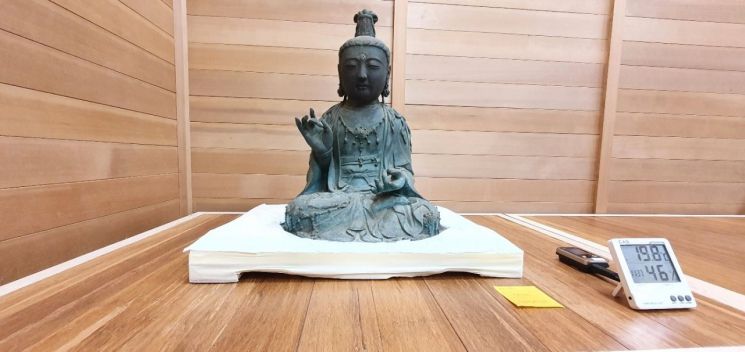 Gilt-bronze Seated Avalokitesvara Bodhisattva stored in the storage of the National Research Institute of Cultural Heritage.
 [Photo by Cultural Heritage Administration] [Image source=Yonhap News]
They added, "Recognizing acquisitive prescription also grants impunity for looted cultural properties," and claimed, "This disregards the historical significance of Korean Buddhism in 2000 and the legitimacy of the Jogye Order."
Earlier, the High Court ruling stated, "It is recognized that the statue was peacefully and openly possessed for 60 years from 1953 until before it was stolen in 2012," and "the acquisitive prescription period (20 years) has been completed, so ownership is recognized." Since 20 years have passed since it was taken to Japan, Buseoksa Temple, presumed to be the original owner, cannot claim ownership.
The Jogye Order expressed its intention to appeal, stating, "We hope that the final judgment will be a decision that aligns with common sense and restores the trust of the Buddhist community and the public."
The ownership dispute began in October 2012 when Korean thieves stole the gilt-bronze seated Avalokitesvara Bodhisattva statue kept at Kannonji Temple in Tsushima, Nagasaki Prefecture, Japan, and brought it into Busan Port. Korean police and the Cultural Heritage Administration conducted an investigation and apprehended the gang of thieves in early 2013, revealing the existence of the statue. The Buddhist community regarded this statue as a cultural property looted by Japanese pirates from Buseoksa Temple in Seosan, Chungnam Province, around 1330, and initiated efforts for its repatriation. In 2016, Buseoksa Temple filed a lawsuit against the state (Republic of Korea) for the return of the statue, which had been held by the National Research Institute of Cultural Heritage.
The first trial court ruled in favor of Buseoksa Temple, stating, "It is reasonable to consider that the statue was transported to Japan by theft or looting and enshrined there," and ordered the statue to be returned to Buseoksa Temple, presumed to be the original owner.
However, the Daejeon High Court overturned the first trial ruling on the 1st, denying Buseoksa Temple's ownership on the grounds that 60 years had passed since the statue was stolen in 1953, completing the acquisitive prescription period (20 years).
© The Asia Business Daily(www.asiae.co.kr). All rights reserved.
!["The Woman Who Threw Herself into the Water Clutching a Stolen Dior Bag"...A Grotesque Success Story That Shakes the Korean Psyche [Slate]](https://cwcontent.asiae.co.kr/asiaresize/183/2026021902243444107_1771435474.jpg)
















