Korean Economic Association 2023 Conference
"Labor Shortage Must Be Replaced by Capital and Technology"
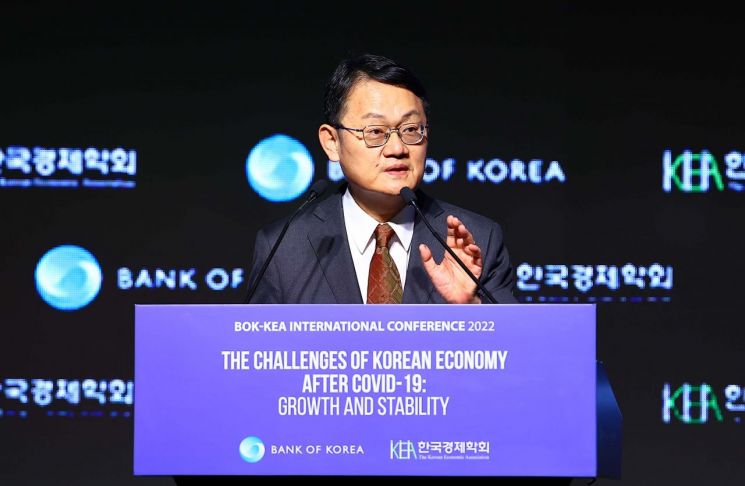
[Asia Economy Reporter Seo So-jeong] As the population continues to decline due to low birth rates and aging, it is forecasted that South Korea's economic growth rate will fall to an average of 0.9% per year in 30 years. Korean economists warn that if the shortage of labor cannot be replaced by capital and technology, the GDP growth rate could plummet to as low as 0.2%.
The Korean Economic Association held the '2023 Joint Economics Conference' at Korea University in Seoul on the 2nd and 3rd to seek solutions for the Korean economy amid population decline. A total of 1,500 researchers from 58 economics-related associations participated, and about 450 papers were presented at the conference.
Lee Jong-hwa, president of the Korean Economic Association (Korea University), emphasized in his keynote speech titled "Growth Models with Declining Population and Their Application to the Korean Economy" that "Although Korea's population will continue to decline in the future, economic growth is not necessarily determined proportionally to population growth rate," adding, "Technological progress, capital accumulation through investment, and qualitative improvement of the labor force can be driving forces for sustained economic growth."
According to Professor Lee's paper, assuming the future population projections by Statistics Korea and simulating growth models, the predicted economic growth rate of Korea until 2060 shows that in the basic model, the average annual GDP growth rate from 2050 to 2060 is estimated at 0.9%, and per capita GDP growth rate at 2.3%. This diagnosis suggests that due to population decline, labor supply and capital investment decrease, and technological innovation also retreats, potentially plunging the Korean economy into a low-growth trap. Furthermore, in a model assuming a gradual decline in physical capital investment rates, the GDP growth rate from 2050 to 2060 is analyzed to fall to 0.2%, and per capita GDP growth rate to 1.5%.
In the subsequent panel session, Heo Jae-jun, senior research fellow at the Korea Labor Institute, analyzed that income inequality has increased globally due to the spread of general-purpose technologies and globalization, and particularly in Korea, wage gaps by company size and gender have widened. He proposed improvements in institutions, norms, and practices to overcome these issues. Professor Lee Jung-min of Seoul National University discussed the positive and negative effects of reduced working hours on the Korean economy and pointed out that technological advancement, improvement of compensation systems, and efficient allocation of manpower are important for the actual reduction of working hours.
On the 3rd, Kim Heung-jong, president of the Korea Institute for International Economic Policy, delivered a keynote speech titled "Will Economic Security Change the Global Economic Paradigm?" In special sessions, discussions were held on recent important economic issues under themes such as ▲ sustainable finance ▲ growth and transformation of the platform economy ▲ solutions to income polarization and welfare blind spots ▲ Seoul Basic Income.
© The Asia Business Daily(www.asiae.co.kr). All rights reserved.

















